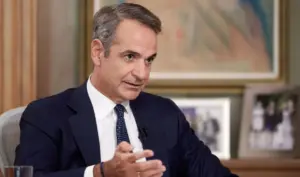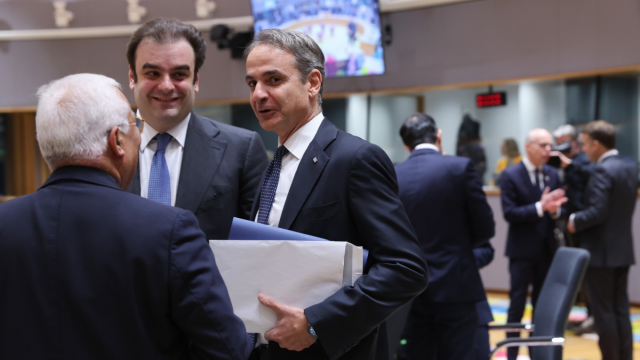
The Greek government is moving to coordinate its actions with the other 16 member states of the “Friends of Cohesion” group (comprising Southern and Eastern European countries), and within this framework, Kyriakos Mitsotakis is expected to conduct an intensive round of international contacts ahead of the December 17 European Council summit, where leaders aim to finalize an agreement on the new Multiannual Financial Framework (MFF).
Mitsotakis launches diplomatic marathon ahead of December 17 EU budget summit
The Greek government has an additional reason to push for a timely agreement, given Greece’s upcoming assumption of the EU Council Presidency in the second half of 2027. Athens is seeking to establish the political framework so that the technical specification of programs can proceed under the Greek presidency without delays to the disbursement of funds on January 1, 2028.
In line with this objective, Athens is aligning itself with Paris around the axis of “a deal here and now, within 2026” — despite individual disagreements over António Costa’s draft proposal.
Greece joins Macron’s front — and sends a clear message about the Draghi report
Macron and Mitsotakis are, after all, the two leaders who have invested the most political capital in the Draghi report and in the concept of shared European investment. As the Greek Prime Minister stated in Brussels: “If we continue to insist on further cuts to the EU budget, we might as well throw the Draghi report and its high ambitions into the dustbin of European history.”
Athens draws two red lines on Cohesion Policy and the Common Agricultural Policy
Kyriakos Mitsotakis will remain in constant communication with both his counterparts and European Council President António Costa, who is embarking on a new round of bilateral contacts to shape a revised compromise text. Athens is insisting on two non-negotiable red lines: no further reductions to Cohesion Policy funds and no further cuts to the Common Agricultural Policy (CAP). Rather than accepting cuts to these two traditional pillars of EU spending, the Greek side is tabling concrete proposals for new European revenue sources — such as a joint European 6G spectrum auction — to fund emerging priorities in defense and competitiveness.
Kyriakos Mitsotakis’s international contacts ahead of the new summit on December 17, the tight timelines, and the frustration over Costa’s handling of the negotiations
Why the December 17 summit is considered critical for Greece
In any case, if no agreement is reached on December 17–18, negotiations risk stalling for months — an outcome neither Athens nor Paris desires. This is partly because the first half of 2027 will be dominated by the French presidential election, with the Élysée having already signaled that Emmanuel Macron will not be in a position to negotiate during an election campaign. Greece, too, faces its own national elections during that period. Furthermore, if the political framework for the MFF is not finalized by December, the entire issue will fall squarely into the hands of the Greek presidency.
By contrast, reaching an agreement within 2026 would allow Athens to use its six-month presidency to advance the technical specification of sectoral regulations and operational programs. The goal is to lose not a single day, ensuring that the first disbursements from the new ESPA cohesion funds and the CAP proceed as scheduled on January 1, 2028 — thereby preventing a dangerous investment gap immediately following the expiry of the Recovery Fund.
In anticipation of developments, the economic team is already working to strengthen Greece’s internal fiscal position. The recently approved Multiannual Fiscal Plan 2027–2030 provides for a gradual increase in the national component of the Public Investment Program (by €1.2 billion in 2028 and €1 billion annually thereafter), ensuring that the country’s growth trajectory and major infrastructure projects will not be held hostage to European delays.
Frustration over Costa’s handling of the emergency summit — and what happened behind the scenes
In Athens and other European capitals, one of the key questions concerns the conduct of European Council President António Costa during the emergency summit — where the Portuguese official managed to frustrate virtually everyone. His decision to break the plenary session into seven smaller consultation groups initially sparked fury among Northern European countries, including Germany. Diplomats from these countries told Politico that the closed-door meetings were an attempt to split their united front and “buy off each member state with some kind of gift.” Paris, for its part, described Costa’s draft as “deeply disappointing,” while Emmanuel Macron called the proposed cuts a “strategic mistake.”
Southern European countries — including Greece — alongside Eastern European member states have also criticized Costa’s negotiating framework, arguing that it continues to place the burden of cuts on the Common Agricultural Policy and Cohesion Policy, bringing the total EU budget (excluding Recovery Fund repayments) below the psychological threshold of 1% of EU Gross National Income for the first time since 2000.
Originally published in Apogevmatini