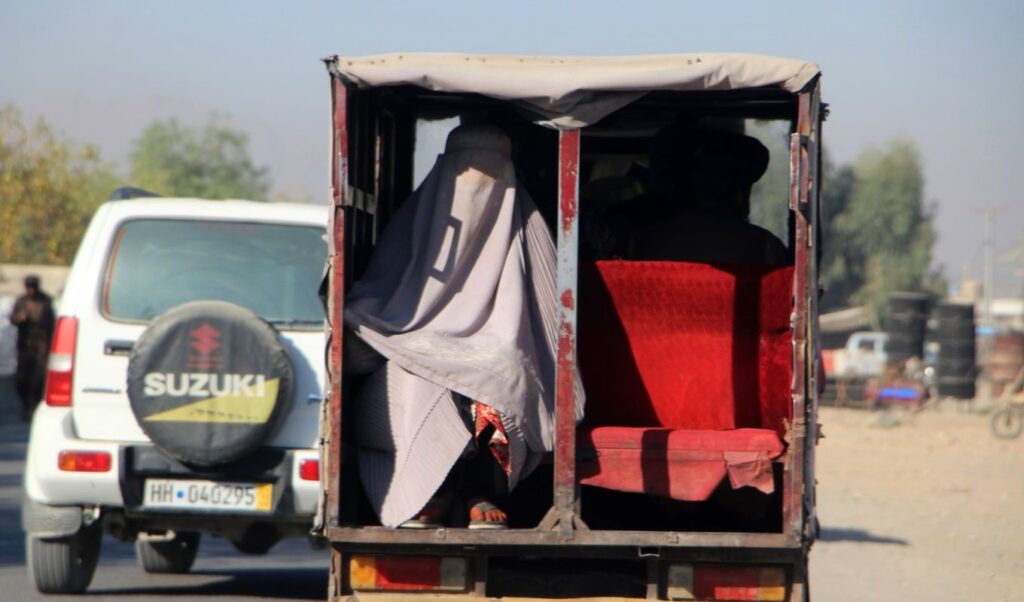
The Taliban have introduced yet another outrageous measure in their ongoing suppression of women’s rights in Afghanistan. Among the many restrictions already imposed on women’s freedoms, the regime has now effectively erased women’s names from all official documents, replacing them with the word “grandmother.” Even on medical prescriptions, women are referred to as “bibi” — meaning grandmother — or simply as “wife” or “daughter.”
Afghanistan: Women’s names “vanish” from official documents
This disturbing practice was brought to light through a joint investigation by Zan News and The Guardian. According to the report, healthcare workers in Balkh province have been instructed to refer to women exclusively as “bibi,” meaning “grandmother.” Officials confirmed that this directive must be followed even on medical prescriptions.
Afghan activist Lala Osmani, who now lives in Germany, revealed to El País that the Taliban also refer to women as “goats” and “cows.” She noted that in other cases, women appear in official documents only as the “wife” or “daughter” of a male relative.
A woman’s name as an insult — omitted even from gravestones
The Taliban’s contempt for women’s identities does not stop there. According to the Daily Mail, in many parts of Afghanistan, publicly mentioning or displaying a woman’s name is considered an insult to the honor of her husband or family. As a result, women’s names are frequently omitted even from their own gravestones.
This is the latest blow to women’s rights in Taliban-controlled Afghanistan. Women and girls are already required to adhere to strict dress codes even during summer months, when temperatures can soar to 50 degrees Celsius, and must always be accompanied by a male guardian.
Legalized beating and a caste system — the 90-page penal code
This new measure further compounds the already dire situation for women’s rights in the country. Earlier this year, the Taliban passed a law permitting husbands to beat their wives, provided no “serious physical injury” is caused. The 90-page penal code, signed by Taliban Supreme Leader Hibatullah Akhundzada, establishes different levels of punishment depending on a person’s social standing.
Article 9 of the code divides Afghan society into four categories: religious scholars (ulama), the elite (ashraf), the middle class, and the lower class. It effectively creates a caste system in which offenders are classified as either “free” or “slaves” — with women placed in the same category as slaves.
Deeply troubling provisions state that “masters,” or husbands, may impose physical punishment on their wives or subordinates. Meanwhile, if a religious scholar or member of the elite commits an offense, the consequence is limited to advice or a court summons.
For the middle class, the same offense may result in imprisonment, while the “lower class” faces both physical punishment and imprisonment. Under the code, corporal punishment for serious crimes is to be administered by Islamic clerics, but the code also encourages husbands to impose “punishments at their discretion” on their wives for lesser offenses.
Regarding violence against women, Article 32 specifies that only if a husband beats his wife with a stick and causes serious injury — such as “a wound or bruise” — and the woman can prove this before a judge, will the husband face a 15-day prison sentence.
The contradiction here is glaring: a woman must remain fully covered at all times, yet is simultaneously required to prove her injuries before a judge. She must also be accompanied by a male guardian — who is typically the very husband who abused her. The new code neither condemns nor prohibits sexual or psychological violence against women. It also prevents women from seeking refuge with their own families to escape domestic abuse.
Child marriage
In May, the Taliban formally recognized child marriage under a new family law regulation that set rules for marriages involving minors and established specific guidelines concerning “virgin girls.” The 31-article regulation, titled “principles of separation between spouses,” outlines the rules governing the dissolution of marriages under an extensive list of religious and legal conditions. These include child marriage, breastfeeding relationships, forced separation, missing spouses, apostasy, and adultery charges.
Under Article 5, if a child’s marriage is arranged by relatives other than the father or paternal grandfather, it is considered legally valid, provided the husband is deemed socially compatible and the dowry is appropriate. The regulation states that the child may later seek annulment of the marriage after reaching puberty, but only through a court ruling, according to independent Afghan media outlet Amu TV.
The document states that a “virgin’s” silence is interpreted as consent to marriage, while the same silence from a man or a previously married woman is not. Meanwhile, women bear a disproportionate burden of a deepening humanitarian crisis, with fathers resorting to selling their young daughters simply to buy food. The practice of selling girls to older men for financial gain has tragically become a normalized response to worsening poverty in Afghanistan.
This trend is expected to intensify as the economic crisis deteriorates further, with a staggering three in four Afghans unable to meet their basic daily needs.