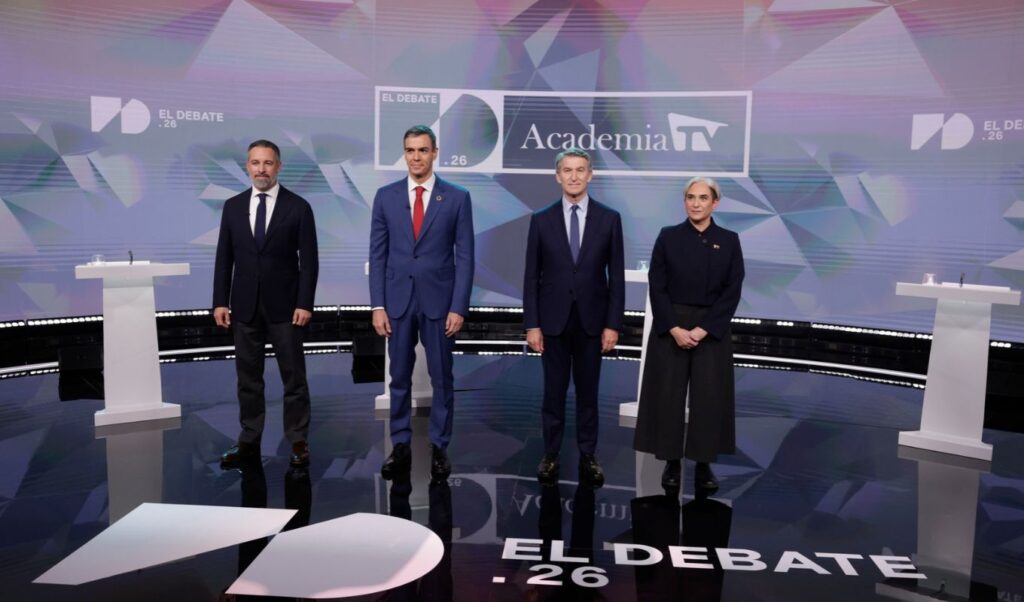
Spain heads to the polls on Sunday, November 29, with the far right potentially becoming a kingmaker and entering Madrid’s government for the first time since the end of Franco’s dictatorship in 1975. The far-right Vox party is expected to be a crucial factor in a possible alliance with the center-right People’s Party (PP), which leads in the polls but is not expected to secure the required majority in the Congress of Deputies — a threshold that requires 176 seats out of a total of 350. Voters will also elect 208 members of the Senate, the two chambers together forming Spain’s parliament, known as the Cortes Generales.
Read more: Politico: Alberto Feijóo one step away from Spain’s prime ministership — the Galician administrator who doesn’t speak English
What the polls say about Spain’s election
According to polling data compiled by Reuters, the PP is considered the largest party with approximately 31% support, while Vox sits at around 18%, buoyed by support from younger and male voters. Despite a recent modest rise to nearly 30%, Pedro Sánchez’s Socialist Party (PSOE) is largely expected to finish in second place by a narrow margin. Left-wing parties, which will play a decisive role in coalition-building, collectively poll at around 10%.
Spain’s National Statistics Institute (INE) reports that approximately 38.7 million people aged 18 and over are eligible to vote.
How members of parliament are elected in Spain
The 350 members of the Congress of Deputies are elected across 50 provinces, as well as in the two autonomous cities of North Africa — Ceuta and Melilla. Each of these two cities elects one representative through a first-past-the-post system. All other provinces elect at least two members of parliament, with the remaining seats distributed according to population size.
Madrid and Barcelona elect 38 and 32 members respectively. By contrast, provinces that may cover vast geographic areas but have low population density — often grouped under the term España vaciada (emptied Spain) — elect only a handful of representatives.
Voters select a political party on the ballot, and candidates are elected based on their position on closed lists drawn up by each party. A party must receive at least 3% of the vote in a province to win a seat.
A party needs 176 of the 350 seats to secure an outright majority. If no party reaches that threshold, parties must form coalitions or negotiate agreements to govern. After consulting party leaders, the king nominates a candidate for prime minister, who must then win a vote of confidence in parliament.
The Senate
Regarding the Senate, the following rules apply: four senators are elected from each province of mainland Spain, with additional representatives elected from the country’s island territories and Spanish enclaves in North Africa. The remaining senators are appointed by regional parliaments.
As Politico notes, the Senate holds fewer powers than the Congress of Deputies, serving primarily as a second chamber for reviewing legislation and representing Spain’s territorial regions. The body has gained a reputation as a political refuge for prominent party figures who have been sidelined, as well as a safe harbor for politicians that Spain’s political forces seek to shield from judicial investigations through parliamentary immunity.
Nevertheless, Senate support is essential for advancing constitutional reforms, and the chamber also has the authority to appoint judges to the Constitutional Court. While the Senate rarely takes center stage during elections, right-wing parties are this year pushing to secure three-fifths of its seats — a supermajority that would allow them to push through appointments capable of shifting the ideological balance of the Constitutional Court without the involvement of the left.
In their efforts to gain control of the Senate, both the Socialists and the People’s Party (PP) have struck agreements with ideologically aligned forces to withdraw candidates from constituencies where they would otherwise compete against each other.
Spain’s current coalition government
Prime Minister Pedro Sánchez leads a minority coalition government composed of the Spanish Socialist Workers’ Party (PSOE) and the left-wing alliance Sumar, led by Yolanda Díaz. The 22-member cabinet includes Sánchez, three deputy prime ministers, and 18 additional ministers.
Each of the three deputy prime ministers oversees a key policy area: Carlos Cuerpo handles the economy, Yolanda Díaz oversees labor and the social economy, and Sara Aagesen is responsible for the ecological transition. Cuerpo is also serving as acting transport minister following the resignation of Óscar Puente in the wake of last month’s train accident, which claimed 69 lives. Thirteen cabinet members belong to the PSOE and five to Sumar, while four are independents appointed by the PSOE.
The parties running in Spain’s election
The following parties are competing for votes:
- Socialist Party (PSOE), center-left – Incumbent Prime Minister Pedro Sánchez is seeking re-election after more than eight years in power, making him Spain’s second longest-serving prime minister since 1978, after Felipe González. His final two years in office have been overshadowed by corruption investigations involving his wife, his brother, and former close allies.
- People’s Party (PP), center-right – Alberto Núñez Feijóo, who has led the PP since 2022, is the party’s candidate. The PP won the most seats in the 2023 elections but failed to secure enough support to form a government.
- Vox, far-right – Led by Santiago Abascal, who co-founded the party in 2014 after breaking away from the PP, Vox has become Spain’s third-largest party. It campaigns for stricter immigration rules, lower taxes, and a hardline stance against Catalan and Basque autonomy movements.
- Frente Amplio (Broad Front), left-wing – Led by Ada Colau, former mayor of Barcelona, this is a new alliance replacing Sumar, the left-wing coalition that governed alongside Sánchez from 2023. Podemos, a former Sumar partner, is running separately in this election.
- Regional parties – These could once again determine who governs. EH Bildu (Basque Country), BNG (Galicia), the Basque Nationalist Party (PNV), and the left-wing pro-independence Catalan party ERC have largely backed Sánchez. The center-right pro-independence Catalan party Junts supported his investiture in 2023 but has since repeatedly voted against his government.
Spain’s key election issues
According to a YouGov poll published on October 30, as cited in an Al Jazeera analysis, the main issues identified by respondents are:
- Housing – Spain faces a shortage of 750,000 homes, according to the Bank of Spain, which warns that the gap could exceed one million by 2028. Average monthly rent has reached €1,176 — almost exactly equal to the average monthly wage of a young person, which stands at €1,191, according to the Spanish Youth Council. Anger over housing costs has fueled protests across the country.
- Immigration – Sánchez has been one of Europe’s leading advocates for immigration and this year offered undocumented migrants a pathway to regularization, attracting nearly 1.2 million applications. Vox, on the other hand, has pledged to deport all undocumented migrants, while the PP has promised stricter border controls in its election manifesto.
- Corruption – Sánchez faces as many as nine judicial investigations involving his party, his government, and his family. His former transport minister, José Luis Ábalos, was sentenced in June to 24 years in prison for corruption. Opposition parties have made corruption a central theme of their campaigns, accusing the Sánchez government of being mired in scandal.
- Healthcare – Long waiting lists are a growing problem across Spain. Doctors have postponed a national strike over working-hours reforms until after the election, but regional strikes continue.
- The state of the economy – The Spanish economy has grown faster than the eurozone average, but inflation is approaching 5% and prices are soaring, meaning that the stronger growth rate has not translated into a tangible improvement in people’s daily lives.