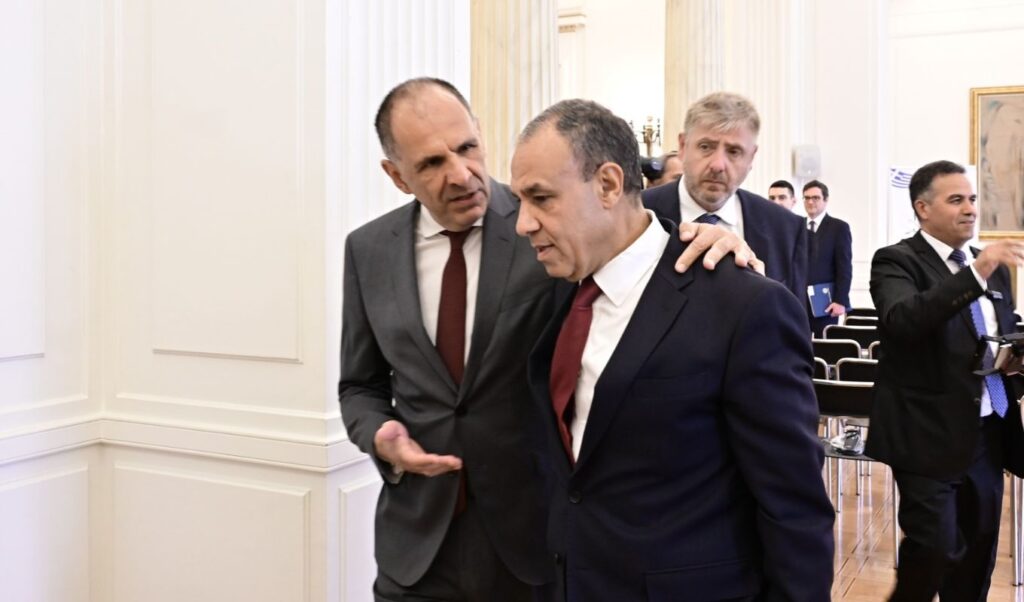
The extension of the Exclusive Economic Zone (EEZ) demarcation beyond the 28th meridian took center stage yesterday during talks between Greek Foreign Minister Giorgos Gerapetritis and his Egyptian counterpart, Badr Abdelatty.
Technical talks on EEZ expansion move forward
According to well-informed sources, the matter is currently being studied by the relevant agencies of both the Greek and Egyptian ministries. An official announcement regarding the start date of technical discussions on expanding the Greek-Egyptian maritime agreement is expected in the coming weeks. In his most recent interview on ANT1, Foreign Minister Gerapetritis highlighted the aligned positions of Athens and Cairo regarding the Turkish-Libyan memorandum and expressed confidence that results on the expansion of the Greek-Egyptian agreement would follow soon.
The area south of Kastellorizo in focus
It is worth noting that Egypt’s top diplomat has expressed support for continuing negotiations beyond the partial EEZ delimitation signed by Greece and Egypt in August 2020 — an agreement grounded in international law and the United Nations Convention on the Law of the Sea (UNCLOS). The shared goal of both countries is to extend their maritime zone delimitation beyond the 28th meridian, covering the area south of Kastellorizo — a region over which Cairo had expressed reservations in 2020 due to competing Turkish claims.
A united front against the Turkish-Libyan memorandum
This move is designed to serve as a resounding response to the recent ratification of the illegal Turkish-Libyan memorandum. It will be firmly grounded in UNCLOS provisions and will take full account of the sovereign rights of Greek islands — most notably Crete, Rhodes, Karpathos, and Kastellorizo. The ongoing communication between Gerapetritis and Abdelatty appears to be successfully steering Egypt away from Turkish overtures to align Cairo with Ankara in drawing up joint maritime zones, despite the lure of potentially larger maritime territory.
In a post about yesterday’s call with his Greek counterpart, Badr Abdelatty spoke of “continuing consultations and coordination between two friendly nations.” Egyptian Foreign Ministry spokesperson Nader Zaki added that “the minister praised the close ties between Egypt and Greece, underscoring the strategic nature of their relationship, their long-standing historical bonds, and their geographic proximity — all of which have contributed to the expansion of shared interests.”
The joint commitment of Greece and Egypt to upholding international law and the Law of the Sea aligns with the European Parliament’s resolution, which unequivocally rejects the illegal Turkish-Libyan memorandum. The resolution calls for UNCLOS to be applied as customary international law, recognizes Greece’s right to extend its territorial waters to 12 nautical miles under Article 3 of UNCLOS, and affirms the right of Greek islands to their own EEZ and continental shelf. It also condemns Turkey’s standing threat of casus belli against Greece, rejects the “Blue Homeland” doctrine, and opposes Turkey’s unilateral designation of marine parks in disputed waters.
Turkey’s reaction to the European Parliament resolution
The European Parliament’s decisive rejection of Ankara’s expansionist moves in the Aegean and Eastern Mediterranean prompted a sharp response from Turkey. In statements issued by both the Turkish Foreign and Defense Ministries, Turkey rejected the resolution, claiming it contains “biased and unfounded allegations” and asserting that “the EU has no jurisdiction over the delimitation of maritime zones.” Ankara dismissed the adoption of the resolution as “a futile effort.” Turkey’s National Security Council, convening under the Turkish President, announced that it would make no concessions regarding Ankara’s claimed rights in the Aegean and Eastern Mediterranean.