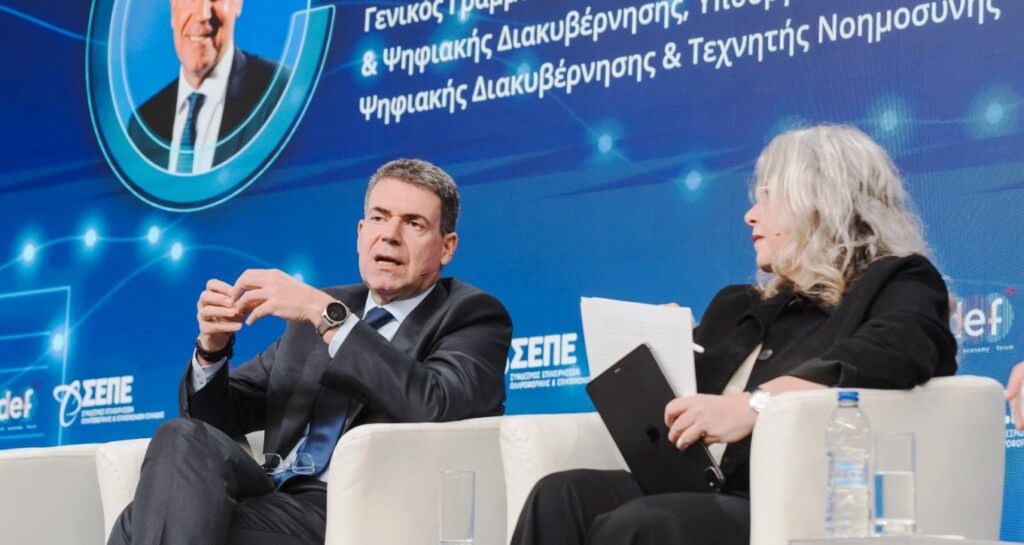
The Greek public sector’s lead over businesses in the adoption of Artificial Intelligence tools was highlighted by Dimosthenis Anagnostopoulos, Secretary General for Information Systems and Digital Governance at the Ministry of Digital Governance and Artificial Intelligence, speaking at the Digital Economy Forum 2026: Building Intelligence. Presenting data for 2025, he noted that AI tool usage in the public sector stands at 15%, compared to just 9% among businesses, linking this development to the cloud-first technology adoption policy introduced by the government in 2020. He also identified four key prerequisites for strengthening Europe’s digital sovereignty, with emphasis on systems resilience, computing infrastructure, technological autonomy, and economic sovereignty.
Read: “Achaia Pass”: Platform opens for €150 voucher — who qualifies and how to apply
Dimosthenis Anagnostopoulos: The public sector’s lead in Artificial Intelligence
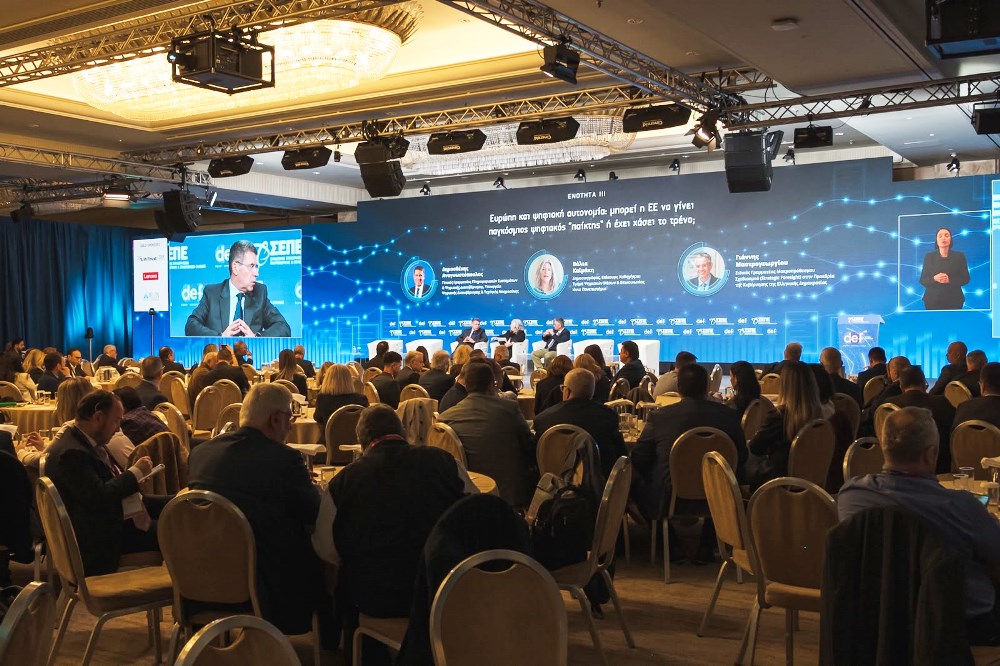
As part of the flagship annual event organized by the Greek Association of ICT Companies (SEPE), the Secretary General participated in a discussion with the Special Secretary for Long-Term Planning, Yannis Mastrogeorgiou, on the topic “Europe and digital autonomy: can the EU become a global digital player, or has it missed the train?”. Reflecting on Greece’s digital transformation journey, Anagnostopoulos drew a parallel between today’s uptake of Artificial Intelligence and the earlier transition to cloud services, highlighting the pivotal role the public sector has played in driving the adoption of new technologies.
“Just as with the cloud-first policy that the government pioneered in 2020 — where the public sector led the way and the private sector followed — today, when it comes to AI tools, the public sector is at 15% compared to 9% among businesses in 2025. That tells us something important,” he noted.
The four pillars of European digital sovereignty
Analyzing the European Union’s potential to establish a stronger presence in the global technology landscape, Dimosthenis Anagnostopoulos placed the development of resilient systems as the top priority — systems capable of continuing to function even under adverse conditions. “Sovereignty means having the ability to choose and the resilience to maintain systems that keep serving their purpose, even when something goes wrong,” he said. The second key prerequisite, in his view, is adequate computing infrastructure, ensuring Europe has the necessary power to develop and deploy advanced digital applications. In this context, he referenced the goal set in June 2026 to triple European data center capacity, citing Greece’s national supercomputer “DAEDALUS” as a flagship national example.
Building infrastructure, however, is only one dimension of the push for digital autonomy. Equally important, according to the Secretary General, is the availability of suitable Artificial Intelligence models capable of making full use of European computing resources. The critical question is whether open-source models will, in time, be able to compete in capability with proprietary solutions such as ChatGPT and Claude. As he explained, the ability to run open-source models on European AI infrastructure is directly tied to technological sovereignty — which could come under serious threat if those models fall significantly short of proprietary alternatives.
Competitive costs for European businesses
As the fourth pillar of digital sovereignty, Anagnostopoulos identified economic sovereignty, connecting it to the ability of European businesses to access advanced Artificial Intelligence tools under sustainable and predictable financial conditions. “European businesses must have access to AI tools at competitive costs, without pricing that changes unexpectedly and unfavorably,” he stressed. In his view, leveraging the negotiating power of the unified European single market — combined with the development of an appropriate European regulatory framework — can help secure more stable access conditions for these technologies.
Artificial Intelligence in citizens’ everyday lives
The Secretary General also spoke about the gradual integration of Artificial Intelligence into daily life and productive processes, predicting that its use will become far more widespread in the coming years. “The forecast is that artificial intelligence will become an everyday tool for every European citizen. We want to harness AI models in daily life and in production, so that we can see tangible results,” he said. In closing, he emphasized that Greece can play an active role in shaping Europe’s direction toward the responsible use of AI, while simultaneously strengthening its own sovereignty at the level of infrastructure and technology.