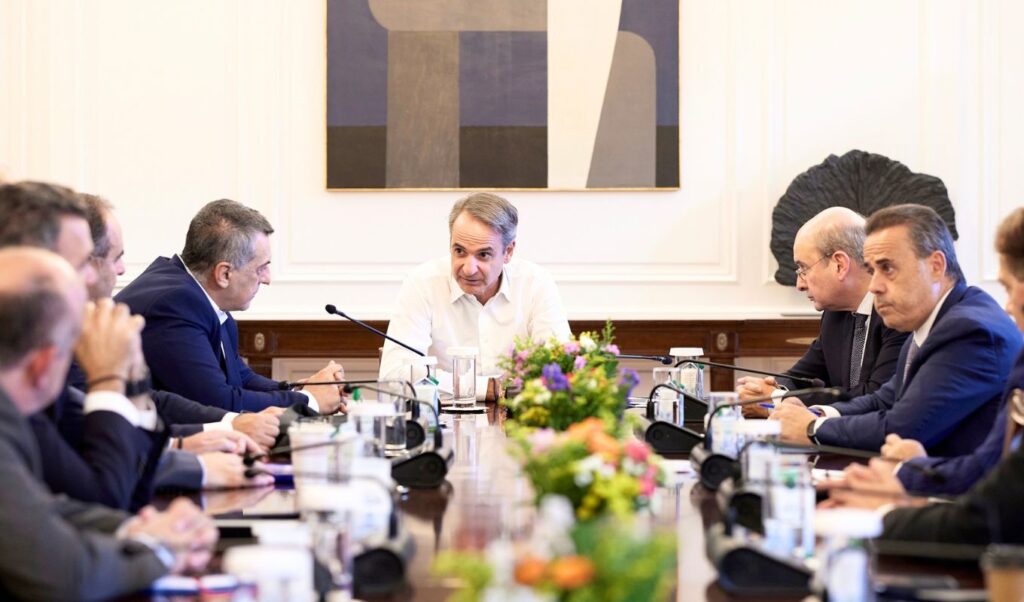
At Wednesday’s cabinet meeting, Kyriakos Mitsotakis is expected to focus on government initiatives aimed at boosting household incomes, as the Prime Minister’s office seeks to reverse the negative mood generated by a string of recent government missteps. Following the latest developments in the Tsavdaridis affair, the government’s inner circle is sending a clear signal that no further ministerial departures are on the table — while simultaneously warning ministers and deputy ministers that the work must go on, and that the race for parliamentary votes can wait.
Read also: Mitsotakis convenes cabinet council on Wednesday — six items on the agenda
Mitsotakis: “The cost-of-living crisis is a global problem”
Mitsotakis drew attention in his Sunday social media post to key budget forecasts, highlighting the further decline of unemployment to 7.7% and the rise in disposable income, which now stands at 78% of the European average — up from just 64% in 2019. “There is a cost-of-living problem, and it is a global one, but the measures we have been able to adopt are addressing it to a significant degree,” the Prime Minister stated. With elections on the horizon, he framed the upcoming vote as a clear choice for citizens, who, as he put it, “will be asked to decide whether we continue on this path.” Wednesday’s cabinet session will be held in this spirit, while the end of the week will also see a summit on the European Union’s next long-term budget framework.
However, according to sources cited by the “Big Mouth” column at powergame.gr, Mitsotakis is also expected to deliver a stern message to government members who have effectively “downed tools.” He has reportedly identified that “apart from the dysfunctions observed within the government, with the exception of one or two ministers, the rest have quietly stepped back from the daily grind.” It is worth noting that at the previous cabinet meeting, Mitsotakis had already sent an unambiguous message to his ministers to maintain the pace of work and push personal pre-election planning to the back burner. He also unveiled a roadmap of 90 government priorities to be delivered before the end of the parliamentary term, with a focus on the economy, infrastructure, employment, housing, healthcare, education, and defence. “I fully recognize the temptation of the pre-election ‘hunt’ for votes. I think that, especially for cabinet members, that can wait. The priority right now is delivering government results. So we still have a lot of work ahead of us,” the Prime Minister had pointedly emphasized at the November session.
What’s planned for large families, farmers, and people with disabilities
“Despite the challenging external environment, the forecasts for the Greek economy as reflected in the budget are encouraging,” said government spokesman Pavlos Marinakis during his briefing to political correspondents, adding that the Greek economy is projected to grow by 2.3% in 2027. In this spirit, the government is highlighting the most significant measures contained in its social support package, including: a zero tax rate on income up to €20,000 for full-time farmers and three-child families; an increase to €400 net in the annual benefit for pensioners, people with disabilities, and uninsured elderly citizens; and the extension of this benefit to all pensioners over the age of 65.
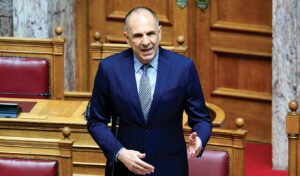
Marinakis also referenced the indexation of disability benefits to inflation, as well as the payment — from December 2027 — of a €500 Christmas bonus to all civil servants and public-sector employees. For the younger generation, a new special investment account will be established, into which the state will deposit an amount matching each parent’s annual savings contribution, up to €1,200 per year. The government spokesman also stressed that, despite the difficult international climate, Greece continues to record growth rates above the eurozone average. According to the “Big Mouth” column, tomorrow’s cabinet meeting is also expected to include an off-agenda briefing by Foreign Minister Giorgos Gerapetritis, focused exclusively on the undersea cable issue, as the government looks to capitalize on the positive turn the matter has recently taken.
Originally published in Apogevmatini