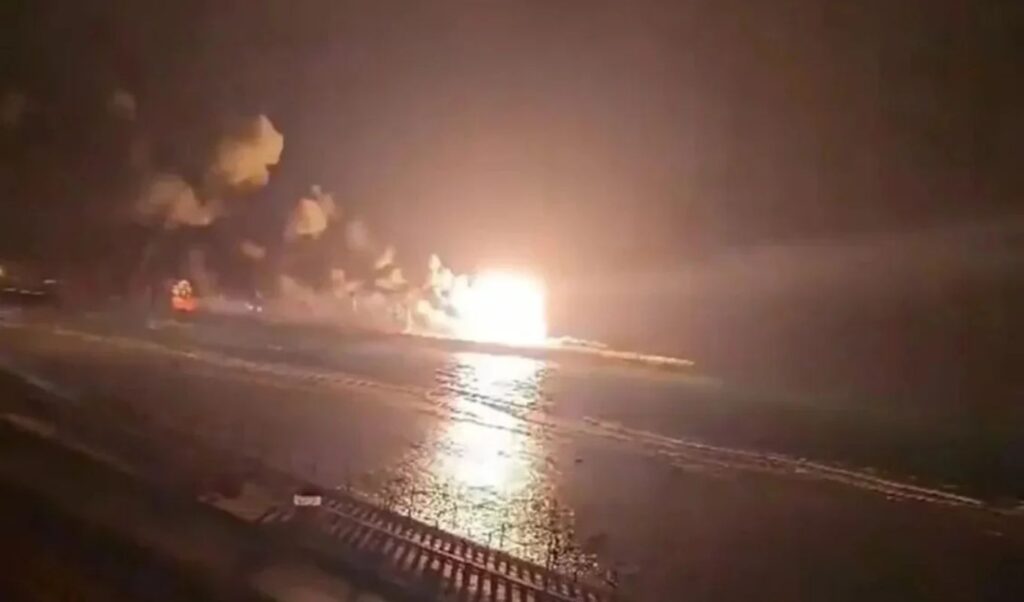
The dangerous prospect of the Russia-Ukraine war spilling over into the broader geopolitical neighborhood of the eastern Mediterranean is becoming increasingly visible. The sinking of the corvette Merkury in Benghazi, eastern Libya — a source of pride for the Russian Navy and Vladimir Putin — by Ukrainian drones follows the equally symbolic strike on the Kerch Bridge in Crimea. The attack poses a direct challenge to Russia’s footprint in eastern Libya while raising questions about how a stealth warship was struck — and who exactly was involved in an operation that Ukraine has claimed responsibility for.
Read: Zelensky admitted that Ukraine struck the Russian ship “Merkury” off the coast of Libya
Putin’s prized warship is sunk
Starting with the identity of the vessel, the Merkury was no ordinary ship. It had been docked in Benghazi for refueling and resupply under a cooperation agreement between Russia and the eastern Libyan government, though no details had been provided about the ship or its cargo.
Vladimir Putin had taken a personal interest in the vessel. In 2019, he visited the Saint Petersburg shipyard where it was being built and championed naming it after a Tsarist-era brig renowned for repelling two Turkish warships in the Black Sea in 1829.
At the 2023 Navy Day parade, the Russian president singled it out among 30 new vessels as proof that Russia was “steadily strengthening the power of its fleet.” The ship flew the Saint George’s flag — of the highest symbolic importance to Moscow — as a “sign of the inviolable nature of our naval traditions,” and Putin declared it “pleasing” that the name of the historic brig had been revived.
Russian state media were equally effusive. The TASS news agency described it as the “newest missile corvette,” while the TV Tsentr channel claimed that its stealth technology made it “invisible to radar,” as noted in a related Guardian report.
Ukraine’s presence in western Libya, with US “backing”
Sunday’s attack was carried out by Ukraine’s Security Service (SBU), which has conducted a series of long-range operations against Russian vessels and naval assets beyond Ukraine’s waters in the Black Sea, as Zelensky confirmed.
The operation also highlights a broader “geopolitical game” of competing influence with Africa at its center. Ukrainian forces have been active in western Libya for approximately one year, according to Libyan officials who spoke to the Associated Press earlier this year. Their presence forms part of Ukraine’s wider efforts to counterbalance Russian influence and interests in the region, according to Ukrainian officials.
These forces — most of them drone specialists — operate primarily from an airbase in the western coastal city of Misrata, as well as from other military facilities in the capital Tripoli and the coastal city of Zawiya, the officials said.
Their deployment was part of a secret agreement between Kyiv and the western Libyan government of Prime Minister Abdul Hamid Dbeibah, the officials said. The deal had the backing of Western nations, including the United States, as part of broader efforts to counter Russian influence, the Associated Press notes.
For its part, Russia has invested heavily in its relationship with Khalifa Haftar, who also maintains parallel channels with the United Arab Emirates. Russia periodically uses eastern Libya as a transit hub for operations in other parts of Africa and as an additional foothold in the southern Mediterranean, alongside its bases in Syria — with which it reached a new agreement with the al-Sharaa government in August. The Russian Navy regularly rotates warships through Libya, international media report.
Albania’s alleged involvement
Given the above, the most likely scenario regarding the launch point of the drones is western Libya. However, a separate scenario implicating Albania has also emerged. A source cited by Clash Report claimed that the vehicles that struck the Russian ship in Benghazi were launched from Albania — not western Libya. The same source said that the eastern Libyan side detected the launch and added that the “western Libya” account is a diversion planted by Ukrainian sources. The report was published on Sunday evening.
BREAKING | Kyiv is stirring up the Mediterranean Clash Report source on the strike on a Russian ship in Benghazi, Libya: ▪️ The vehicles launched from Albania, not western Libya. ▪️ The eastern Libyan side detected the launch. ▪️ The “western Libya” account is a diversion by Ukrainian sources.
— Clash Report (@clashreport) November 22, 2026
The source of the story is itself particularly noteworthy. Clash Report, which broke the story, is based in Turkey and is widely regarded as frequently promoting Ankara’s positions, particularly to American and broader English-speaking audiences. This context is clearly significant — especially as Tirana has denied the claim — while Anadolu Agency (again, perhaps not coincidentally) was among the international outlets that swiftly amplified the Albanian denial, potentially signaling Turkey playing its own parallel game.
Zelensky’s statement
Ukraine formally claimed responsibility for the strike yesterday through a post by Volodymyr Zelensky, describing it as “an exemplary Ukrainian operation” carried out using seven naval drones.
“An exemplary Ukrainian operation in response to the Russian war. I thank the fighters of the Security Service of Ukraine and all our Defense Forces who took part in carrying out these missions. Yesterday and today I received detailed reports on the progress of the operation — the designated objectives were achieved.
The operation took place off the coast of Libya. Our fighters used seven naval unmanned vessels of Ukrainian manufacture. Despite the enemy’s efforts to intercept the attack, the Russian corvette Merkuriy was sunk. This is one of their newest vessels, which entered service in 2023, during the full-scale war. Along with the corvette, a Ka-27 combat helicopter was also destroyed. Our second target was the Russian cargo vessel MV Angara, which the enemy was using to transport weapons. The result: the ship was hit.
We continue operations in the designated maritime zones. We respond to Russian aggression. We deploy Ukrainian weapons systems. Glory to Ukraine.”