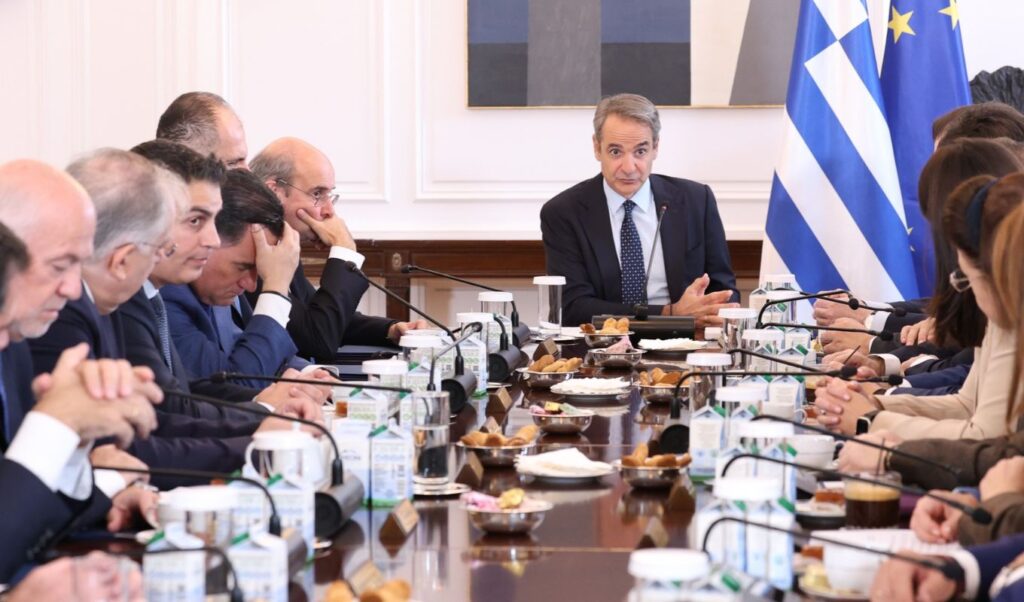
The government is seeking a formula to shift the public debate toward a positive agenda, putting social support measures and the continuation of its governing work at the forefront. This direction will shape the upcoming Cabinet meeting on Wednesday, November 25, while later in the week, the Summit on the next EU multi-year budget is set to take place. Kyriakos Mitsotakis is linking the new Multiannual Financial Framework to the dilemma posed by the upcoming elections, centering his narrative on stability versus the risk of political uncertainty.
A firm brake on right-wing coalition scenarios
In the wake of the recent Tsavdaridis affair, the Prime Minister’s office has stated that there is no question of further departures from the governing coalition — neither Deputy Interior Minister Vangelis Liakos nor Deputy Environment and Energy Minister Nikos Tsafos are under threat. At the same time, the government is emphatically seeking to shut down any discussion about New Democracy’s political orientation, flatly rejecting statements by party officials about potential post-election coalitions with parties further to the right.
The Prime Minister’s office responded sharply — through its government spokesperson — to a statement by MP Dimitris Kalogeropoylos, who floated the idea of a possible alliance between New Democracy and parties positioned to its right. The spokesperson was quick to clarify that the MP’s view does not reflect the position of the Prime Minister, the government, or the party.
The primary reason the government is shutting down any talk of New Democracy opening up to right-wing parties is the risk — observed closely by government insiders — of voters feeling free to cast a “consequence-free” protest vote. With this in mind, government officials consistently reiterate that New Democracy’s electoral goal is an outright parliamentary majority, explicitly and categorically ruling out post-election coalition scenarios with parties to the right. The aim is to prevent fostering a sense of an “alternative option” for disgruntled New Democracy voters who have drifted into the undecided zone. This categorical rejection takes on added significance given that speculation about former Prime Minister Antonis Samaras launching a new party has been reignited by his recent high-profile activity.
The “single ballot” strategy: Targeting an outright majority
Against this backdrop, the government’s core strategy centers on the concept of the “one election, one shot” approach. As elections draw closer, the Prime Minister’s office is intensifying its electoral messaging, seeking to neutralize soft or wavering votes. The message is clear: there is only one “Election Sunday” — no trial runs, no protest votes to be corrected later, and above all, no “second round.” In this environment, the dilemma of “realistic hope versus ungovernable chaos” is being pushed forcefully by government voices, while New Democracy’s narrative is being built around the three pillars of stability, continuity, and consistency. Within this framework, the Prime Minister’s strategists are targeting the 45% of citizens who consistently say they prefer single-party majority governments.
Pivoting to a positive agenda with the economy front and center
Adding to the equation is the pre-election budget submitted to Parliament on Friday, November 20, with the government placing social interventions targeting income, the cost of living, and everyday quality of life at the center of its messaging. Across all recent polling surveys, despite the opposition’s efforts to capitalize on government fatigue, the high cost of living remains the single biggest concern for Greek households. The government is now seeking a deliberate “pivot” toward a positive agenda, spotlighting its income-boosting measures.
A new household support package is on the table
According to sources, the Prime Minister’s team is actively discussing a targeted support package to be implemented in the first months of the new year — a period when the pre-election campaign will be in full swing. The measures under consideration may be announced by the Prime Minister himself during the full parliamentary vote on the budget. However, the final plan will depend on updated assessments of public finances, with the government signaling that fiscal balance remains its top priority. Social support measures are already being pushed to the forefront of the government’s public messaging, with the recent disbursement of a €400 bonus to all pensioners over the age of 65 leading the way. This will be followed by annual pension increases, the full abolition of the personal income differential, and on November 30, the payment of rent subsidies to eligible recipients.
Support for borrowers and a response to the opposition
In the context of the parliamentary inquiry committee on non-performing loans, the government has sought to underscore its track record on private debt management and support for vulnerable — as well as responsible — borrowers, arguing that it has accomplished more in this area than all previous governments combined.
“All of this is the best answer to the vague rhetoric, the outdated sloganeering, and the cheap — and above all, uncosted — promises of the opposition parties,” government spokesperson Pavlos Marinakis stated.
Originally published in “Kyriakатiki Apogeymatini” (Sunday Evening Edition).