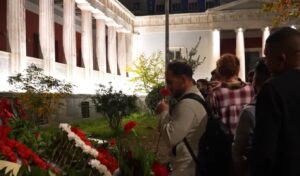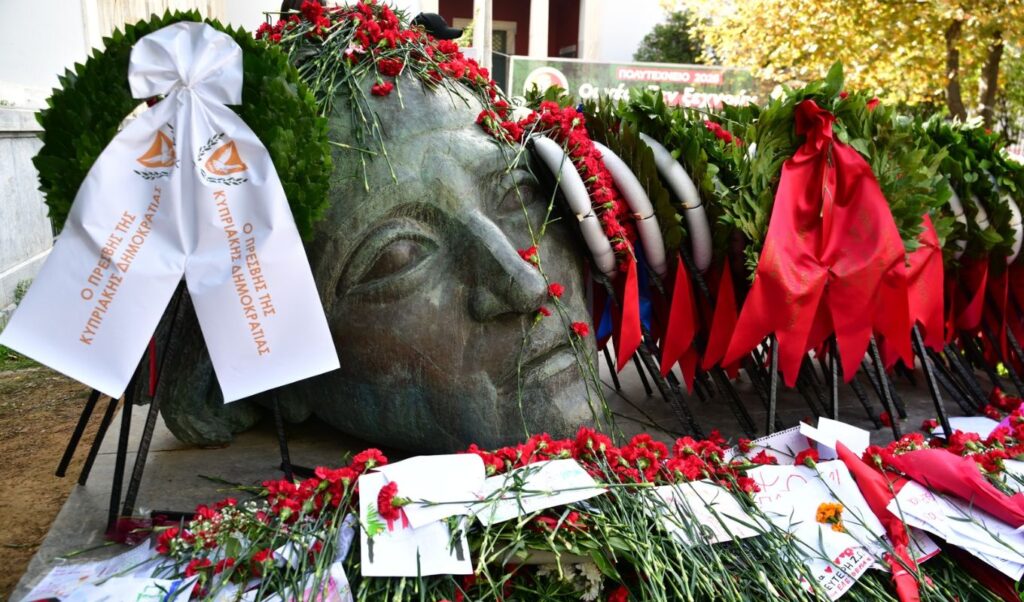
Greek Police are on heightened alert for the culmination of events marking the 53rd anniversary of the Athens Polytechnic Uprising, taking place today, Tuesday, November 17. More than 5,000 officers will be deployed across Athens, with the bulk of forces concentrated in the city center, where the traditional march to the American Embassy is set to take place.
The Greek Police’s operational plan includes a strong law enforcement presence, pre-emptive security checks, aerial surveillance, and extensive traffic management measures — all aimed at ensuring the events proceed smoothly and preventing incidents.
Officers from the riot police (MAT), the DIAS motorcycle unit, the DRASI rapid response team, the OPKE special operations unit, the Security Division, and the Traffic Police will be deployed from early morning at multiple points across Athens.
Polytechnic anniversary: Pre-emptive checks, searches for suspicious items and detentions
Particular emphasis is being placed on the now-standard pre-emptive security checks, which will be carried out by officers at various points in the city center — primarily around the Polytechnic building, in the Exarcheia neighborhood, and along the routes demonstrators are expected to take. Officers will conduct checks of individuals and their belongings, searching for materials that could be used in potential incidents. These include improvised incendiary devices such as Molotov cocktails, hammers, knives, wooden clubs, and other objects that could be used to attack police forces or cause property damage.
In addition, individuals whose identity cannot be verified on the spot will be taken in for further identification checks. According to the police operational plan, the aim of these pre-emptive checks is to detect suspicious items early and prevent them from being brought to the rally sites.
Drones and a helicopter over the city center
Aerial surveillance is also being given significant priority. Police drones and a helicopter will stream live footage to the Operations Center, allowing commanding officers to monitor how the gatherings develop and coordinate ground forces accordingly. Key areas of focus include the historic Polytechnic complex on Patission Street, the wider Exarcheia district, other university campuses, and public buildings.
Enhanced security measures are also in place around the embassies of the United States and Israel, while plainclothes officers from the Security Division will be stationed at strategic locations.
Traffic restrictions: Which roads are closing
Emergency traffic regulations introduced by the Attica Traffic Police, which came into effect on Sunday, November 15, are also in force and are expected to remain in place until 6:00 a.m. on Wednesday, November 18. In the area around the Polytechnic, the measures affect Patission Street between Kodrigktonos and Panepistimiou, as well as Stournari, Tositsa, Bouboulinas, and several streets surrounding Exarcheia Square.
From 6:00 a.m. on Tuesday, additional stopping and parking bans are in effect, while from midday onward, gradual road closures are planned on major central arteries, including Panepistimiou, Stadiou, Akadimias, Vasilissis Sofias, Vasilissis Amalias, and Alexandras Avenue.
The restrictions also cover roads around Syntagma Square and the American Embassy, as well as sections of Kifissias and Mesogeion Avenues in the inbound direction toward the city center. Road closures will be applied progressively, depending on how the gatherings and the march unfold.
Three Metro stations to close
Disruptions to public transport are also expected. According to an announcement by STASY (the Athens Urban Transport Organization), three Metro stations — Syntagma, Panepistimio, and Megaro Mousikis — will close from 2:00 p.m. onward, by order of the Greek Police.
Trains will pass through these stations without stopping, and they will reopen upon further instruction from the police. Modifications are also expected to bus and trolley routes and stops serving the Athens city center.
The Traffic Police are urging drivers to avoid traveling through or parking in the wider area of the events and along the march route, in order to minimize traffic disruption.