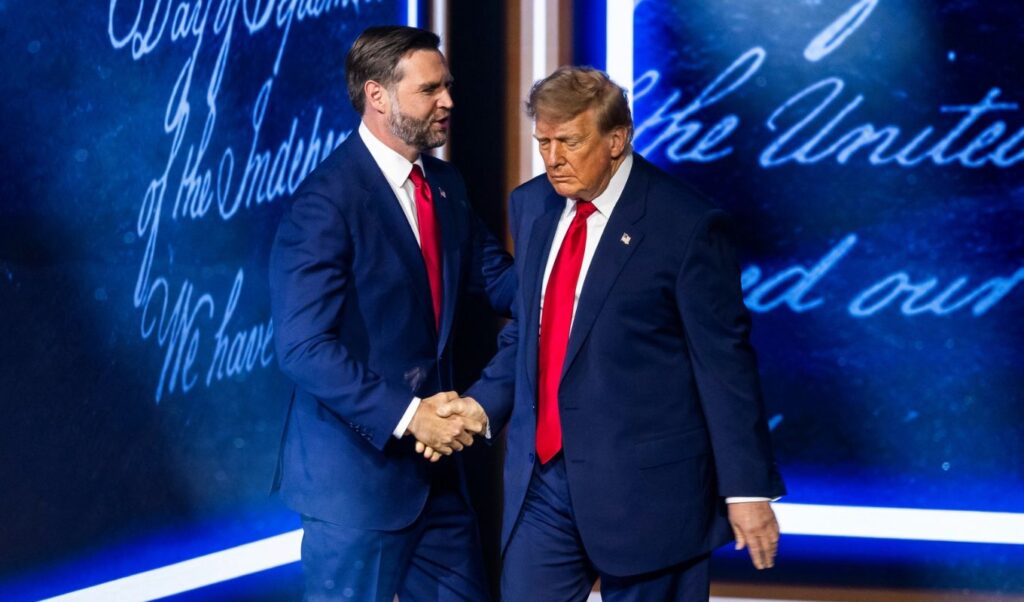
Donald Trump sent a clear message to JD Vance to stop dealing with Iran, with the American president appearing furious over the Republicans’ poor performance in the midterm elections. “We don’t need a deal with Iran,” Trump wrote in a Truth Social post. “Those days are long gone. We have their money, hundreds of billions of dollars, and we have their strait!” He announced that the vice president would henceforth devote his “full and complete attention” to exposing the “massive corruption and criminality” taking place in Democrat-controlled cities and states across the country. In other words, the vice president has been sidelined from his efforts to end the war — a war that, according to Vance, was the primary cause of the Republicans’ devastating defeat in last week’s elections.
It is hardly a coincidence that Vance’s removal from handling the Iran issue came just hours after the Wall Street Journal reported that the vice president had been open to a private meeting with Mohsen Rezaei, the hardline official who now serves as secretary of Iran’s Supreme National Security Council. Was Trump afraid of some kind of “treasonous” concession? One would hardly expect Vance — who appears desperate to end a conflict that seems to be destroying whatever remaining hope he has of becoming president — to negotiate from a position of strength. Or perhaps Trump simply woke up in a bad mood. Whatever the immediate cause of the president’s decision, it made clear — in the emphatic, all-caps style Trump favors when underlining his choices — that, when it comes to the Middle East conflict, his vice president no longer speaks for him.
This issue warrants deeper analysis. The most important question is what exactly Trump plans to do to extricate himself from a war that has undermined his presidency. Before the elections, Trump had hinted that he was considering a new military escalation to break the deadlock with Iran. Since then, however, he has sharply reversed course, telling “60 Minutes” that he sees “no reason” for such a move. By rejecting, in recent days, both the prospect of renewed conflict and the possibility of new negotiations, Trump appears to be signaling that he is pursuing a form of status quo — a limbo state of neither war nor peace — in which the US attempts to pressure Iran through a naval blockade and punishing economic sanctions, while avoiding both the humiliation of a deal on Iranian terms and the shock of a new wave of military strikes across the broader region.
Trump’s rage posts
None of this is unfolding in a vacuum. The American president’s outburst of fury could last as long as two more years, with Trump — now operating as a lame duck with limited political power — expected not to go quietly, as the New Yorker observes. On Thursday, Trump began his morning rant at 5:50 a.m. with a Truth Social post complaining about how “viciously” he and his administration were being accused of corruption by Democrats, while — in his view — they were the ones who were “CORRUPT AND EVIL.” Thirty-eight minutes later, he accused them of “illegally threatening Republicans with knowingly false accusations and prosecutions.” At 7:04 a.m., he returned to one of his favorite narratives from his first term, warning that “massive CARAVANS” of undocumented migrants were heading toward the US from the south, and that if they were not stopped, he would immediately double tariffs on Mexico. At 10:59 a.m., with no public events on his schedule, he continued in the same vein — wondering aloud, in the tone of someone asking why no one has acted yet, when six Democratic members of Congress would finally be prosecuted. Those members had, a year ago, published a video reminding US military officers that they are not obligated to carry out unlawful orders.
Yet no amount of social media venting appears to have eased his fury over the midterm results.
It is, one might say, entirely understandable that his rage should be proportional to the scale of the electoral defeat — which was, in truth, nothing short of epic. As vote counting continues, Democrats are leading by a margin approaching fourteen percentage points in the overall popular vote for the House of Representatives — the largest margin for the party in more than fifty years. Within my lifetime, Republicans have never come close to suffering such a sweeping popular vote loss in a midterm election. Trump’s record so far in his second term includes a political achievement that once seemed unthinkable: he has managed to unite Ohio, Kansas, North Carolina, South Carolina, Texas, and even Mississippi against himself and his candidates.
Following the morning’s posts came the 8:07 a.m. announcement that he was immediately relieving JD Vance of responsibility for negotiating a peace deal with Iran — ultimately focusing attention on what may have been the leading cause of the Republican defeat.