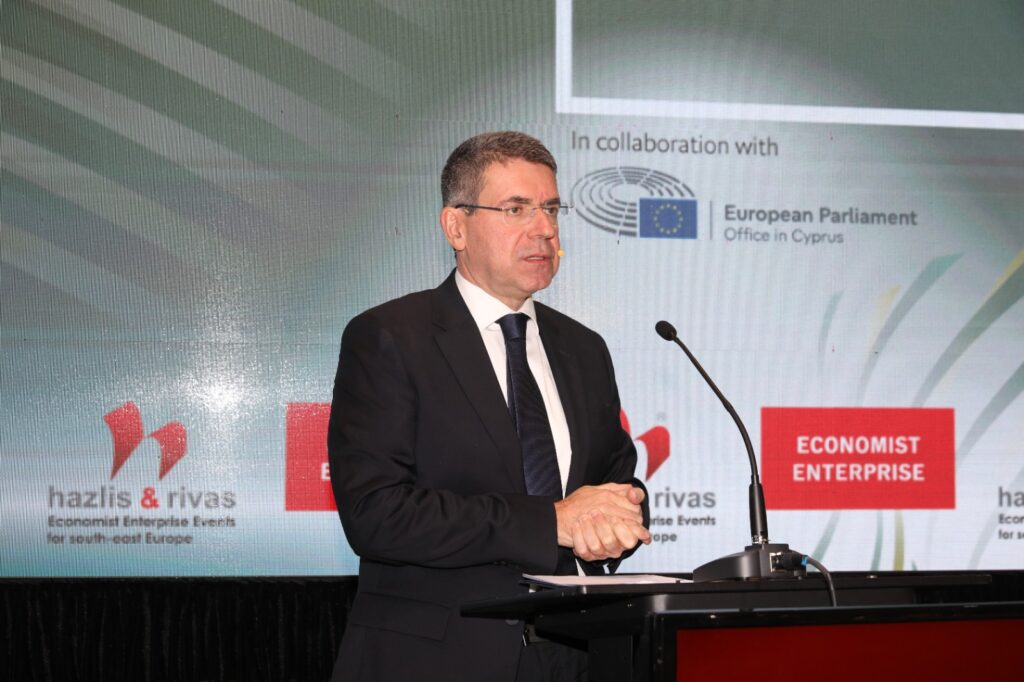
Artificial Intelligence has the potential to boost productivity, competitiveness, and economic growth — provided its capabilities are meaningfully harnessed by the majority of citizens, businesses, and public organizations. This was the central message delivered by Dimosthenis Anagnostopoulos, Secretary General for Information Systems and Digital Governance, at the 22nd Annual Cyprus Summit organized by The Economist, held on November 10 in Nicosia.
Read also: Choose: New Contact Center investing in technology and Artificial Intelligence for customer service
The two sources of the new digital inequalities
Anagnostopoulos emphasized that the new digital divide is not simply about access to AI tools, but more critically about the ability to use them effectively. He outlined three key areas of competition: the development of AI models, their integration into economic activities, and the achievement of real productivity gains.
He identified two main sources of potential inequality.
The first concerns skills.
The scale of the challenge is reflected in Eurostat’s 2025 figures, which show that AI tools were being used by 55% of large EU enterprises, compared to just 17% of small businesses. In Denmark, the figure for all businesses combined reached 42%, while in Greece and Cyprus it stood at approximately 9%. However, in Greece’s public sector, the rate climbed to 15%.
Referring to national initiatives that help explain this figure, he highlighted the distribution of 60,000 office automation tool licenses to civil servants, complete with free AI tools, and the training of approximately 30,000 of them. “The goal, however, is not simply access to new applications, but measurable improvement in day-to-day operations and productivity,” he noted. He went on to propose a methodology for achieving this, summarized in the following steps:
- Soliciting new ideas for AI adoption from each organization’s management team
- Eliminating procedural and legal barriers to AI implementation
- Demanding tangible, measurable results
- Closely monitoring progress on a weekly, monthly, and semi-annual basis
The second source of potential inequality relates to infrastructure requirements.
He made special reference to the national supercomputer “DAEDALUS” and the Greek AI Factory “PHAROS,” both of which expand the capabilities for developing and deploying AI models, as well as the broader EU initiatives around AI Factories.
Particular emphasis was placed on European technological sovereignty. As he elaborated, this does not depend solely on building infrastructure, but also on access to competitive models and services — ensuring that businesses and citizens have genuine choices.
He raised a series of critical questions: What happens if the most advanced AI models remain proprietary and cannot be deployed on European infrastructure? What if European open-source models are not competitive enough for the most demanding applications? What if a small European business builds its operations around a commercial AI model, only to discover that its provider can significantly raise prices or unilaterally change the terms of access?
We may find ourselves facing a paradoxical situation in which Europe has more computing infrastructure, yet European businesses remain dependent on a handful of global AI providers.
He therefore expressed the view that what is needed are competitive models, open technological standards, genuine portability between providers, and affordable access to AI capabilities.
He also argued that Europe must not spend billions building AI infrastructure while leaving even the slightest possibility that the intelligence running on that infrastructure — and the cost of accessing it — remains entirely under the control of others.
And that the answer to this challenge lies in the scale and strength of the European single market.