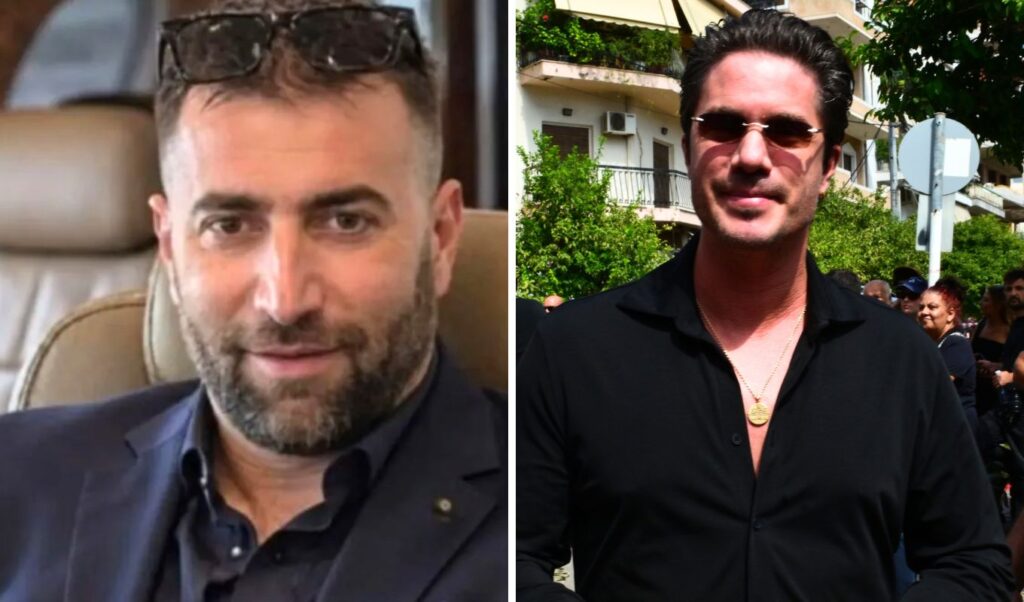
A new shocking dialogue between the founder of the NGO “Playground” (“Paidiki Hara”), Konstantinos Firinidis, and his 35-year-old partner has come to light. Both defendants have been remanded in custody, as they are alleged to have exploited the anguish of families with sick children by organizing fundraisers and collecting donations for their treatments. Among the victims of this massive fraud is Nikos Oikonomopoulos, a popular Greek singer who had responded to a plea for financial assistance on behalf of a child in need.
NGO “Playground”: The couple discussed how to extract money from Oikonomopoulos
According to the dialogue brought to light by LiveNews, the couple accused in this high-profile case discussed how they would persuade Nikos Oikonomopoulos to donate money. Vasiliki Manisioti allegedly suggested asking the singer for a “small amount” — which turned out to be a donation of €10,000. “He picked up the phone. Oikonomopoulos answered and said tell me tomorrow. It’s better, my love, if we ask him for a relatively small amount tomorrow. We’ll tell him it covers exactly this and that, and if he’s willing to put it in, my love,” she is alleged to have told her partner.
The four cases of child exploitation
Meanwhile, the revelations surrounding the alleged activities of the accused NGO “Playground” members continue to shock the public. Both the 37-year-old and his 35-year-old partner have maintained that they bear no responsibility, claiming that the amounts they received were small and that the children were not deprived of funds. They have also attributed their actions to a gambling addiction. These claims stand in stark contrast to the evidence gathered during the investigation and the accounts of families who, desperately seeking help for their sick children, placed their trust in the NGO.
According to Live News, one of the cases uncovered involves young Maritina, who is battling end-stage cancer. The 35-year-old allegedly approached the family, promising the parents that she would raise the funds needed for their daughter’s treatment through the NGO. The second case involves little Paraskevi-Lydia, who suffers from brain cancer. This is one of four alleged child exploitation cases included in the investigation. According to the evidence, when fundraising revenues fell short of targets, the accused allegedly swapped photos, names, and even the identities of the children featured in their posts. In some instances, they reportedly used photographs of entirely different children.
The most recent case involves little Paraskevi. In January 2026, the NGO had published her real photographs along with her real name. By September of the same year, however, in a new post, Paraskevi-Lydia was presented as “Anna.” Instead of her actual photos, a cartoon sketch of a fictional baby was used, according to the report. Those responsible are now being called upon to explain what was happening behind the NGO’s posts and to provide credible answers regarding the practices being uncovered. The in-depth investigation by Live News has also revealed at least three other similar cases to that of Paraskevi.
The case of Nikolas
The earliest case involves 7-year-old Nikolas, who suffers from neuroblastoma. In January 2025, the NGO published a post seeking support for him, using his name and real photographs. In May 2025, however, the same child appeared again — this time under his full name, Efraim Nikolas Aristopoulos — with different real photos from those used in the previous post. The situation escalated further in May 2026, when a new fundraising campaign for Nikolas featured two photographs of a completely different child, presented alongside Nikolas’s personal details and medical condition.
“I had told him what the child’s name was. What he did after that, I don’t know. They asked us for a hospital document and photographs. We were speaking with the 35-year-old, and once with the other one — the one with the cigar. The cigar guy, I say, with the Louis Vuitton and the Moncler jackets. If I had known he was doing this, I would have killed him,” said the child’s father. But the case didn’t stop there. In June 2026, a fourth fundraising campaign was launched for the same Nikolas. This time, instead of real photographs of the child, a cartoon sketch of a baby was used, creating the impression that it was an entirely different case. Four separate fundraising campaigns for the same child, using different photos and illustrations — a practice that, according to the investigation’s findings, was not limited to Nikolas’s case.
An unrelated baby’s photo used in fundraiser for an 11-year-old
A similar situation involves 11-year-old Manos from Laconia, who suffers from leukemia. In the summer of 2026, the NGO initially published real photographs of the child. In one post, however, a photo of a completely different child suddenly appeared — a baby, in place of the 11-year-old Manos. Manos’s mother, outraged by this change, contacted the 35-year-old and demanded an explanation. “I immediately called my mother and my brother. I said, ‘This child is not mine. It’s not Manos.’ ‘Yes,’ they said, ‘we saw it too. What happened?’ Then I called the 35-year-old. She told me, ‘We put that photo in because we were struggling to raise money for Manos,'” the mother recounted.
The case of Otto
Yet another case involves 12-year-old Otto, who passed away in August. The child appeared in NGO posts under the name “Othonas,” while in earlier publications — in which his medical condition was described and financial help was sought — he was referred to as “Dimitris.” “The reason my son Otto’s name was falsely listed is because I was embarrassed to have my child publicly identified, and so they told me they would use the fake name ‘Dimitris.’ In total, three campaigns were run for my child, through which I received €50,000 credited to my bank account, as well as €5,000 in cash handed to me directly by the 35-year-old. After the first campaign, they asked me whether I wanted them to run another post about my son so I could receive more money,” the mother testified.