Prime Minister Kyriakos Mitsotakis is pursuing a broad political outreach strategy aimed at professional groups and social constituencies that have either kept their distance from the government or openly expressed dissatisfaction with aspects of its policies — all with an eye firmly fixed on the elections scheduled for spring 2027. Inside the Maximos Mansion, a plan appears to be taking shape for a gradual restoration of relations with key social audiences — one that combines targeted policy interventions, economic relief measures, and carefully crafted political messaging.
Read also: Elections: Dates locked in for April 11 or May 16 — Why only these two dates are on the table
Eye on the ballot box: Mitsotakis’ announcements at the KEDE conference
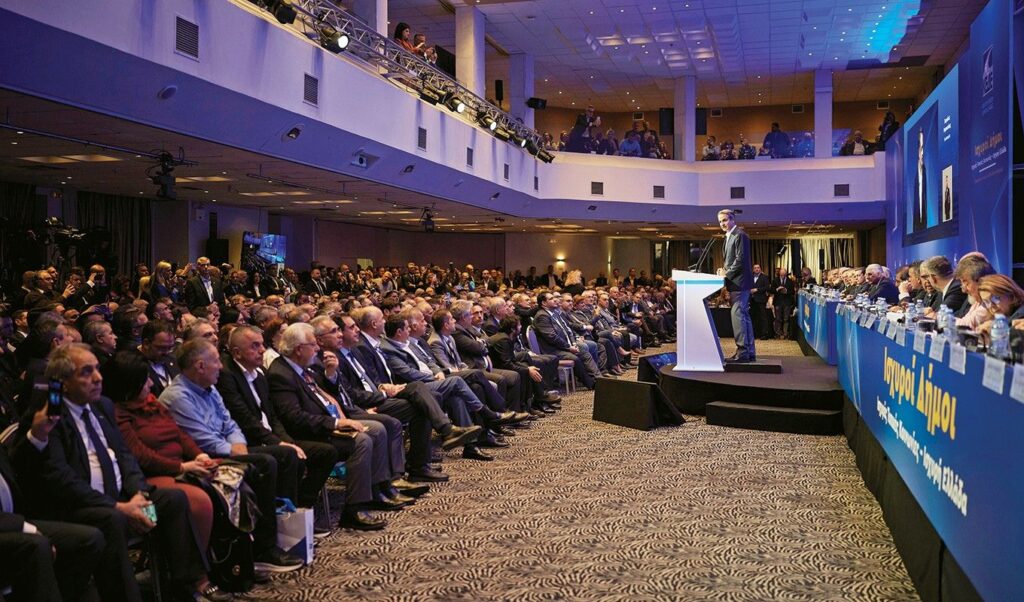
This broader strategy was on full display at the conference of the Central Union of Greek Municipalities (KEDE) in Kalamata, where the prime minister unveiled a package of “6+2 realism initiatives” before an audience of mayors. The measures are designed to address long-standing demands from local government bodies, which have repeatedly complained about chronic underfunding, a lack of resources, and the transfer of responsibilities without adequate financial support.
Among the most significant announcements was the doubling of the annual state subsidy for the maintenance of school buildings, as well as the allocation of €240 million in November to clear municipalities’ overdue debts to energy providers. The government also announced an increase in the tourist accommodation tax to 1%, boosting municipal revenues from tourism.
Further measures include the allocation of €200 million over four years — funded through a special levy once fuel markets stabilize — earmarked for repairing and maintaining the road network. An additional €50 million has been set aside for battery procurement in collaboration with Greece’s Public Power Corporation (PPC), while a new debt restructuring arrangement for municipalities is also reportedly under consideration.
The critical link
The prime minister’s decision to place local government at the center of his agenda is far from coincidental. Mayors serve as a vital link between the central government and local communities, wielding considerable influence over the political climate in every region. Addressing their demands can act as a lever for broader political reconciliation with local societies. A similar logic appears to underpin the government’s announcement targeting female voters: a reduction in VAT on menstrual products from 24% to 13%, effective January 1, 2027.
Mitsotakis described the move as an act of “social justice,” acknowledging that applying the highest VAT rate to such products had been a distortion. He also revealed that he had requested an examination of programs to distribute menstrual products free of charge in schools in disadvantaged areas, noting pointedly that “there are girls who cannot afford to buy them.”
In the same vein, the Ministry of Transport announced a revision of taxi fare tariffs — a move that directly responds to longstanding industry demands. Specifically, the flat rate for the journey from Athens International Airport “Eleftherios Venizelos” to the city center will increase from €40 to €50 (single rate) and from €55 to €65 (double rate). For the route from Thessaloniki’s “Macedonia” Airport to the city center, fares will rise to €28 from €25 and to €38 from €35, respectively. The hourly waiting charge will also increase from €15 to €20.
New interventions on the horizon
The outreach effort, however, does not stop there. According to sources, the government team is examining targeted measures for freelancers and small-to-medium-sized enterprises — two groups that felt the prime minister’s announcements at the Thessaloniki International Fair failed to meaningfully address their concerns. Related announcements are expected in early 2027, with the precise scope and scale of the measures depending on the trajectory of the economy and available fiscal headroom.
Running in parallel with the economic initiatives is a second, more distinctly political operation: the reconsolidation of the right-wing electorate, an area where New Democracy has faced pressure and losses to other political formations.
Mitsotakis’ visits to Kalamata and Serres, as well as the systematic regional presence of ministers and party officials, are all part of this effort. Particular importance is also being attached to engagement with the Greek Orthodox Church. It is no coincidence that government officials are actively seeking meetings with local metropolitans during their regional tours, while an open channel of communication is being maintained with Archbishop Ieronymos — with the aim of resolving pending issues and addressing matters of concern to the Church.
The overriding objective for the Maximos Mansion is to contain the sources of public discontent, rebuild trust among groups that have drifted away, and lay the groundwork — as early as possible — for more favorable conditions heading into the 2027 electoral contest. Whether these moves will translate into a genuine political reconsolidation of New Democracy’s voter base will ultimately be determined not by the announcements themselves, but by their implementation and the tangible difference they make in citizens’ everyday lives.
Published in Parapolitika