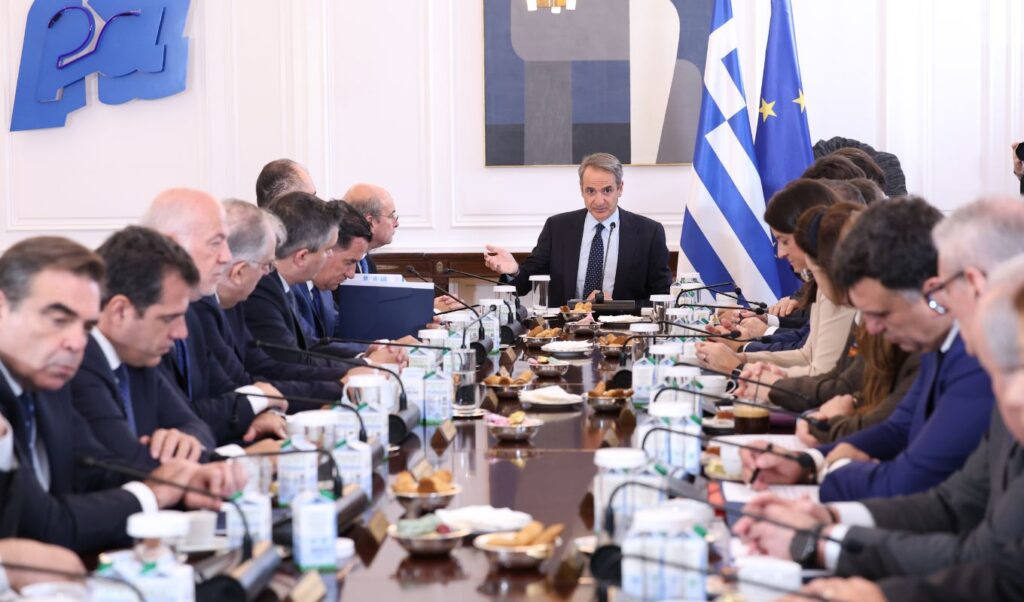
With specific deliverables and timelines set through the end of its term, the Maximos Mansion is working to keep the government machine running at full capacity on its path toward the national elections. The agenda presented at the most recent cabinet meeting includes 90 critical projects, with Maximos signaling a push for tangible results right up until the final stretch before the polls. “Kyriakátiki Apogeumatini” presents the 25 critical priorities of the government’s agenda, along with their implementation timelines: 10 with milestones in 2026 and 15 in 2027, reflecting the government’s political direction and planning framework.
Read more: Cabinet meeting: The final crash test for government members, the 90 “specific and measurable deliverables” in progress, and the electoral battle that may lie ahead
Coordination entrusted to Hatzidakis and Skretsas
The coordination of collecting and evaluating ministerial proposals has been assigned to Deputy Prime Minister Kostis Hatzidakis and Minister of State Akis Skretsas, with the General Secretariat for Coordination — led by Evi Dramaliotis — playing a central role in processing and structuring the overall plan. The shared framework of deliverables and deadlines provides concrete reference points for tracking progress across each portfolio.
For Hatzidakis and Skretsas, the process underscores the horizontal coordination of government work, while the General Secretariat for Coordination links individual ministerial commitments to the broader planning framework. The political value of this endeavor will ultimately be judged by its implementation: the infrastructure delivered, the services made operational, and the processes advanced to the next stage.
In this context, distributing commitments across two consecutive years creates a sequence of milestones running through to the end of the government’s term. For the government’s leadership team, the goal is for adherence to these milestones to sustain the pace of governance and deliver tangible results to citizens — while the clear description of what is to be delivered at each stage simultaneously allows progress to be assessed against specific criteria.
By the holiday season
— At the Ministry of National Economy and Finance, two key milestones are set for December.
* The first is the tax bill incorporating the measures announced at the 2026 Thessaloniki International Fair (ΔΕΘ), which represents the legislative step for implementing the related announcements.
* The second is the activation of the Property Ownership and Management Registry (MIDA).
In the first case, the deliverable is legislative in nature; in the second, it concerns the launch of a new registry.
— In National Defense, the delivery of two FDI frigates to the Hellenic Navy is scheduled for December 2026.
This represents one of the most clearly defined material deliverables in the plan, with a direct link to strengthening the naval fleet.
— In Civil Protection, that same month sees the planned upgrade of the 112 emergency line through the integration of next-generation technologies — the Next Generation 112 initiative.
— In Education, by December the government plans to announce the inclusion of more than 500 new schools in the “Marietta Giannakou” program and to begin the relevant studies. This deadline refers to the enrollment of schools in the program and the launch of preparatory studies — not the completion of construction work on school buildings.
— In Health, the corresponding milestone is the continuation and expansion of the national cancer screening program “Prolamvano II,” with a focus on prevention and early diagnosis.
— In Labor, the expansion of the Digital Work Card to new sectors is scheduled for November 2026. The broadening of the card’s application is linked to recording working hours and monitoring compliance with working schedules.
— That same month, the Ministry of Culture is set to oversee the restoration and reopening of the Old Museum on the Acropolis Rock.
— Two interventions relate to agricultural production:
* In November, a reform and modernization of the organic products inspection and certification system is planned — an initiative aimed at strengthening the credibility of this market.
— In December, a new payment management model is set to be introduced. The final presentation records it as a standalone deliverable, without elaborating further on its operational content.
Housing, home care, the VOAK highway, and new refugee facilities in 2027
Housing is one of the central pillars of next year’s agenda. At the Ministry of National Economy and Finance, January is set for the opening of applications for the “My Home III” program. This milestone marks the launch of the program for interested applicants.
— At the Ministry of Social Cohesion and Family, February is earmarked for the first tender for the utilization of public properties for social in-kind contribution and affordable housing, while April will see the first tender for the utilization of inactive military camps. These two tenders mark the starting point of the respective housing projects.
— In student housing, the selected priority for 2027 is the delivery of the first student dormitory for Panteion University in May.
— Meanwhile, the Ministry of Education has a second milestone: the National School Leaving Certificate. By April, the government plans to complete the roadmap and prepare the institutional framework. This represents the reform’s design stage — defining its direction and laying the groundwork for its institutional basis.
— At the Ministry of the Interior, the reduction of bureaucracy is being tackled through the electronic automatic retrieval of four civil documents: marriage certificates, death certificates, cohabitation agreements, and citizenship certificates. The deliverable, with a February 2027 deadline, includes the corresponding abolition of their manual issuance, enabling services to retrieve the required information digitally.
— In Health, March sees the planned launch of a pilot community and home care model in the 1st Health Region. The model is based on collaboration between Mobile Health Units, the National Telemedicine Network, and the Stavros Niarchos Foundation. This commitment refers to the launch of the pilot operation, with the goal of connecting different care delivery tools closer to citizens.
— In Citizen Protection, February is the target for providing network and telecommunications connectivity services for the “Smart Policing” project. This deliverable concerns the communications infrastructure supporting the project and forms part of the digital upgrade of policing.
— At the Ministry of Migration and Asylum, by March the government plans to establish and operationalize two new reception and identification centers in Crete, along with operational support for the transfer of asylum seekers to other facilities under the ministry.
— In Infrastructure, March 2027 is the milestone for opening 25 kilometers of the VOAK North Crete Motorway to traffic — specifically the bypasses of Rethymno and Heraklion — along with road safety interventions spanning 130 kilometers. The commitment targets specific sections and interventions along the axis, with a practical impact on mobility and safety.
— At the Ministry of Environment and Energy, May is set for the establishment of marine parks in the Aegean and Ionian seas, in line with commitments made at the Our Ocean international conference on the protection of marine protected areas. The deliverable concerns the institutional designation of the parks and sets a concrete timeline for this environmental initiative.
— In Development, priorities center on two funding rounds under the development law. The issuance of a call for proposals and the evaluation of submissions for “Large Investments” (second round) are scheduled for January, while the corresponding steps for “Manufacturing and Supply Chain” (fourth round) are planned for February. These dates refer to the tender and evaluation processes for investment proposals.
— In Justice, the new Property Code has a target date of March 2027 and is recorded as a standalone institutional deliverable.
— In Culture, April is set for the delivery of the National Museum of Underwater Antiquities — a new museum infrastructure dedicated to showcasing Greece’s underwater cultural heritage.
— In agricultural policy, February is the target for launching a new recovery plan for the Greek livestock sector, as a distinct intervention for this specific branch of production.
— Finally, the Ministry of Foreign Affairs has a central milestone in June 2027: preparations for the Greek presidency of the Council of the European Union. Its inclusion in the plan links domestic government programming with a European obligation requiring cross-portfolio cooperation. According to government sources, the objective is twofold: first, to prevent ministerial complacency during the pre-election period; and second, to anchor the political debate around results that can be verified.
The government aims to enter the final stretch of its term with a concrete record of achievement in everyday life, housing, health, investment, and security. Nevertheless, government officials stress that highlighting these interventions does not limit the remaining work of ministries, which continues on its normal course.