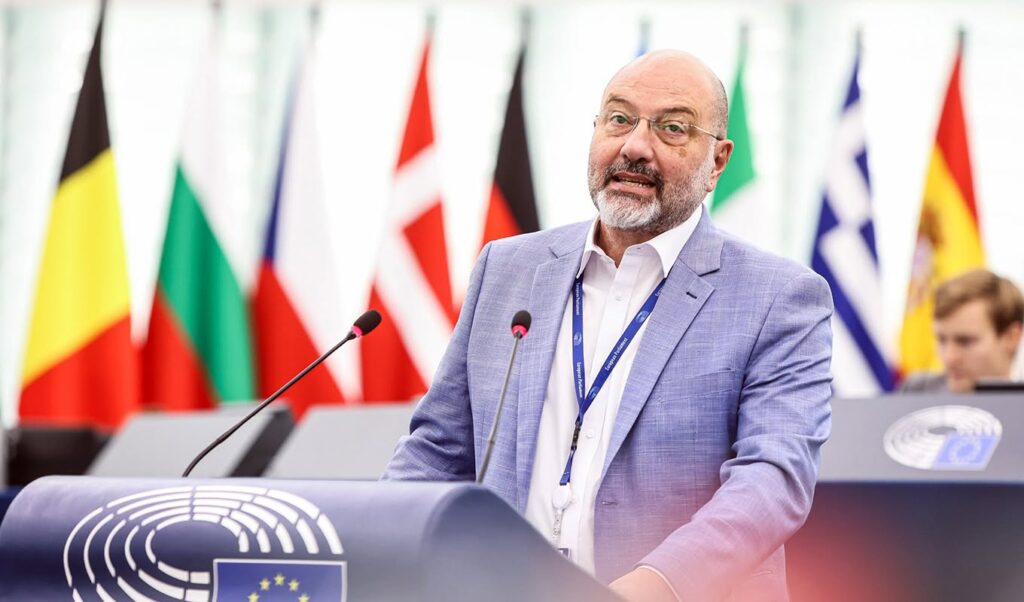
MEP Sakis Arnaoútoglou of PASOK highlighted the urgent need to establish modern cross-border rapid response protocols for combating wildfires during a discussion at the European Parliament’s Committee on Environment, Climate and Food Safety with representatives of the European Commission. He also called for an examination of how the European Civil Protection Mechanism could support the creation and updating of bilateral and regional protocols, providing technical assistance, common operational standards, and appropriate funding instruments.
Read also: EU: One in three 15-year-olds falls behind in reading and mathematics — The Commission’s plan for education
Sakis Arnaoútoglou: The need for immediate response to cross-border wildfires
The goal is to develop a functional framework, complementary to rescEU, that strengthens cross-border prevention and early intervention without replacing the responsibilities of individual member states. The discussion was prompted by Special Report 17/2026 of the European Court of Auditors on rescEU, which acknowledges the significant contribution of the European mechanism in disaster response while also identifying weaknesses in planning and the sustainability of available capabilities.
The MEP, as stated in an official press release, raised a specific problem faced by fire services along Greece’s borders with Bulgaria, Albania, and North Macedonia, where administrative restrictions and gaps in operational coordination can delay firefighting efforts during the critical first minutes of a blaze.
In particular, the following issues were highlighted: delays in receiving alerts about fires developing near border areas, restrictions on the cross-border movement of fire vehicles and personnel, the inability to immediately deploy aerial assets beyond the border line, and the absence of joint operational centers and compatible radio communication systems.
The problem is particularly acute in the mountainous and remote areas of northern Greece, such as Beles, Orvilos, and Frakto, where in some cases access to a fire is easier from the neighboring country’s side of the border.
The Greek Fire Service noted that during the 2026 fire season, cross-border wildfires engaged significant firefighting forces for many consecutive days, exposing the operational weaknesses of the existing system.
Cooperation protocols with Bulgaria and Albania
Greece has had a firefighting cooperation protocol with Bulgaria since 1993, while a bilateral agreement was signed with Albania in 2007. However, according to the responsible fire services, the existing framework with Bulgaria is in urgent need of updating, and there are calls for a dedicated operational protocol to be established with North Macedonia as well.
Particular emphasis is placed on the ability to immediately mobilize ground and aerial assets, with pre-established procedures and clear rules of operational responsibility, so that valuable time is not lost waiting for lengthy approval processes.
The Spain-Portugal model
A comparable cooperation model has already been established between Spain and Portugal. Under a dedicated bilateral protocol, initial firefighting intervention is permitted within a 25-kilometer zone from the border, under specific conditions, without requiring a formal prior request for assistance — but with notification to the relevant authorities.
This example demonstrates that practical rapid-response procedures can be established between neighboring countries, with full respect for national sovereignty and operational safety.
Mr. Arnaoútoglou stated specifically: “It is unacceptable that in 2026 we are still losing precious time fighting a fire because the nearest fire truck or aircraft is on the other side of the border. We must listen to the people on the front lines — those who know the terrain and risk their lives to protect citizens. The climate crisis is escalating risks and demands that we utilize every available resource from the very first minutes. European solidarity must not begin only after a fire has already spiraled out of control. It must function proactively and operationally, before the disaster spreads. We call on the European Commission to support the creation of modern cross-border protocols — both between member states and with neighboring third countries — featuring joint training, compatible communications, and the capacity for immediate coordinated response. Wildfires know no borders. Neither should the protection of human life and the natural environment.”