A new charge is set to shake up online shopping from non-EU countries for European Union consumers — and it’s arriving just ahead of Black Friday and the Christmas shopping season.
Read also: Courier cash-on-delivery shake-up: Plans for abolishing cash payments put on hold
The stinging €5 fee on small parcels from non-EU countries
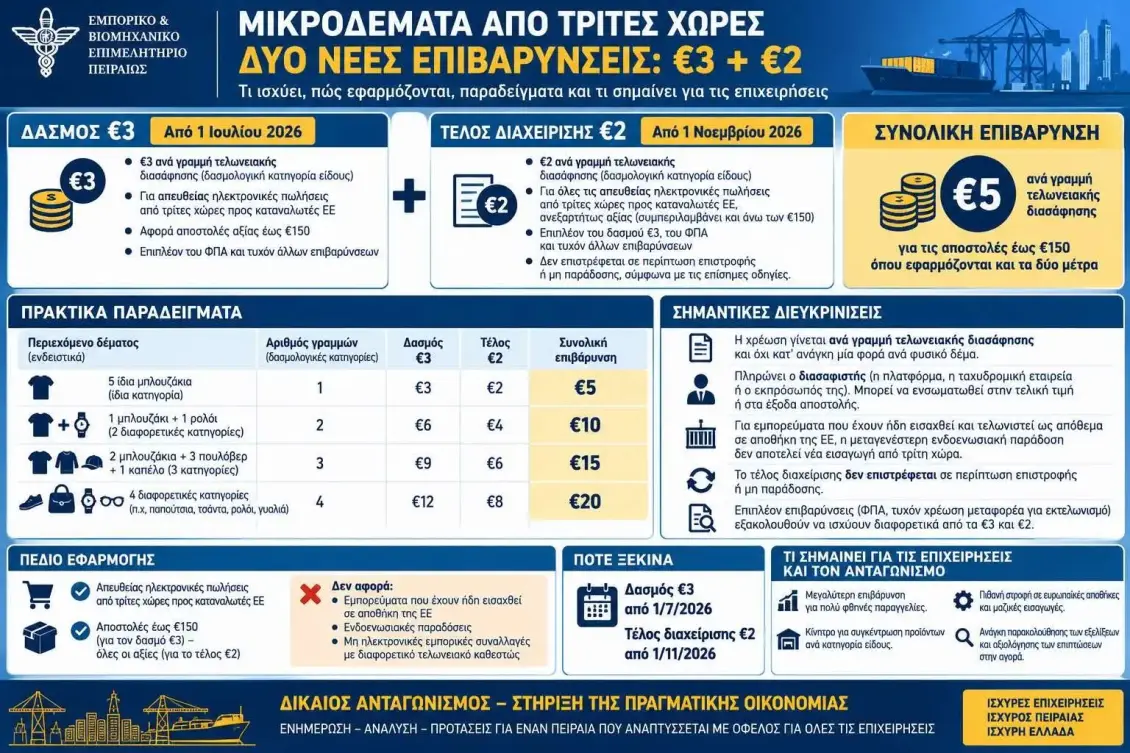
Starting 1 November 2026, a new EU customs handling fee of €2 will come into effect on direct online purchases shipped from non-EU countries to European Union consumers. This amount does not replace, but rather adds to, the existing €3 customs duty that has been in place since 1 July for covered shipments valued at up to €150. This means that for a standard parcel containing a single product category, the total charge amounts to €5. The key detail, however, lies in how the fee is calculated — it is not necessarily charged per physical parcel, but per customs declaration line, meaning per distinct product category included in the shipment.
How the charge is calculated
According to examples provided by the Piraeus Chamber of Commerce and Industry (PCCI), the total charge depends on the number of different product types (tariff categories) included in a single shipment:
- A parcel with five identical T-shirts (same category): €3 duty + €2 fee = €5 total.
- A parcel with one T-shirt and one watch (two categories): €6 duty + €4 fee = €10 total.
- A parcel with two T-shirts, three sweaters, and a hat (three categories): €15 total.
- A parcel with four different product categories: €20 total.
In simple terms, the more varied the order, the steeper the customs cost. A parcel containing two identical pens, for example, incurs a total charge of €5 — but if that same parcel includes a pen, a notebook, and a keyring, the charge can climb to €15.
Who pays and how
The €2 fee is charged to the declarant — that is, the business or representative that submits the customs declaration. Online platforms such as Shein and Temu may incorporate the cost into the final product price or shipping fees. In practice, this means consumers may not need to pay the amount separately upon delivery; instead, it will likely be embedded in the listed price. According to customs guidelines, the fee is applied at the point of import and covers direct online sales from non-EU countries to EU consumers, even when the value of the goods exceeds €150. The €3 customs duty, by contrast, applies specifically to covered shipments valued at up to €150. Importantly, the handling fee is non-refundable in the event of a return or failed delivery.
What is exempt
Goods that have already been imported and cleared through customs as stock held in a warehouse within the EU are exempt from the new procedure, since their subsequent delivery within the Union does not constitute a new import from a non-EU country. The PCCI notes that in order to properly assess the impact on competition, both direct shipments from China and bulk imports into European warehouses should be closely monitored. The new fee was set to take effect on 1 November 2026; as of 20 October, it had not yet begun to be collected.