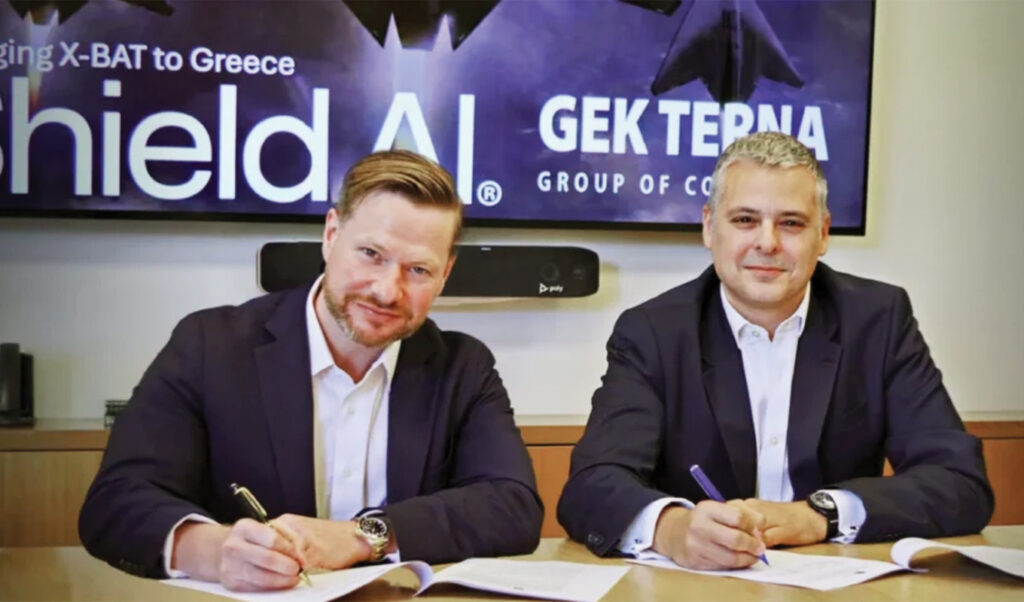
Shield AI and GEK TERNA are laying the groundwork for a new industrial venture in Greece’s defense technology sector, centered on the X-BAT — the unmanned combat aircraft currently under development by the American company. The two groups have signed a strategic agreement to explore the development of production facilities, systems assembly and integration, and long-term technical support for the X-BAT on Greek soil.
Read also: GEK TERNA: Tourism transformation on the Argolic Riviera with hotel and residences
Shield AI – GEK TERNA: Greece’s role in X-BAT production
The agreement confirms a report by powergame.gr, which had previously suggested the possibility of Shield AI establishing a production base in Greece, revealing that the American company was already in discussions with Greek businesses about participation in the X-BAT’s production and support chain. James Lythgoe, Shield AI’s Regional Director for Eastern and Southeastern Europe, had emphasized at the time — speaking to powergame.gr — that Greek industry had already expressed interest in joining the program and that related contacts had begun in early 2026.
One month later, those discussions have taken on concrete business substance. GEK TERNA is now assuming the role of strategic partner to the American company in Greece, tasked with developing and coordinating a domestic supplier network that is expected to include small and medium-sized enterprises. The Greek conglomerate will also take on the operation of a local program management office for the X-BAT.
According to sources familiar with the details of the agreement who spoke to powergame.gr, the goal is to establish the necessary conditions for X-BAT production in Greece well in advance, so that if the Greek Armed Forces decide to proceed with procurement, the production process can begin immediately. Greece’s relationship with Shield AI already has an operational dimension through the V-BAT, which the Greek Armed Forces have already acquired. This existing relationship creates a more favorable foundation for the potential acquisition of the X-BAT as well, though it does not predetermine any decisions regarding a new defense procurement program.
Greece’s industrial readiness
At the heart of the new agreement is the creation of a domestic industrial base that could involve small and medium-sized enterprises, technology companies, component suppliers, and Greek universities. If the plan moves forward, it could generate new highly skilled jobs and strengthen Greek industry’s participation in international defense programs.
In practical terms, the agreement signed in Athens not only opens the door for Greek companies to participate in the supply chain of a new defense program, but also positions Greece to compete for a role as a regional hub for training, maintenance, and technical support serving Cyprus, the Balkans, and Southeastern Europe.
“Given our deep and continuously strengthening relationship with Greece, the X-BAT could ultimately become part of our plans for the country. Greek industry has already expressed interest in participating in the X-BAT’s production and support chain — not just in operating the aircraft — and this is a conversation we are conducting in parallel with our current programs here,” Shield AI’s Regional Director had stated to powergame.gr a month ago.
GEK TERNA’s role and Greek industry
For now, the agreement takes the form of a Memorandum of Understanding (MoU). The precise division of responsibilities, the facilities to be developed, and the specific commitments of both parties will be defined through final agreements that are already under negotiation. Under the framework of the agreement, Shield AI will retain responsibility for the X-BAT program, providing the aircraft’s autonomous flight software and mission systems. The scope of potential Greek participation ranges from component manufacturing and assembly to ground equipment, operational bases and launch facilities, training centers, and maintenance and repair infrastructure. Research collaboration with Greek universities is also included in the plan.
GEK TERNA’s involvement is particularly noteworthy, as the Greek conglomerate is looking to leverage expertise gained from developing, constructing, and managing complex infrastructure projects in a new domain: dual-use defense systems. As Giorgos Kouladis, Investments Monitoring Head at GEK TERNA, notes, the collaboration aims to enable Greek companies to assemble, integrate systems, and provide technical support for the X-BAT in Greece. The ambition, according to him, is for the country to become a center of excellence for training and maintenance of the aircraft serving users across the broader region, while simultaneously creating long-term, highly skilled jobs and strengthening the domestic supplier chain.
Why the X-BAT is of particular interest to Greece
Greece’s selection is also connected to the X-BAT’s operational capabilities. The unmanned combat aircraft is designed to take off and land vertically, without requiring a conventional runway. This capability is of particular significance for countries with extensive island geography, such as Greece, as it enables the aircraft to operate from ships, islands, and remote installations — reducing dependence on large air bases.
The X-BAT is being designed as a long-range combat aircraft capable of carrying weapons systems in internal bays, including munitions of up to 2,000 pounds. Its intended combat radius reaches 1,000 nautical miles, and the aircraft will be able to support electronic warfare, intelligence, surveillance, and reconnaissance missions. It will use GE Aerospace’s F110 engine and Shield AI’s Hivemind autonomous flight software, which is designed to enable mission execution even in environments without GPS or communications.
Flight tests scheduled for 2026
Flight tests for the X-BAT are scheduled to begin within 2026. James Lythgoe directly links the new agreement to Greece’s geographic and defense particularities. As the American company notes in a related announcement, the Greek Armed Forces are already operating Shield AI aircraft over the Aegean, while Greek engineers are already working on the company’s software.
In this context, the X-BAT represents the next step in the partnership. According to Lythgoe, an aircraft that does not require a runway directly addresses the needs of a country that must protect hundreds of inhabited islands. At the same time, GEK TERNA’s experience in managing critical infrastructure is considered a key asset for developing training, maintenance, and technical support facilities that will serve not only Greece but the broader Eastern Mediterranean region.
From V-BAT to X-BAT
The agreement with GEK TERNA is the latest development in Shield AI’s expanding presence in the Greek market. In June 2026, the Hellenic Army signed an agreement to expand its fleet of V-BAT unmanned aircraft, aimed at enhancing maritime surveillance capabilities in the Aegean. During the same period, the American company announced the opening of an office in Athens, reinforcing its physical presence in Greece.
In July, the V-BAT conducted a live demonstration at the inauguration of the Joint Tactical Unmanned Aerial Systems Training Center in Tripoli. In the Greek market, Shield AI has already developed partnerships with EFA Group and ALTUS-LSA, while also seeking to expand the use of its Hivemind autonomy software across unmanned systems operated or developed by the Greek Armed Forces and the domestic defense industry.
The new partnership, however, marks a different dimension of Shield AI’s presence in Greece. The focus is shifting from the procurement and operational use of unmanned systems toward the possibility of domestic industrial participation — with activities that could take on a regional scope. For GEK TERNA, the agreement likewise opens prospects for entering a new field of activity, leveraging its experience in high-complexity technical projects and critical infrastructure.