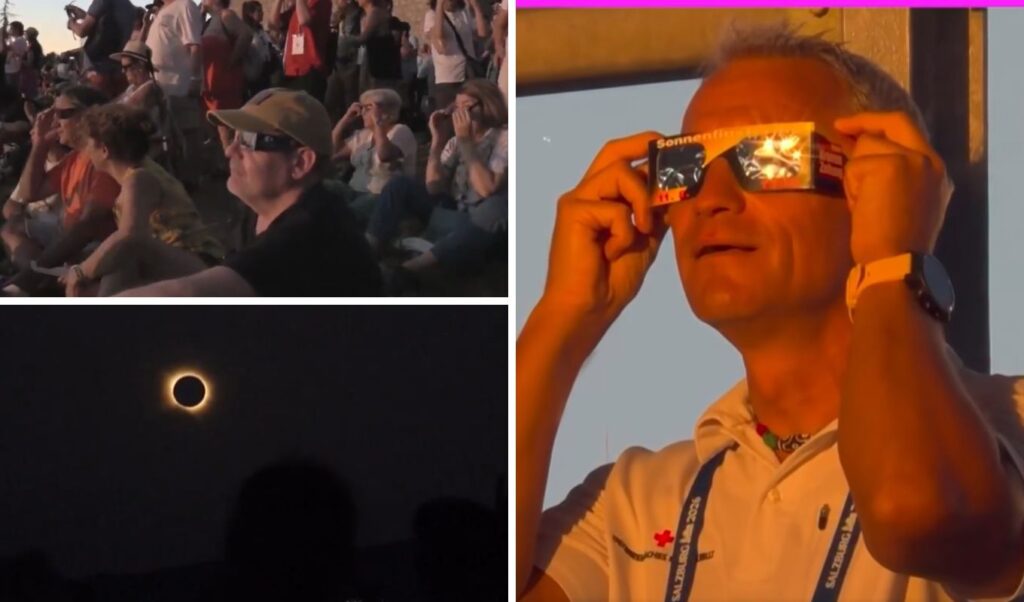
Despite repeated warnings that viewing a total solar eclipse with the naked eye is strictly prohibited due to the risk of serious eye damage, many people ignored the advice. As a result, Google recorded a dramatic surge in searches for the phrase “my eyes hurt” as early as the following day. Many of those who traveled to Spain specifically to witness the total solar eclipse should have taken far greater precautions. On Thursday, August 13, searches for “my eyes hurt” in the United Kingdom skyrocketed by 1,500% compared to the previous day. The spike was even more dramatic in Spain, where “me duelen los ojos” (“my eyes hurt”) recorded a staggering 5,000% increase. Experts had previously warned that serious risks existed, including permanent eye damage and even complete vision loss. They emphasized that any changes — ranging from excessive tearing to headaches — require immediate medical attention.
Read more: Total solar eclipse: The universe’s “miracle” that lasted less than 2 minutes — the phenomenon from ancient times to today
Total solar eclipse: When is immediate medical attention necessary?
Alex Ionides, consultant ophthalmic surgeon at Moorfields Eye Hospital and Moorfields Private, stated that medical attention is essential after staring directly at the sun if any of the following symptoms occur: eye pain, redness, a gritty or irritated sensation, blurred vision, distorted vision, new dark spots in the visual field, or sudden changes in vision. “One of the most common misconceptions is that a partial eclipse makes it safe to look at the sun. In reality, even during an eclipse, the sun remains bright enough to cause damage to the delicate tissues of the eye,” he explained.
“The retina is the light-sensitive layer at the back of the eye that allows us to see. When you look directly at the sun, the intense light and ultraviolet radiation can damage the retinal cells. This condition is known as solar retinopathy,” he noted. “Solar retinopathy can develop even after a brief period of exposure. The damage may not be painful, which means people often don’t realize there is a problem until hours later,” he added.
“Symptoms can include blurred vision, distorted vision, reduced color perception, difficulty reading, or a dark spot in the center of the visual field. In some cases, the condition improves over time, but permanent vision loss may occur,” he warned.