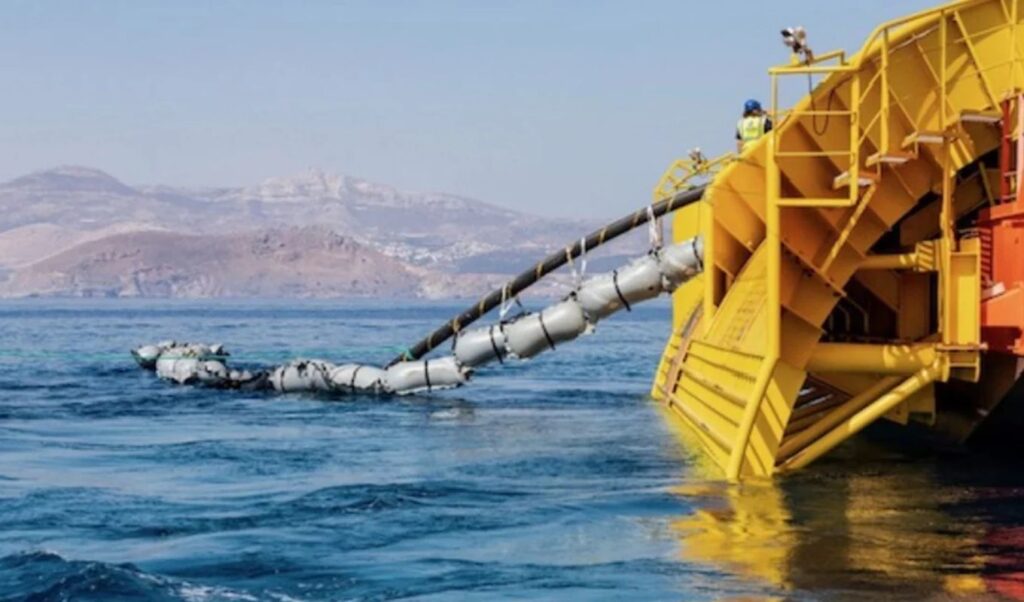
The submission of an investment request by IPTO (Independent Power Transmission Operator) to the regulatory authorities of Cyprus and Israel marks a significant acceleration in the Cyprus-Israel electricity interconnection project, known as the Great Sea Interconnector (GSI). The move was made in accordance with European regulatory framework provisions (TEN-E Regulation), with IPTO acting as the project’s implementing body.
As IPTO states:
This latest development aligns with the Greek government’s steadfast strategy to advance the Great Sea Interconnector as a project of exceptional geopolitical and energy significance for Greece, Cyprus, Israel, and Europe as a whole.
It comes just one week after the signing, at the Maximos Mansion, of the IPTO-Meridiam agreement, which saw the French investment group enter as a majority shareholder in the Great Sea Interconnector company. It also follows a phone call between Greece’s Minister of Environment and Energy, Stavros Papastavrou, and his Israeli counterpart, Eli Cohen, aimed at advancing the Cyprus-Israel electrical interconnection. These successive developments are generating powerful new momentum for the project’s full implementation.
The investment request for the Cyprus-Israel interconnection represents the essential next step under the European regulatory framework, following the completion of the required cost-benefit analyses (CBA) and the proposal for cross-border cost allocation (CBCA).
During the preparation of these studies, an extensive consultation and data-exchange process was carried out with the relevant authorities of both countries, including the respective Energy Ministries, the Cyprus Transmission System Operator (TSO) and Israel’s system operator (NOGA). The aim was to incorporate the most up-to-date assumptions regarding the evolution of electrical systems, electricity demand, renewable energy penetration, and the required infrastructure.
The findings of the studies confirm the project’s economic viability across all analyzed scenarios. In particular, the studies identified the project’s significant contribution to security of supply, renewable energy integration, and the further interconnection of Eastern Mediterranean electricity markets with the European transmission system.
The submission of the investment request is a prerequisite for initiating the evaluation process by the competent regulatory authorities of Cyprus and Israel, with a view to reaching a joint decision on the cost allocation between the two countries — costs that will be recovered through the project’s regulated revenues.
Since assuming the role of Project Promoter for the full scope of the project, IPTO has maintained continuous cooperation with the relevant authorities, transmission system operators, and all other stakeholders in the interconnected countries, with the goal of advancing the necessary technical, regulatory, and financing actions.
Following an agreement between the countries, the Final Investment Decision (FID) will be taken, signaling the launch of the project’s financing procedures. IPTO’s objective is to attract additional investors for the Cyprus-Israel interconnection segment, as was achieved for the first leg of the project — the Greece-Cyprus interconnection — with the entry of Meridiam into the investment structure.
The GSI, designated as a Project of Common Interest (PCI) by the European Union, will have a nominal transmission capacity of 1,000 MW and will consist of a bipolar High Voltage Direct Current (HVDC) system operating at 500 kV. According to the project design, the cable system’s connection point on the Cyprus side will be a Converter Station to be developed at Kofinου, while the corresponding Converter Station on the Israeli side will be constructed in the Hadera area.
The Cyprus-Israel electricity interconnection segment will have an offshore length of approximately 324 km, with laying depths ranging between 2,200 and 2,400 meters. The interconnection will enable bidirectional electricity transmission, allowing for the reversal of power flow direction.
ANA-MPA