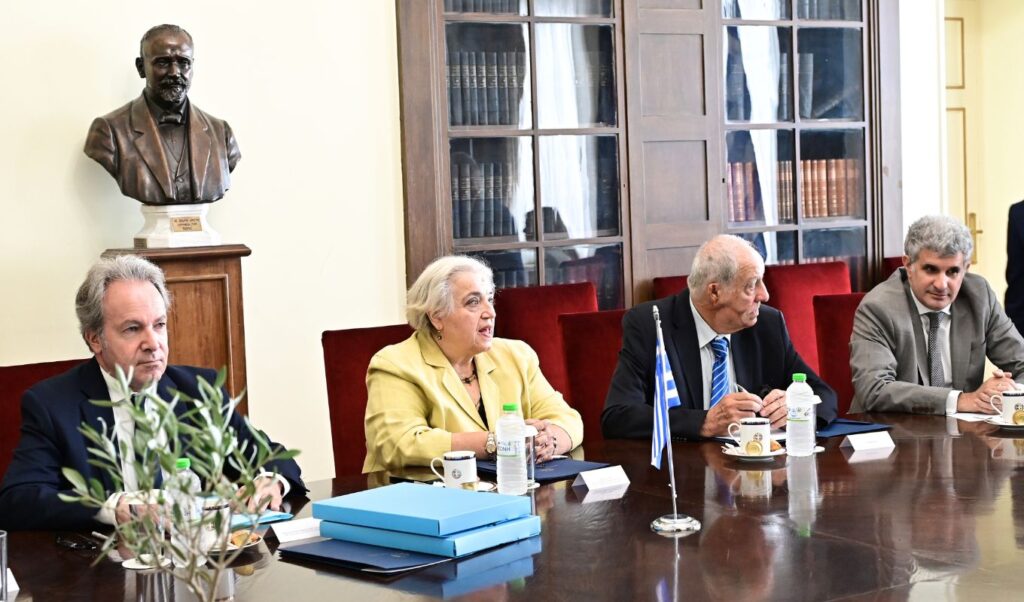
The difficult path toward delimiting maritime zones between Greece and Libya runs straight through the thorny issue of the North African country’s political division, according to reliable diplomatic sources speaking to parapolitika.gr. The third round of technical talks between the two sides, held yesterday in Athens, yielded no substantial convergence on the matter. Despite a shared willingness to make progress, the dominant obstacle to reaching a final and binding agreement remains the absence of unified governmental representation in Libya — a reality that undermines any effort to reach a deal with the Greek government.
Greece-Libya maritime zones talks: The behind-the-scenes picture — what Professor Kostas Ifantis tells parapolitika.gr
Professor of International Relations Kostas Ifantis, speaking to parapolitika.gr, argues that the key question is what options Athens actually has. As he puts it: “The options are either to not engage in talks at all, because there are two centers of power, or to make use of whatever communication channel is available and maintain some form of contact. There is no optimism that we will reach a concrete outcome, but in any case, this is, in my view, the best option for the country — that is, to try to draw Libya into a technical discussion at this stage. This is not a political discussion. The political discussion will come if the technical one advances, in the sense that the issue of the Turkish-Libyan memorandum will then be directly on the table. My view is that we are absolutely right to engage in these talks, because if we don’t, someone else will. Without expectations, I repeat, that we can actually get somewhere — because Libya, at least at this stage, is not going to back away from the Turkish-Libyan memorandum.”
Athens is attempting to navigate an extraordinarily complex geopolitical puzzle. In the technical consultations currently underway, led by acting Deputy Foreign Minister Alexandra Papadopoulou, Greece is laying out the conditions under which convergence might be achieved — either with the Government of National Unity in Tripoli, or with Field Marshal Haftar and his sons, who are based in Benghazi and govern eastern Libya.
Greece’s position has from the outset revolved around three core principles: the firm stance that talks must be conducted exclusively on the basis of the UN Convention on the Law of the Sea (UNCLOS); the demand for full recognition of the effect of Greek islands on maritime boundary delimitation; and the nullification of the 2019 agreement between Turkey and Libya that produced the Turkish-Libyan maritime memorandum. Yet the paradox of holding technical talks amid Libya’s political division creates an unusual diplomatic landscape, forcing Athens to conduct an institutional dialogue with the internationally recognized government in Tripoli — while that same government remains bound to Turkey, which holds it to the legally invalid Turkish-Libyan memorandum.
According to Professor Ifantis, Tripoli distancing itself from Ankara’s influence is not something that appears likely in the near future. As he explains: “It is extremely difficult, because the Tripoli government in particular has made its very survival entirely dependent on Turkey — that is, on the intervention of Turkish armed forces, or at any rate the mercenaries that Turkey has been deploying in the region for many years now to keep the Tripoli government afloat. And the price for that was the Turkish-Libyan memorandum. So, I repeat, it would be a very great surprise if Libya were to back down. Right now, the conditions for that simply do not exist — though no one can be certain what the future holds. Whether, that is, Libya and Tripoli, once they find their footing, will need Europe more than they need Turkey. But all of that is a matter for the future, and not the immediate future.”
Under these circumstances, the strategy being pursued by the Greek Foreign Ministry is clearly reflected in Foreign Minister Giorgos Gerapetritis’s recent moves — including his visit to Benghazi for the opening of the Greek consulate and his reception of Saddam Haftar in Athens last month. Greek diplomacy is thus underscoring the need to keep channels open with both camps in Libya. This approach is considered essential, as a joint referral to the International Court of Justice in The Hague represents the only practical path to invalidating the illegal Turkish-Libyan memorandum. However, the absence of a unified Libyan government capable of ratifying internationally binding agreements leaves every step in a state of uncertainty. Athens is being called upon to walk a tightrope — pursuing an agreement grounded in international law, while simultaneously remaining hostage to Libya’s internal crisis, which for now prevents any definitive resolution of the maritime boundary dispute.