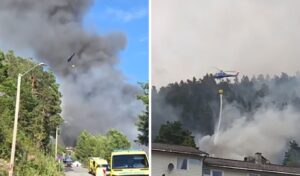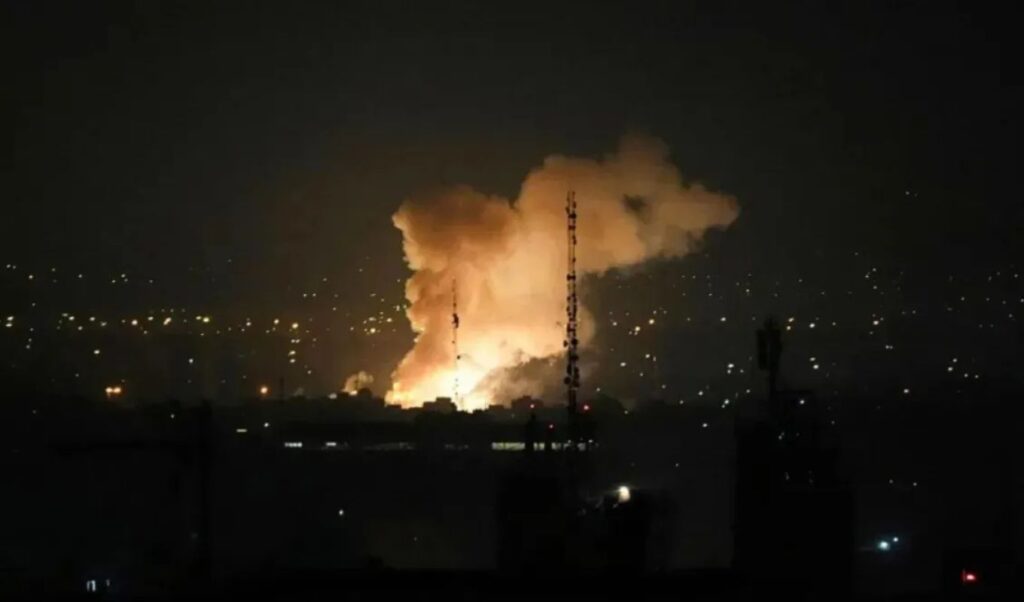
Bombardments across the Middle East continued with unrelenting intensity for a seventh consecutive night, as the United States launched a new wave of airstrikes against Iran, where at least three people were reportedly killed in the country’s southern regions. At the same time, Tehran announced it had struck military targets in Kuwait and Jordan. The US military announced via X on Friday, July 17 (Washington time; 04:39 Greek time on Saturday) that it had “completed” a new wave of strikes against Iran, specifying that it had targeted “surveillance facilities,” “military logistics infrastructure,” “underground weapons depots,” and “naval capabilities.”
Read also: Iran: Revolutionary Guards Strike Commercial Vessel in the Strait of Hormuz (Video)
Authorities in Hormozgan Province, in southern Iran, announced that American strikes resulted in the deaths of at least three people and left eight others wounded, according to the Iranian news agency IRNA via Telegram.
Explosions were also heard across several other areas of southern and central Iran, according to Iranian media. In retaliation, the Iranian military announced it had targeted American military bases in Jordan and Kuwait.
The day before, US armed forces had reported striking “dozens” of targets. Eight people were killed in Friday’s bombardments, according to IRNA.
Iranian authorities reported damage to the power grid in the south and urged residents to reduce their electricity consumption. They also reported strikes against bridges, a port, an airport, telecommunications infrastructure, and a railway station. Washington did not confirm this information.
Iran: Oil tankers “explode”
The Revolutionary Guards, Iran’s ideological military force, announced that two oil tankers “exploded” and “caught fire” after striking mines as they crossed a mined area in the southern section of the Strait of Hormuz. US armed forces denied the claim.
Donald Trump threatened this week to order the bombing of bridges and power plants in Iran if the Islamic Republic’s leaders did not return to the negotiating table.
Tehran would enter a phase of “total offensive” if the American bombardments continued for more than “two or three days,” warned Mohsen Rezaei, military affairs adviser to Iran’s Supreme Leader Mojtaba Khamenei, on Friday.
The Revolutionary Guards warned that their strikes would “continue” until “calm returns to the southern (Iranian) coastline and the Strait of Hormuz.”
“The Strait of Hormuz is becoming a trap for both sides. The logic of escalation is increasingly spiraling out of control,” said David Khalfa, a Middle East expert at the Jean Jaurès Foundation, who expressed concern over the “risk of a broader regional conflict.”
In Kuwait, a power and water desalination plant was struck in an Iranian attack, according to the emirate, which called on users “to rationalize” their electricity consumption “during this exceptional phase” for a country where temperatures are currently reaching as high as 48°C.
“My house was shaking”
In Qatar — a mediating country — the Revolutionary Guards reported targeting the American Al Udeid Air Base, claiming to have destroyed radar systems and military aircraft in order to “punish” the United States. “I was in bed, almost asleep, when I heard the alarm,” Abu Bakr, a 27-year-old Sudanese government employee living in Qatar, told AFP. “I was hoping it would be out over the sea, but then explosions started going off and my house was shaking,” he added, expressing concern that “this war is becoming endless.”
Hostilities resumed on July 7, following attacks on commercial vessels in the Gulf attributed to Iran. The bombardments since then have been the most extensive since a ceasefire was declared in April, and are undermining diplomatic efforts aimed at ending the armed conflict.
The war, which broke out on February 28 with US-Israeli strikes against Iran, has claimed thousands of lives — the vast majority in Iran and Lebanon — and continues to shake the global economy.
Oil prices continue to rise amid the ongoing hostilities. North Sea Brent for September delivery was trading on Friday at $88.10 per barrel (+4.60%). The American benchmark WTI (West Texas Intermediate) for August delivery had reached $82.49 per barrel (+4.48%).
The foreign ministers of China and Pakistan — the latter also serving as a mediator in Washington-Tehran negotiations — urged both sides to resume talks under the framework of the “memorandum of understanding” signed on June 17, which has now been effectively shattered.
Islamabad also renewed its call for “the restoration of normalcy in the Strait of Hormuz,” which Tehran closed again last weekend. In response, Washington announced it was once again moving to blockade Iranian ports in the Gulf.