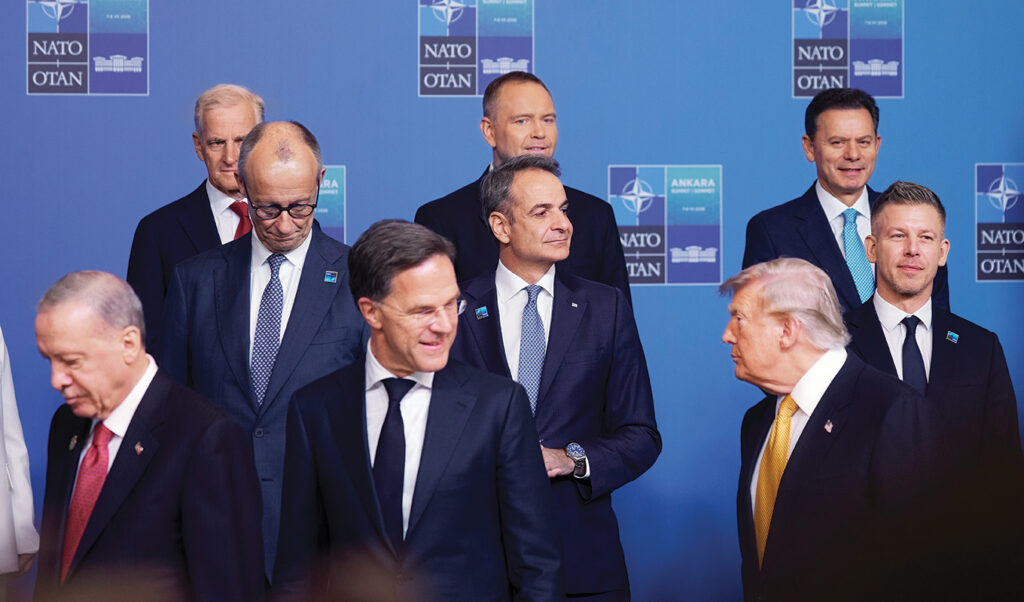
“Expected.” This is the word used by senior diplomatic sources in Athens to describe the outcome of the NATO Summit held in Ankara. Parapolitika reveals what went on behind the scenes and what was said behind closed doors. The diplomatic flirtation between Donald Trump and Tayyip Erdogan did not please Athens — but it did not surprise it either. It was largely considered a given that the US president would speak favorably of his Turkish host, given the well-established personal rapport between the two leaders. However, as a senior diplomatic source told this correspondent, this does not mean it will translate into a “green light” for the sale of American F-35s to Turkey. After all, the US president publicly stated that he has not yet decided whether he will authorize the transfer of the fighter jets.
In any case, the road ahead is long and complex, and the process is very clearly defined. Any party submitting the relevant request to Congress must provide proof that Turkey no longer possesses the Russian S-400 systems and that there will be no future cooperation with Moscow. The scenario being worked on in Ankara involves relocating the S-400s to Gulf states, with Qatar and the UAE reportedly emerging — according to reliable sources — as the top candidates under this compromise formula aimed at lifting CAATSA sanctions.
Either way, Athens makes clear that it is not in a position to dictate US arms policy. It does consider it self-evident, however, that conditions must be attached — namely, guarantees that the weapons will not be used against another NATO member state.
Particularly noteworthy were the remarks made by Defense Minister Nikos Dendias at the Economist conference. Specifically, the minister posed a pointed rhetorical question: “Is it in or against the interests of the United States to provide a platform to a country in the Eastern Mediterranean without the assurance that this program will not be used against another member state?”
F-35s: Greece moves forward — Turkey left waiting
It is worth recalling that Greece has already placed an order for F-35s — 20 aircraft, with an option for an additional 20 — and is currently in Lockheed Martin’s production queue. Turkey, which had been a co-production partner in the program since 2002, has been excluded for the past seven years.
Greece expects to receive its first fifth-generation stealth fighters — aircraft invisible to enemy radar — around 2029, while Greek pilots are set to begin training on the new jets as early as next year. Investments of several million euros are also being channeled into the 117th Combat Wing at Andravida, which will serve as the home base for the F-35s.
On the other side of the equation, Turkey was removed from the F-35 program in 2019, following its 2017 purchase of the Russian S-400 missile defense system — a system it must now somehow divest itself of. Turkey has already paid for a number of aircraft; in fact, six of them have been manufactured and are currently stored in a hangar in the United States. Unlocking access to these aircraft is Erdogan’s primary objective.
Why is he focused on those specific jets? Because even if sanctions are lifted in the coming months and Turkey places a new order, it would not be able to take delivery for another four to five years. As a knowledgeable source put it: “If Turkey placed an order today, it wouldn’t receive the jets until 2030–2031, since Greece, Finland, and Belgium are all ahead of it in the production queue.”
The critical casus belli
Following the conclusion of the Summit, a senior diplomatic source noted that it was critically important that the Greek Prime Minister raised the issue of the casus belli in Ankara — describing it as a “historical anomaly” — and added that unless this threat of war is lifted, there can be no discussion of Turkey’s participation in European defense.
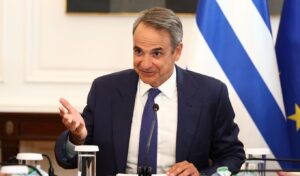
“The problems rooted in the past, the decisions taken by the Turkish Grand National Assembly in the 1990s, simply have no place in today’s world,” said Kyriakos Mitsotakis in response to a question from A Haber.
For his part, Erdogan attempted to downplay the issue, framing it as something largely unknown within Turkey and of no concern to ordinary Turkish citizens.
“It is not diminished by the fact that it is not widely known. We want its definitive withdrawal. If it does not preoccupy domestic public opinion in Turkey, then it should be all the easier to rescind,” the same diplomatic source remarked.
The Mitsotakis–Erdogan tête-à-tête
Upon the leaders’ arrival at the Summit venue, Prime Minister Mitsotakis held a brief tête-à-tête with NATO Secretary General Mark Rutte, as well as with President Erdogan, during which he is reported to have thanked the Turkish president for his hospitality and the flawless organization of the event.
Government sources noted that Turkey, as the host country, was exemplary in its treatment of the Greek delegation — just as Greece is when Turkish officials visit Athens.
As for the Ottoman military march played before the leaders’ dinner, it was clarified that the piece was performed upon the arrival of all leaders, not exclusively for any particular delegation.
No substantive discussion on Greek-Turkish relations took place — neither during the brief meeting between the two leaders nor during the equally brief tête-à-tête between the two foreign ministers.
The broader conversation regarding the one core dispute between the two countries — the delimitation of the continental shelf and the Exclusive Economic Zone (EEZ) — has yet to begin.
“No progress has been made, because we disagree. We say we have one problem, while Turkey speaks of interconnected issues. If the leaders decide they want to sit down at the negotiating table, they will. But for that to happen, technical, diplomatic, and legal groundwork is required — groundwork that has not been done, because we disagree,” competent circles told this correspondent.
*Published in Parapolitika