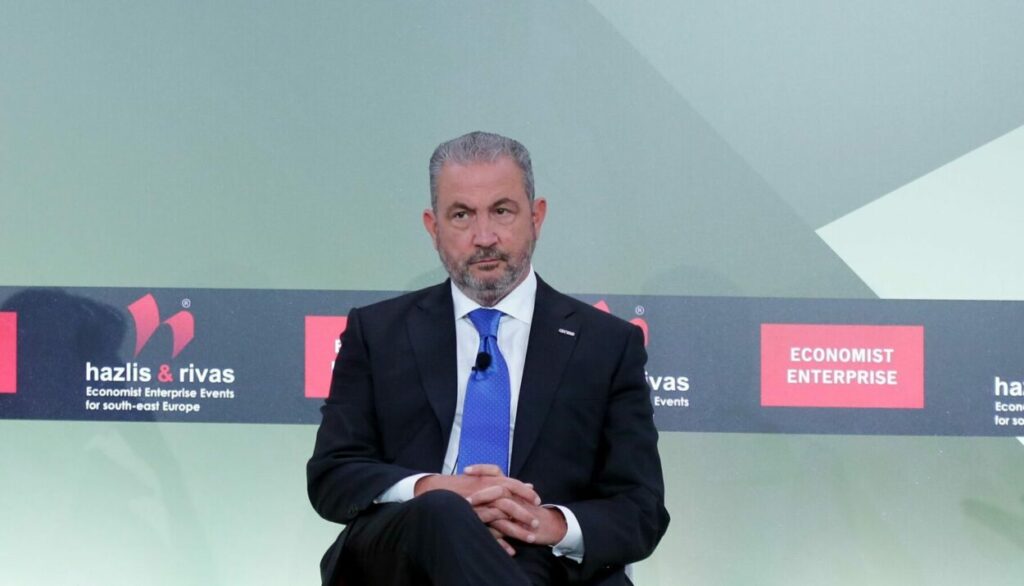
Energy security, Europe’s need for strategic autonomy, Greece’s role as an LNG hub, and the new investment momentum of the Greek economy took center stage at the intervention of Alexandros Exarchou, Chairman and CEO of the AKTOR Group and CEO of Atlantic SEE LNG Trade, at the 30th Annual Government Roundtable of the Economist.
Mr. Exarchou emphasized that “energy is security.” As he noted, this was proven by the war in Ukraine, when the European Union was confronted with the consequences of its excessive dependence on Russian natural gas. In his analysis, Moscow exploited Europe’s energy dependence as a pressure tool — exposing, in the harshest possible way, the limits of a supply model built on a single dominant source.
He stressed that the European Union received a “very powerful lesson” for both the present and the future, but offered pointed criticism of how it has responded. As he put it, Europe “now reacts rather than prevents” and is learning from its mistakes the hard way. The real challenge, in his view, is not simply replacing one dependency with another, but achieving genuine balance across energy sources.
Alexandros Exarchou’s intervention at the Economist conference
In his address, Mr. Exarchou warned that it would be equally misguided for Europe to abandon its dependence on Russian natural gas only to fall into exclusive dependence on American LNG. “If we leave one dependency to enter another, it will be just as wrong a choice,” he said, describing diversification, geopolitical balance, and Europe’s ability to hold its own at the table of major powers as the central priorities.
In his view, the European Union must reclaim its seat in major geopolitical negotiations. As he pointed out, today’s major players are the United States, China, and Russia — and Europe, unless it develops a unified strategy and the capacity for timely decision-making, risks becoming a spectator of events rather than a shaper of them.
His criticism extended to European energy policy more broadly. Mr. Exarchou made clear that he does not oppose the green transition or the development of renewable energy sources. On the contrary, he described green energy as a critical tool for Europe’s energy autonomy. However, he pointed out that it cannot be the only path to energy security — especially when the associated costs are passed on to businesses and citizens.
As he put it, Europe cannot choose “the most expensive electricity in the world” simply because it wants it to be green, without taking into account the competitiveness of its economy. If the European Union wants to pursue a high-cost policy, he added, it must also have the financial capacity to sustain it. Otherwise, it will need to make compromises until it acquires the economic strength to impose such a model in the future without undermining its productive base.
The Vertical Corridor and Greece’s role
Against this backdrop, Mr. Exarchou positioned Greece as “one step ahead,” primarily due to the Vertical Corridor. As he explained, the development of the Vertical Corridor concept gives Greece the ability to transport significant volumes of American LNG to Europe at a time when the continent urgently needs new, reliable supply routes and sources.
According to him, from 2027 onwards, when the trading of Russian natural gas will no longer be permitted within the European framework, the need for alternative volumes will become even more pressing. Combined with geopolitical turbulence and constraints affecting other suppliers, Mr. Exarchou noted that the most reliable source of LNG at this moment is the United States.
He clarified that the Vertical Corridor is not a concept that emerged in recent months, but an idea that has been in development for years. However, as he explained, the shift in American policy in the region and the geopolitical changes of recent months have made the project far more essential for Europe. In this context, Greece already possesses critical infrastructure — such as the Revythoussa terminal and Alexandroupolis — which can support the corridor’s operation.
He also made special reference to Atlantic SEE LNG Trade, the company established in partnership with DEPA Commercial, noting that it demonstrates the commitment and dedication to creating the commercial conditions necessary for the Vertical Corridor to function. As he emphasized, securing long-term contracts is “the only way” to achieve genuine balance in Europe’s natural gas supply sources.
Issue-specific alliances
Mr. Exarchou insisted that the European Union must develop greater flexibility in its international alliances. As he noted, strategies shift according to geopolitical developments, the demands of the moment, and the interests at stake in each case. If cooperation with the United States is needed on one issue, Europe must be able to choose it. If cooperation with China is required on another, it must be equally capable of pursuing that path.
The prerequisite, as he put it, is having both the political will and the decision-making mechanisms in place. The European Union must know what it wants, be able to decide in a timely manner, and act in the common interest of both the Union and its member states. Otherwise, it risks remaining trapped in delayed reactions while the major powers move faster.
The need for European champions
Connecting geopolitics with economics, Mr. Exarchou also addressed the question of business scale. As he noted, the AKTOR Group may be considered a large conglomerate by Greek standards, but Greek-scale businesses remain small relative to the international economy. For this reason, rather than national champions — a concept he said he had heard discussed — Europe needs “European champions.”
In his view, only through the creation of larger European business entities will EU companies be able to compete with American and Chinese firms at the scale they currently command. Otherwise, Europe will continue to fall short in terms of scale, capital, and strategic influence.
The new face of the Greek economy
In the final part of the discussion, Mr. Exarchou spoke extensively about the Greek economy, which he described as living through “historic moments.” He outlined a dramatic shift in the investment climate compared to the years of the crisis. As he recalled, there was a period when merely mentioning Greece was enough to end a conversation with foreign investors. This was followed by a transitional phase in which investors would listen but not act. Over the past year, however, he observed “strikingly serious interest” from foreign capital willing to take on Greek risk.
The critical distinction, he emphasized, is that this is no longer just debt financing — it is equity investment, meaning investors are putting their own capital into Greece and taking on the risk of the Greek economy directly. This, he said, is something he has not seen at this level of intensity before. Today’s investment landscape, in his view, is the result of efforts made over the past seven to eight years, as well as the opportunities that emerged following the very low levels of the previous decade.
Mr. Exarchou argued that Greece has reached a stage where private investment can gradually replace tools such as the Recovery and Resilience Facility. This, he said, is the proper foundation for economic growth: an economy that stands increasingly on its own feet and relies less on external financing mechanisms.
AKTOR’s footprint
In this environment, the AKTOR Group is presented by Mr. Exarchou as a conglomerate that both follows and capitalizes on this new phase of the Greek economy. As he explained, the group is growing and expanding because it finds opportunities in a country that has returned to the investment radar of the international economic system.
Referring to the group’s areas of focus, he highlighted energy, renewable energy sources, concessions, and construction — the group’s core activities — while also mentioning ongoing discussions around investments in the circular economy. Although he noted that tourism is not currently a central pillar of AKTOR’s strategy, he expressed confidence that this sector will continue to attract serious interest from foreign investors.
In closing, Mr. Exarchou expressed strong optimism about the Greek economy, provided that political stability is maintained, that the progress achieved to date continues, and that private capital attraction remains a priority. As he put it, if Greece manages to sustain this momentum, it can lay the foundations for the “next generation of the RRF”: an economy that stands on its own feet rather than relying on external support.