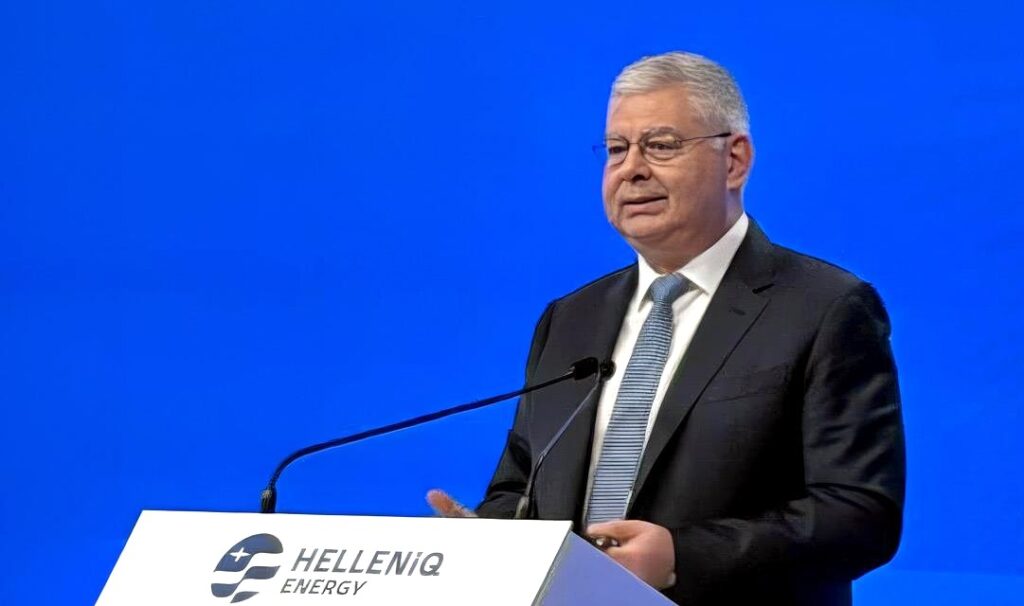
If all goes well, by the next general shareholders’ meeting in 2027, we will have the results of the drilling in Block 2 (NW Ionian) and seismic data from areas south of Crete and the Peloponnese, noted HELLENiQ Energy’s CEO, Andreas Siamisis, speaking today at the company’s annual general shareholders’ meeting.
Mr. Siamisis highlighted the partnerships with American energy giants Exxon and Chevron in the field of exploration, efforts that he said began years ago and ensure proper risk management. “Given that a drilling operation like the one in ‘Block 2,’ scheduled for early 2027, costs between $60 and $100 million, if we were to carry out 10 drillings, we would need $1 billion,” he stated. He also added that the company will seek an extension of the exploration period for the “Ionian” block, west of Epirus, which remains the only block where HELLENiQ is currently the sole shareholder.
Andreas Siamisis: Criticism of the EU’s stance on hydrocarbon investments
He emphasized strongly that despite electrification and energy transition policies, hydrocarbons will remain part of the energy mix — accounting for 32% by 2050 — as global energy demand continues to rise. “Those who think hydrocarbons have no future will run out of energy,” he stated pointedly.
Presenting the company’s trajectory over recent years, he noted that it has more than doubled in size compared to 2024 “without asking shareholders for capital — something we may need to do at some point.” He outlined the company’s strategy for the coming years, stressing that over the next 5 to 10 years, the target is to increase operating profitability (EBITDA) to €1.5 billion, up from €1 billion today. This goal will be achieved through investments in both refineries and hydrocarbon exploration, as well as in renewable energy sources and natural gas.
Mr. Siamisis made extensive reference to the company’s contribution to ensuring energy security during international crises, in contrast to other European countries that faced supply issues — particularly with aviation fuel. On the topic of prices, he emphasized that Greek consumers do not face higher energy prices than the European average, “without suggesting that energy is cheap or that there is no ‘prices rise fast, fall slow’ phenomenon.”
Finally, he criticized the EU’s ambiguity regarding hydrocarbon investments, the high operating costs imposed on industry players by the European regulatory framework, and the delays in licensing, spatial planning, and permitting in Greece for investments in renewable energy and battery storage.