Deputy Transport Minister Konstantinos Kyranakis is implementing a comprehensive plan to strengthen Athens’ urban transport, with the primary goal of addressing the shortage of bus drivers, a problem that has been a roadblock to improving services in recent years. OSY now employs 2,820 drivers, compared to approximately 2,300 a year ago, with the goal of reaching 3,000 by the end of 2026, marking the highest staffing level in recent years.
This initiative addresses a chronic challenge that affects not only Greece, but almost all of Europe. Despite investments in new buses, fleet renewals and modern mobility services, finding sufficient numbers of professional drivers remains the most difficult challenge for public transport. An aging workforce, increased mobility needs and mass retirements have created significant staff shortages, which in many European cities lead to reduced services and service degradation.
Within this environment, strengthening OSY’s human resources is a key priority for the Transport Ministry, aimed at more frequent route execution, improving passengers’ daily experience and creating a more reliable and modern urban transport network.
For years, Athens was no exception. The problem lay not only with the fleet or infrastructure, but also with human resources. Hundreds of drivers left OSY in previous years due to retirements and other reasons, creating a persistent gap that directly affected the ability to execute routes. When Kyriakos Mitsotakis set upgrading Athens’ urban transport as a central goal, the discussion was not limited to procuring new vehicles. Strengthening human resources was recognized as a prerequisite for all other interventions to pay off. For the first time, the driver issue was addressed as a strategic priority rather than just another administrative matter.
Kyranakis: 3,000 drivers by end of 2026
In this context, Deputy Transport Minister Konstantinos Kyranakis undertook to implement a plan with clear objectives and measurable results. Today, OSY already employs 2,820 drivers, compared to approximately 2,300 it had a year ago. The goal is for this number to approach 3,000 drivers by the end of the year, the highest level in recent years.
The significance of this number is not accounting-based. It’s operational. Each new driver means more available vehicles on the road, more routes, shorter waits at stops and greater reliability for passengers. It means that the new buses acquired in recent years can be fully utilized for the benefit of the traveling public.
Monthly bonus of 150 euros serves as incentive to attract drivers
An incentive to attract drivers is the monthly bonus of 150 euros that active drivers receive regardless of their salary. The intervention is part of the overall plan to strengthen OSY with new staff and aims to meet the increased needs of transport operations, contributing to improving the frequency and reliability of services.
What stands out in the new strategy is that it’s not limited to traditional hiring. Instead of exclusively seeking ready-made professional drivers in a market already facing serious shortages, OSY is attempting to create its own pool of human resources through the new model driver training school. The school offers subsidized training for obtaining a professional driving license while simultaneously opening the path to immediate professional placement in urban transport. This is a model that for the first time systematically connects education with employment and aspires to address the problem at its root.
Over 500 applications for OSY’s model driver school
The interest recorded so far is considered particularly encouraging. Within a short period, applications exceeded 500, confirming that the driving profession is regaining attractiveness when accompanied by stable working conditions, modern training and clear career prospects.
Interventions made in the transport work environment play a decisive role in this development. The signing of new collective labor agreements at OSY and STASY, improved compensation and the overall effort to upgrade working conditions were critical factors in attracting new staff. Government officials note that for the first time in many years, a coherent framework is being formed that allows workers to view urban transport as a stable and attractive career choice.
The Transport Ministry believes that the battle for transport in the next decade will be decided less by vehicles and more by the people who staff them. And while just a few years ago, the shortage of drivers was the biggest obstacle to upgrading urban transport, today it’s gradually evolving into one of their key progress indicators.
For the government, achieving the goal of 3,000 drivers is the prerequisite for turning recent years’ investments into tangible results for hundreds of thousands of citizens who use public transport daily. And perhaps for the first time in many years, this bet appears to be absolutely achievable.
Comprehensive checks to address abusive sick leave practices
Alongside hiring and operating the model driver school, the Transport Ministry proceeded with comprehensive checks to address abusive sick leave practices that were depriving transport services of staff.
The checks concerned approximately 700 bus drivers who were off duty for long periods. According to data presented by Konstantinos Kyranakis, many cases revealed that employees claiming inability to work at OSY were normally employed in tourist agencies or other professional activities.
The intervention had immediate results. Approximately 150 drivers have already returned to active duty, strengthening staff availability and contributing to increased services. Disciplinary procedures were also initiated where deemed necessary.
9-minute intervals for model lines expanding to 20
Results are already becoming visible in passengers’ daily experience. The 15 model bus lines implemented in the previous period show noticeable improvement in time intervals during peak hours compared to a year ago. The program now expands to 20 lines, aiming for improvement to acquire permanent characteristics and affect an increasingly larger part of the network.
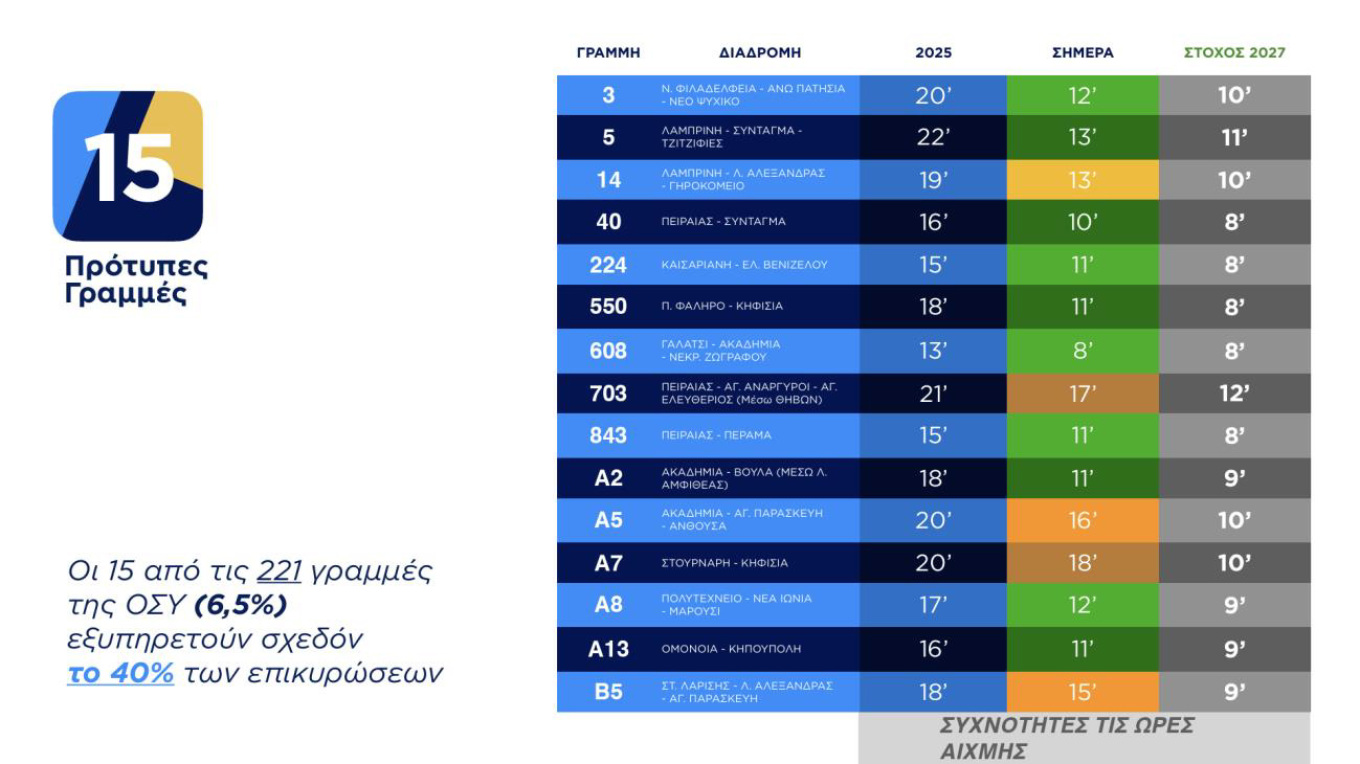
The improvement is already reflected in passengers’ daily experience, with noticeable reduction in waiting times on model lines, a factor connected both to increased vehicle availability and operational network reorganization.
Specifically, on the 15 model lines, which serve almost 40% of the transport network’s validations, average waiting time has already decreased from 20 to 12 minutes with a final target of 8 minutes during morning peak hours.
For example, line 550 has gone from 18 minutes to 11 today, with a target of 8 minutes. Similarly, line 608 has already reached 8 minutes from 13 minutes.
Another critical factor is added to this effort: protecting bus lanes. Implementation of the new Traffic Code and gradual development of a camera system to monitor illegal parking and illegal entry into exclusive traffic lanes is expected to further improve route speed and consistency. For the first time, fleet strengthening, driver increases and protecting bus traffic are being addressed as parts of the same plan.