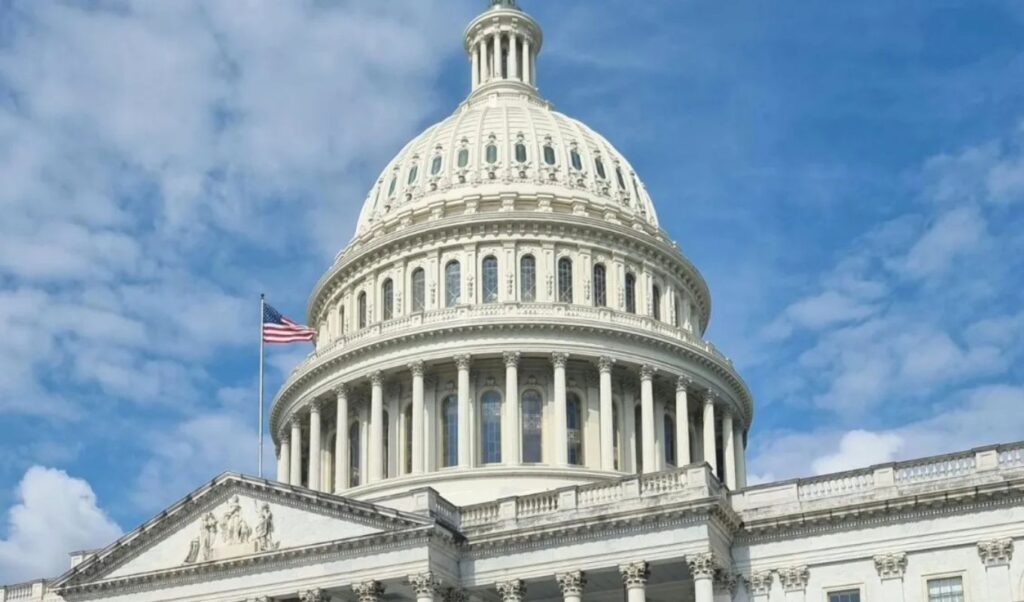
The various aspects of Turkey’s “authoritarian drift” were the focus of a special hearing held Wednesday at the Tom Lantos Human Rights Commission of the House of Representatives. The hearing, titled “Can Turkey find its way back to freedom? The consolidation of authoritarianism versus defending Turkish democracy,” highlighted that Turkey’s trajectory is viewed in Washington not only as a human rights issue, but also as a matter of judicial independence, free elections, regional stability and the credibility of a NATO ally.
In this context, a series of issues were examined ranging from the deterioration of the rule of law and political persecutions, such as the detention of Istanbul mayor Ekrem İmamoğlu, to cases of censorship and systematic restrictions against religious minorities.
According to the Committee’s briefing materials, Turkey has been classified by Freedom House as “Not Free” since 2018, with the situation described as worsening. Particular reference was made to the arrest of İmamoğlu in March 2025, shortly before his expected presidential candidacy, which has raised serious concerns about judicial independence and the integrity of future elections.
“Turkey an unfree state after 2016 – Institutions serve as tools for Erdoğan’s political survival”
Henry Barkey, senior fellow at the Council on Foreign Relations, argued that the arrest of the Istanbul mayor and the indictment of hundreds of his municipal colleagues mark “the most aggressive use of prosecutorial power against electoral competition in the history of the Republic.”
Barkey described Turkey as a personalist regime, arguing that since 2016 the country has transformed into an unfree state. As he stated in his testimony, Turkish state institutions, from courts and prosecutors to the electoral commission and central bank, have been reshaped to function as tools for President Erdoğan’s political survival.
Particular reference was made to interventions in the Republican People’s Party. Barkey argued that the annulment of the party’s 2023 congress results was aimed at causing internal crisis in the opposition and diverting it from the electoral process.
The discussion extended to the instrumentalization of justice. Barkey highlighted Ankara’s refusal to comply with European Court of Human Rights decisions, citing as characteristic examples the cases of Osman Kavala and Can Atalay. As he noted, by late 2025 Turkey was violating more than eighty unexecuted ECHR decisions, as well as a comparable number of decisions from its own Constitutional Court.
The hearing also addressed press freedom. Barkey noted that Turkey ranks 159th among 180 countries in Reporters Without Borders’ World Press Freedom Index, while arguing that the disinformation law has become a tool for prosecuting journalists and restricting public criticism.
The Committee also focused on political prisoners and the targeting of Kurdish politicians. According to the hearing’s briefing materials, human rights defenders estimate that more than 15,000 political prisoners remain imprisoned in Turkey, including journalists, lawyers, elected officials, academics, civil society leaders and democracy activists.
Barkey’s testimony states that the Turkish state systematically accuses opposition leaders, especially those defending Kurdish rights, with charges related to undermining state unity. In this context, reference was made to imprisoned former HDP leader Selahattin Demirtaş.
The most politically sharp statement came from Michael Rubin, policy analysis director at the Middle East Forum think tank and senior researcher at the American Enterprise Institute. Rubin argued that the human rights situation in Turkey deteriorated over the past year also due to Washington’s stance. In his assessment, President Donald Trump and his close advisors have given Erdoğan the impression that he will not face consequences for human rights violations.
References to genocides, the Ecumenical Patriarchate and Halki Theological School
Rubin also criticized US Ambassador to Turkey Tom Barrack, arguing that his public stance is interpreted in Ankara as a sign of tolerance. At the same time, he connected internal repression in Turkey with issues of historical revisionism, genocide denial and protection of religious minorities.
Showing particular interest in Greece, Rubin referenced the genocides of Armenians and Pontic Greeks, the Ecumenical Patriarchate, Hagia Sophia, and Halki Theological School. He argued that if Turkey does not allow the Greek community to appoint its own clergy without interference or arbitrary restrictions on entry permits, the United States should respond with sanctions.
The human dimension was highlighted by Serkan Gölge, former political prisoner in Turkey and scientist who worked on NASA programs. Describing his arrest after the 2016 coup attempt, he noted that his case began with an anonymous complaint that presented him as connected to a terrorist organization and implied he wasn’t actually working for NASA, but for the CIA.
“In my case, the accusation came first. The so-called evidence followed,” Gölge said, presenting his case as an example of a system where, as he put it, collective guilt replaced individual proof.
Serkan Gölge further argued that his case was political in nature and connected to diplomatic negotiations between Ankara and Washington. “I don’t use the phrase hostage diplomacy lightly,” he said, adding that “a judicial file became a diplomatic folder.”
The Committee’s briefing materials also mention growing concerns about transnational repression against critics of the Turkish government living outside Turkey, as well as restrictions affecting the Ecumenical Patriarchate of Constantinople and Halki Theological School.
The hearing was not limited to documenting violations, but also posed questions about what policy options the US and Congress have to support democracy and human rights in Turkey. As characteristically emphasized, this is no longer an internal issue concerning Turkey exclusively, but a matter connected to Western cohesion, as it involves an ally accused of steadily moving away from the democratic principles championed by the NATO alliance.
ANA-MPA