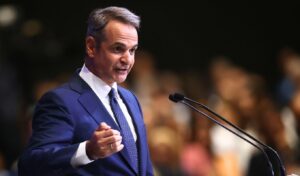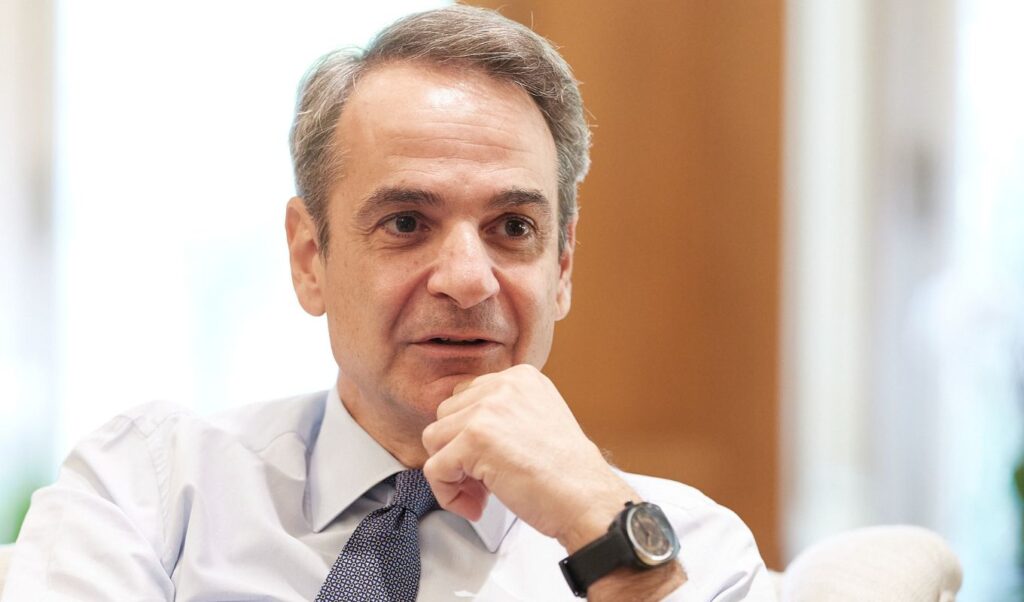
The government’s focus turns to the Balkans over the next 48 hours, as Kyriakos Mitsotakis travels to Sofia, where at 11 a.m. he will meet with the country’s newly elected prime minister, Rumen Radev (who has been president from 2017 to 2026). This will be followed by an expanded meeting of delegations from both countries, after which the two leaders will make statements to the press.
Subsequently, the Greek prime minister will travel to Tivat, Montenegro, where he will attend a dinner hosted by Montenegro’s president, Milo Djukanovic, for European Union leaders and Western Balkan leaders on the occasion of Montenegro’s national anniversary celebrations, on the eve of the EU-Western Balkans Summit.
Mitsotakis in Sofia: Focus on energy interconnections and the vertical LNG corridor
The importance Greece places on relations with neighboring Bulgaria amid geopolitical challenges for Europe and the broader region is signaled, according to government sources, by Kyriakos Mitsotakis’s brief visit to Sofia and his meeting with Mr. Radev. As they note, the prime minister is among the first European leaders to meet with Mr. Radev in his new capacity, following the formation of the new government in Bulgaria.
Greece and Bulgaria, as they emphasize, are neighboring countries, partners and allies in the EU and NATO, with significant cooperation and prospects for synergies in energy and transport connectivity projects (Vertical LNG Corridor), projects important for both countries, but also for the energy security of Central and Eastern Europe. They also recall that Greece recently, responding to a related request from Sofia to address potential threats, actively strengthened Bulgaria’s air defense, creating a “security umbrella” in the region.
Theodorikakos: Bulgaria among Greece’s most important economic partners
“Our cooperation constitutes a strong pillar of stability and an important hub for trade, energy and investment in the region. Something even more important today, as the war in Ukraine and the crisis in the Middle East create uncertainty throughout the region. Energy security, in particular, is at the core of this stability,” emphasized Development Minister Takis Theodorikakos from Sofia, where he was on Monday. As he said, Bulgaria is one of Greece’s most important economic partners and in 2025 bilateral trade reached 6.05 billion euros, marking a 6.2% increase compared to the previous year.
Deputy Minister of Environment and Energy, Nikos Tsafos, speaking to journalists in Athens, spoke of the intense export character of the Greek electrical system to neighboring markets, particularly to Bulgaria, as reflected in cross-border trade data during May.
From Sofia to Montenegro for the EU-Western Balkans Summit
In Montenegro, European Council President Antonio Costa and European Commission President Ursula von der Leyen will be present. The leaders of the “27” are expected to assess the progress made regarding the gradual integration of the Western Balkans into the EU and ways to further promote it, especially through the development plan for the Western Balkans. They will also discuss ways to strengthen cooperation on foreign policy and security and defense policy issues, particularly by strengthening Western Balkan armed forces through the European Peace Facility and increasing cooperation through partnerships and dialogues in the security and defense sector.
Greece, as government sources emphasize, consistently supports EU enlargement as an investment in security and stability. It maintains the position that this is a process that depends on the performance of each candidate member state. This is a difficult process that requires reforms and compliance with the prerequisites of the accession process.
The Greek position on Western Balkan integration into the European Union
Regarding Western Balkan partners, our country’s standing position is that the future of the Western Balkans lies in the EU. Greece steadily supports their accession prospects, provided they meet the conditions and prerequisites, particularly good neighborly relations, respect for fundamental rights and adherence to binding international agreements. Specifically regarding Albania, Kyriakos Mitsotakis has noted on several occasions that issues concerning the protection of the Greek national minority, securing their property rights, and the right of self-determination are not bilateral issues, but matters concerning Albania’s relations with the European Union.
The European prospect of the Western Balkans constitutes, as the same sources note, a priority with the horizon of the Greek Presidency of the Council of the European Union in the second half of 2027.