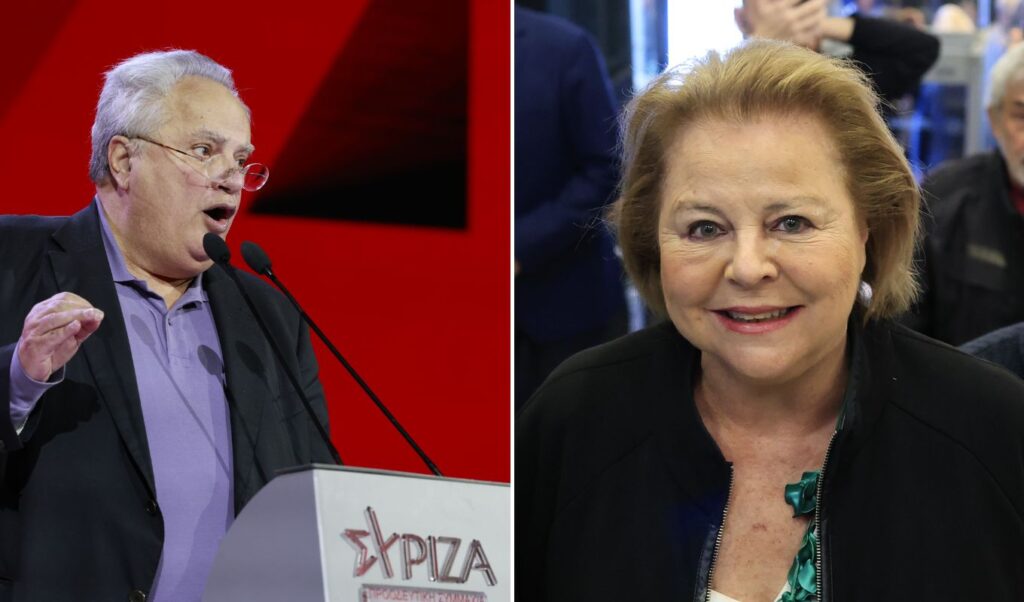
Numerous scenarios are circulating recently about how SYRIZA members who don’t join Alexis Tsipras’ party, Nikos Kotzias and PRATTO party, as well as Louka Katseli, will be politically represented in the upcoming elections.
The fact that SYRIZA officials, with Sokratis Famellos’ approval, are participating in events for Left unity, where Nikos Kotzias and Louka Katseli also participate, has sparked considerable discussion. Some even argue that those remaining in SYRIZA prefer Nikos Kotzias to lead the new venture, though it remains unclear whether they’re discussing party cooperation or something entirely new.
They note that Rena Dourou appears to align with this initiative. Until recently, she hadn’t revealed her position, but now she’s saying that “Kotzias has created a roadmap for SYRIZA” and that she’s bothered by some putting their parliamentary seats up for auction. She added that it’s illogical for some to talk about SYRIZA’s self-dissolution, emphasizing that “we’ll discuss progressive alliance in the Central Committee.”
Finally, she called on everyone wanting to join another party to surrender their seats.
Nikos Kotzias’ post about the party system, oligarchy and the Left
Meanwhile, on Saturday, Nikos Kotzias made a social media post discussing the party system, oligarchy, and the Left.
Among other things, he stated: “After Greece’s transition to democracy, the two-party system of PASOK and New Democracy dominated. Subsequently, due to the crisis of Greek capitalism and parliamentarism, the major parties shrank. In the new two-party system, where one pole wasn’t systemic, SYRIZA replaced PASOK. The Tsipras government, despite being slandered and facing difficulties, maintained SYRIZA at 32%, losing only 140,000 votes.
Conversely, between 2019-2023, SYRIZA shrank to almost half its votes, losing a total of one and a half million votes. The defeat’s causes were multiple: SYRIZA’s insufficient defense of its governmental work, leadership’s practical refusal to provide substantial opposition, the shift from cooperating with progressive smaller organizations to collaborating with Right-wing figures like Antonaros, Spilioptopoulos, Kyrtsos, and Loulis.
The fairy tale that the Prespa Agreement was to blame for the unprecedented defeat – a 2018 agreement judged in 2019 – was manufactured to cover the leadership’s heavy responsibilities for opposition deficiencies. SYRIZA of those years had approved over 75% of New Democracy’s bills and policies. SYRIZA didn’t fail as government. It failed as opposition.
The Oligarchy, unlike the Left, has learned from the difficult decade of 2009-2019 for both itself and the country. One of its main lessons was that it’s not enough to own the main party of the two-party system and certain smaller ones, but should also support and control as much as possible whatever party forms the official opposition. This is confirmed by carefully recording the communication games from oligarchs’ channels and the major support flows they provide. The usual corruption cronies help with this, along with a new breed, ‘leftist lackeys,’ who take care to tarnish the image, even with fake news, of those who don’t join these schemes. On this basis, the oligarchy wants a New Democracy government, controlled in cooperation with PASOK segments. It also wants a non-anti-systemic official opposition.
2. The oligarchy
The basic goal of that part of the oligarchy wanting to change New Democracy’s current leadership is to unify parties under the banner of (simply) ‘Mitsotakis must go.’ However, the fight against Mitsotakis alone doesn’t constitute proof of progressivism. The same goal is held by New Democracy’s internal opposition, the far-right, and party formations preparing to cooperate with New Democracy, with the intended justification that they forced New Democracy to change its potential prime minister.
Let me put it differently. Is Greece’s problem only Mitsotakis or the entire system that dominates and governs the country? The core of this power is the partnership of political elite, today primarily Mitsotakis and his circle, and the social-economic oligarchy controlling everything in the country, which has prioritized its interests. It promotes savage redistributions of income and property. It ensures super-profits for itself and poverty for others. It prevents the country from utilizing its productive, dynamic, and talented segments.
The country’s oligarchy controls an overwhelming part of the economy and public revenues. It treats the state as spoils and the country’s wealth as its dowry. It doesn’t make productive investments that would ensure competitiveness, employment, and national development, but ‘simply’ tries to control banks, shipping, and energy, often on behalf of third parties. The Oligarchy controls major channels and radio stations, nationwide press, most teams with large popular bases, many cultural sectors. These are producers of corruption and degradation of the country’s values and principles. Therefore, the power complex of oligarchs and Mitsotakis must be defeated to stop Greece’s decline.
3. The Left
The central issue of the Left’s struggle for a new Greece, for national regeneration, is breaking the existing power partnership and advancing the country on the path of freedom and rights, liberation and emancipation. The militant Left considers necessary the removal of Mitsotakis from power and breaking the Oligarchy complex, as the homeland faces the danger of historic-scale retreat – social, economic, political, and international. To prevent this requires battle against interests cooperating with Mitsotakis and every mitsotakis. The battle for national regeneration was never an easy walk, a charming single-person adventure. Quite the opposite. It’s a difficult collective struggle requiring strategy, force concentration and cooperation, ethics, ideas, and strength with boldness.
It’s clear that I look to this Left, fight for it, believe in it. And surely all this isn’t expressed by those who don’t speak of social opponents, homeland dangers, the need for its regeneration, or who limit the Left to union issues.
PS. I’m certainly not represented as Left by those who vilify the national resistance and democratic struggle participants as ‘gang members’ and refuse to take it back. I’m not represented by Loverdos’ former closest advisors. I’m not represented by those who organized the Prespa incidents and characterized the Agreement as treason without retracting it to this day. I’m certainly not represented by those who voted for Stournaras as Bank of Greece governor and renewed his term. All these coexisting today in the same party space cannot constitute the Left of my heart. Leftists have character and soul. They’re fighters with ethos. Not everything in life is negotiable!”
This text received considerable reactions, with Left voters criticizing him with the logic that if SYRIZA runs in elections cooperating with other parties, this will cost Alexis Tsipras.
Nikos Kotzias responded sharply that “corruption schemes are ‘helped,’ as usual, by its cronies, but also a new breed, ‘leftist lackeys,’ who take care to tarnish the image, even with fake news, of those who don’t join these corruption schemes. And here they are today, the lackeys showed up again. What do they tell us? That I’m preparing a party, that I’ll be party leader, that because of me they’ll lose the election victory. Did they ask me if these are my intentions, like normal journalists do? But what am I asking? This is what lackeys do. But the funniest thing is that relatives and friends connected to the space using these lackeys started commenting, dripping poison and engaging in campaigns based on news carried by a ‘lackey,’ as it apparently stopped feeling like a journalist and undertook to be a little steamboat.”