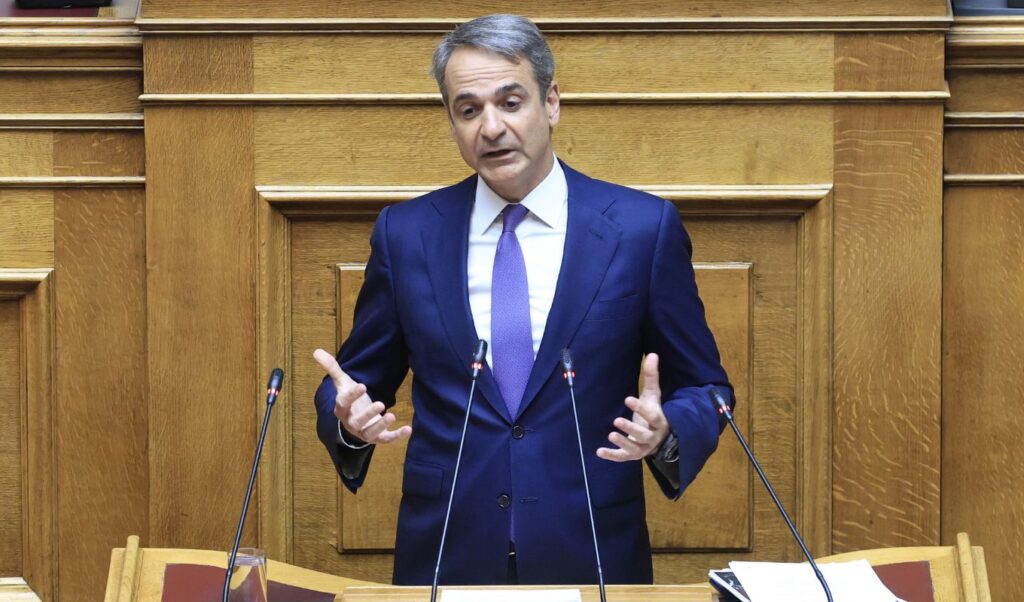
The hour of the Parliamentary Group meeting for New Democracy arrives tomorrow Thursday, and Kyriakos Mitsotakis is reportedly ready to reveal his cards regarding the Constitutional Revision, which he will present extensively at the ND congress on May 15-17 in Athens. Tomorrow’s session is also expected to feature the government party’s rapporteur on the constitutional revision discussion, Evripidis Stylianidis, who will explain some of the key changes to be proposed.
What the Maximos Mansion expects from the ND Parliamentary Group session
Many more MPs will take positions, some will express objections and concerns on a series of issues – like those expressed by five MPs in their joint article in “Nea” a few days ago – however, the current assessment at the Maximos Mansion is that the discussion will move within measured frameworks and there will be no tensions or extreme expressions.
The Constitutional Revision timeline
Regarding the Constitutional Revision, a two-month period preceded where approximately fifty ND MPs submitted written proposals on specific articles, which were “very refined and high-level,” as a government official with knowledge of the process notes. About 20 more communicated their thoughts and ideas orally, resulting in a core of proposals, some of which will be incorporated into the final recommendation that ND will present to Parliament in the Constitutional Revision Committee, which will likely be established at the end of May.
This will be followed by discussion in the Plenary and – as Article 110 of the Constitution stipulates – voting on the articles to be revised “in two votes separated by at least one month.” If procedures move relatively quickly, both votes could be completed by October.
Constitutional Revision: “Restart of Democracy” Mitsotakis’ message
The Prime Minister has already hinted at major institutional changes that will mark “the restart of the Greek Republic.” In tomorrow’s ND Parliamentary Group session, he will analyze the rationale behind the major institutional changes he will propose to the Constitution and will emphasize that the majority’s proposal took into account the documented proposals submitted by nearly half the party’s MPs, who participated in this informal intra-party consultation.
The “hot” issue: Minister-MP incompatibility
The proposal expected to provoke the most lively discussion within the ND Parliamentary Group is the one regarding minister-MP incompatibility, with replacement of the minister in Parliament by the first runner-up for as long as they participate in the Ministerial Council and simultaneous enhancement of the MP’s role.
The “institutional leap forward,” however – as Mr. Mitsotakis has characterized it – includes many more interventions and changes to at least 25 Constitution articles, which may ultimately reach thirty. Such changes include amending Article 16 to allow not only the establishment of branches as already happens, but also the founding of new non-state universities. Also, constitutional provision of the state’s obligation to ensure affordable housing, adding reference to artificial intelligence in the Constitution to protect individual freedom and serve society’s welfare, and securing the possibility of postal voting.
Articles 86 and 90: Major institutional reforms
Two much-discussed articles in the public sphere are Article 86 on ministerial responsibility and Article 90 on selecting Justice leadership. With the changes ND will propose, ministers will be prosecuted by decision of a collective judicial body – possibly the Supreme Court Prosecutor’s Office – and not by Parliament as happens today, while promotions to supreme court presidencies will be made by a special Parliamentary Committee, choosing among the three most senior vice-presidents, without government intervention. The institutional reforms that the government majority will propose to Parliament will also touch on civil service tenure, so that it connects with target-setting and specific effectiveness.
Electoral system on the table: Scenarios for after 2030
Regarding the electoral system, which has already caused discussions and reactions within New Democracy, government sources note that ND – with implementation after 2030 – will propose an honest discussion about which electoral system best serves the country’s needs: About the advantages and disadvantages of preference voting, about the fact that when a minister holds ministerial office while simultaneously thinking about re-election, this calls into question the separation between executive and legislative power, and about the logic of a mixed system with smaller and larger constituencies.