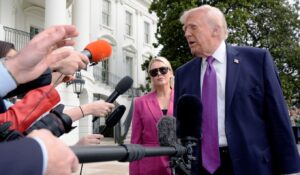
Matthew Boyle, director of the Washington bureau of Breitbart News, is perhaps the journalist who has conducted the most interviews with ministers and officials of the Trump administration – as well as with the US president himself, who regularly reads the influential American conservative website. He came to Greece to participate in the 11th Delphi Economic Forum and spoke to “Parapolitika” about Greek-American relations and the Middle East war.
Nearly two months have passed since the first American-Israeli attack on Tehran. Who is winning and who is losing this war, first on a military level?
It is absolutely clear that the United States is winning this war on a military level. The Ayatollah was neutralized from the first night, most of Iran’s supreme leadership has been eliminated, and Iran’s Navy and Air Force have been decimated. The United States achieved this completely without ground forces, with the sole exception of the extremely successful rescue operation of the pilot and aviator whose aircraft was shot down. This operation was a spectacular success, particularly for the American intelligence community and specifically the CIA, as well as for all involved, and demonstrates the superiority of the United States Armed Forces against any adversary. According to all indications, Iran’s ability to continue its nuclear ambitions and ballistic missile programs has suffered possibly irreparable damage, beyond any possibility of recovery.
And now, on a political level?
The political dimension is much more complex. Domestically in the United States, there is a radical Left that has prevailed in the Democratic Party – thus, the opposition to the ruling party is guided by extreme elements, which we often point out suffer from what we call “Trump derangement syndrome.” Most critics of the president cannot even give him credit when he achieves something exceptional, like this or the Venezuela operation, where within hours one of the world’s harshest dictators, Nicolás Maduro, was captured to face justice literally overnight. Therefore, the opposition will never give the president credit. Additionally, there is war fatigue in American public opinion – and rightfully so. In recent decades, presidents from both parties have shown excessive willingness for military interventions in regions like Iraq and Afghanistan, resulting in the public viewing with great skepticism any American president pursuing military objectives anywhere in the world, especially in the Middle East. However, the president had stated from the beginning that this would last four to six weeks, and the ceasefire was achieved within that timeframe, with a margin of two days. It will become apparent in the coming days, as negotiations with Iran continue, how the situation will be finalized, but according to all indications, it appears that President Trump has once again achieved something almost miraculous, against all odds, as he usually does.
President Trump has hinted that he intends to make a visit to the Greek capital soon
What are the main factors affecting Greek-American relations today?
The main factors affecting Greek-American relations today are connected to the pillars of President Trump’s policy: geopolitical security, trade imbalances, cultural challenges, and economic uncertainty. Greece has emerged during Trump’s second term as one of the most effective allies of the United States in Europe – if not the most effective – partly because it is on the front line of all these issues, historically, since ancient times. Greeks have keen awareness of cultural threats on a global level – the Orthodox Church functions as a pillar of stability in an unstable world – given that, as a people, they emerged from Turkish occupation of Greece with their independence, which came not much later than that of the United States. Greece’s recent exit from its economic and financial crisis also brings to the forefront of Greek thinking what can happen if radical, extreme leftists take power and implement extreme liberal policies. Additionally, the country’s geopolitical position makes it a gateway to Europe from the Middle East and Far East. It is no coincidence that Xi Jinping visited Greece during Trump’s first term, highlighting the port of Piraeus as the “dragon’s head”: Greece will play, from a geopolitical perspective, a significant role in shaping the world’s future. That’s why the United States is now funding Elefsina as a counterweight to Piraeus, as they realize how critical the importance of these ports and sea routes is. The Greek-owned fleet carries approximately 25% of global LNG, and Trump understands energy better than any modern American president.
Could Donald Trump schedule a visit to Athens in the coming months and for what purpose?
The president, I think, has hinted that he intends to make it happen soon, possibly focusing on the above issues. Making such a visit on the occasion of the 250th anniversary of the United States would also be ideal, as Trump could highlight the importance of Athenian democracy in shaping an effective governance system by the founding fathers of the United States.
The Turkish government is seeking reintegration into the F-35 program. Do you think it can succeed? What is the general state of relations between President Trump and President Erdogan?
It’s interesting that this was the main question I received last year here in Delphi, and my answer was to watch what Trump does, not what he says. A year later, Turkey still has not been reintegrated into the F-35 program. Trump may speak positively about Erdogan, as he does about Xi Jinping or Vladimir Putin, but the question is whether he actually concedes anything substantial in practice. I recommend people look at the tangible results of policy and not the fluctuations in the president’s statements. The president uses all available tools in negotiations – for him, everything is a negotiation. After all, he has written a book about it, so we must focus on the result and not the process regarding the “art of the deal.”
Published in Parapolitika