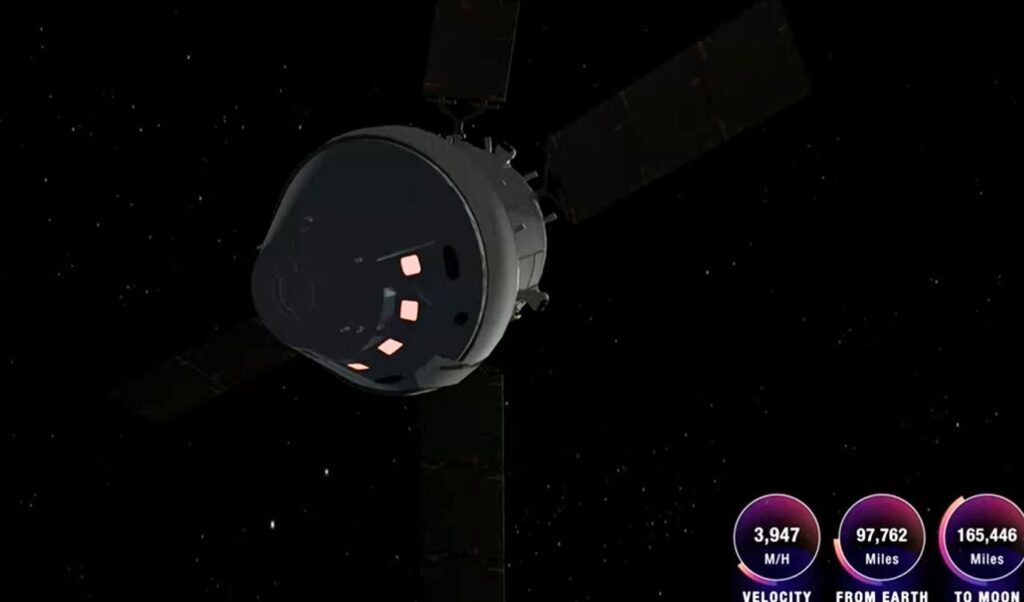
The total number of humans who have traveled to the Moon and safely returned to Earth is expected to reach 28 on Friday evening, when NASA’s Orion capsule, carrying four astronauts from the Artemis II mission, will splashdown in the Pacific Ocean with the help of three large parachutes. The scheduled arrival at 5:07 p.m. Pacific time (3:07 a.m. Saturday Greece time), off San Diego, will mark the completion of a ten-day lunar journey. The three American and one Canadian astronaut thus become the first humans to venture beyond Earth’s low orbit since the last Apollo mission in December 1972.
Read: Why the Artemis II return to Earth is the mission’s most dangerous phase (Video)
Artemis II: The Moon is truly its own unique body in the universe
It will also mark a new beginning for the American space agency and its international partners, following a highly successful test flight around the far side of the Moon that, at first observation, appears to have fulfilled every one of its objectives. NASA has proven it can once again safely send humans to and from cislunar space, the void between Earth and its nearest celestial body, and will build upon the knowledge gained to advance the Artemis program toward a planned crewed lunar landing in 2028, 56 years after the last one.
The rest of humanity, meanwhile, received reminders over more than a week during which the world seemed to unite in a rare moment of unity to enjoy stunning high-resolution video and images of the lunar surface – and Earth from afar – as well as some profound and heartfelt words from usually unemotional astronauts as they described what they saw. “I just had an overwhelming sense of emotion looking at the Moon,” said NASA astronaut Christina Koch about her first impressions from Orion’s closest approach on Monday, 6,545 kilometers above the lunar surface.
“The Moon is truly its own unique body in the universe. When we have that perspective and compare it to our home Earth, it just reminds us how much we have in common. Everything we need, Earth provides, and that, by itself, is like a miracle.”
Koch became the only woman to travel to the Moon and return during a mission full of firsts. Jeremy Hansen of the Canadian Space Agency became the first non-American. Victor Glover, Artemis II’s pilot, became the first person of color to do so.
Success for the first splashdown from the Moon in fifty years
On the “professional” side of the mission, the astronauts evaluated Orion’s life support systems, radiation detectors, next-generation spacesuits, and tested other functions that will be critical for future deep space missions and NASA’s long-term plans for the Artemis program, including an ambitious $20 billion Moon base to be built within a decade.
The agency views the first splashdown of a crew returning from the Moon after more than five decades as a significant next step. While not as visually spectacular as the fiery launch on April 1st from Florida’s Kennedy Space Center that sent Artemis II to the skies, the landing required a similar level of complex planning, precision, and execution.
A sequential deployment of Orion’s 11 parachutes at various altitudes was designed to slow the spacecraft to 523 kilometers per hour, then to 209 kilometers per hour, before the three main parachutes, with their canopies spanning a total of 73 meters, deployed for further deceleration to a 27 kilometers per hour splashdown.
Recovery crews from the Coast Guard and NASA have been positioned to cover a landing zone approximately 885 kilometers in diameter. After medical checks, hatch opening, and a brief stop at a San Diego military base, the crew’s next destination is Houston’s Johnson Space Center, which they last saw on March 27th, and reunion with their families.
Nicky Fox, associate administrator of NASA’s Science Mission Directorate, summarized the mission’s significance and impact in a briefing with reporters this week.
“Our four Artemis II astronauts, Reid, Victor, Christina, and Jeremy, took humanity on an incredible journey around the Moon and brought back images so exquisite and full of science that will inspire future generations,” she said.