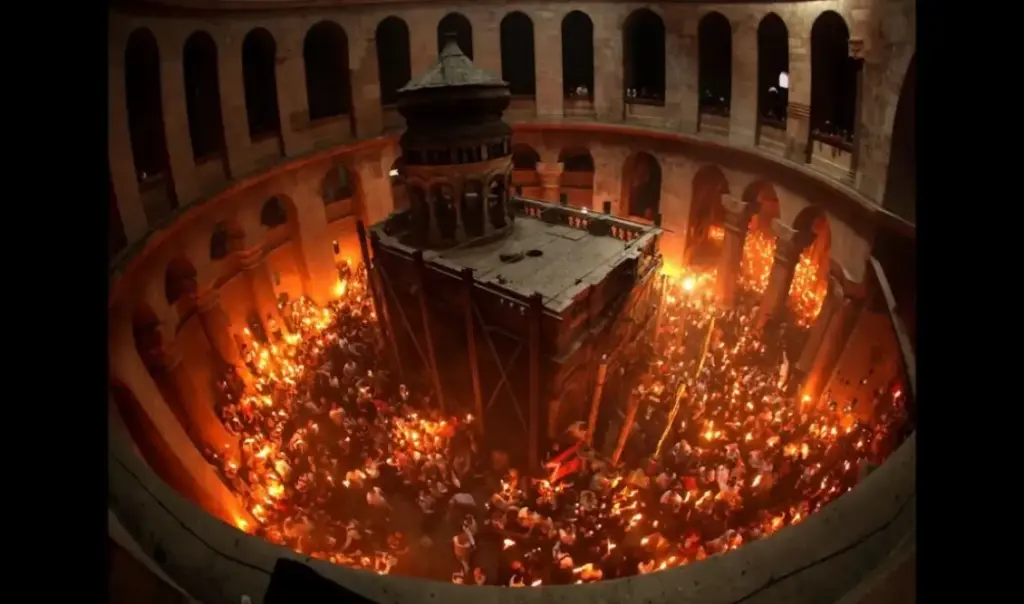
The Greek Ministry of Foreign Affairs is in constant communication with Israel’s Ministry of Foreign Affairs, seeking the optimal solution for the Holy Fire to reach Greece on Easter evening. There are two basic prerequisites: the ceremony of lighting must take place normally at the Holy Sites, and then the safe transport of the flame must be ensured.
According to the plan that has been formulated, on Saturday a five-person mission will depart with a government aircraft to Israel. This delegation will include, among others, the Exarch of the Holy Sepulchre in Athens and Deputy Foreign Minister Yannis Loverdos. The schedule is to land at Tel Aviv airport, collect the Holy Fire, and return to Athens within a few hours. The prerequisite is that Israel’s airspace remains open.
Holy Fire: Plan B and the red alert scenario in the Middle East
Otherwise, Plan B will be activated. This, according to sources, provides for either the government aircraft to land in Egypt and the Greek mission to travel by road from Sharm El Sheikh to Jerusalem, or to fly to Jordan and travel by road from Amman to Jerusalem.
However, if the situation in the region remains on red alert, there is also the possibility that none of the above will happen, that the Greek mission will not travel to Israel, and the Resurrection service will be conducted in Greece “with last year’s Holy Fire,” which is preserved in oil lamps in several churches in Athens and throughout the country.