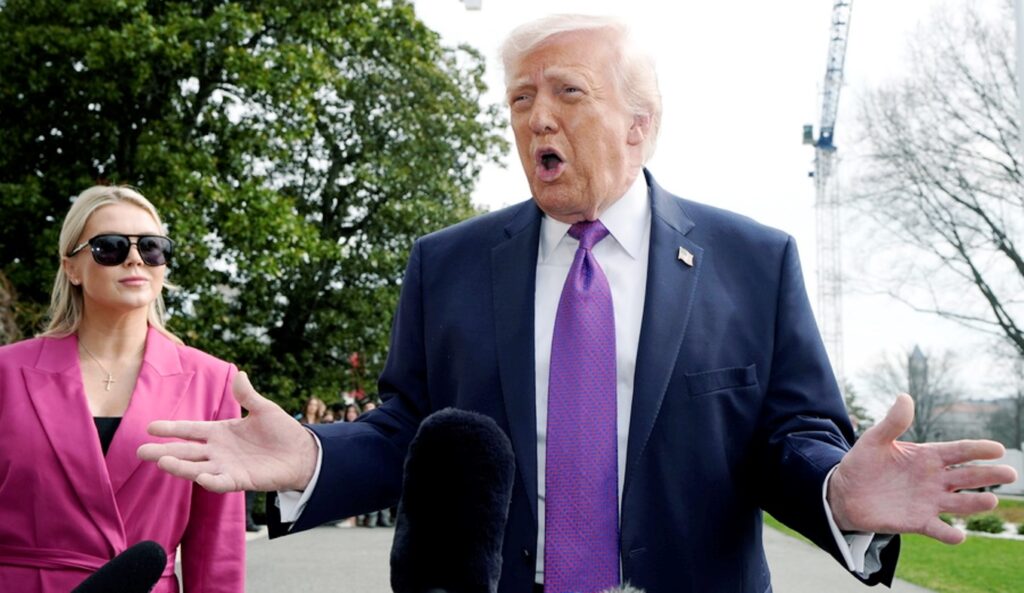
Donald Trump appears to be weighing his next moves against Iran in an environment of extreme tension, with Axios revealing that the Pentagon is examining all military options for a “final strike,” should diplomatic efforts fail to yield results. The essence of American planning, as described, is that Washington wants to end the war from a position of absolute strength, seeking to dismantle Tehran’s nuclear program, strike its ballistic capabilities, and crush the leadership of the Iranian regime and the Revolutionary Guards. The report, citing two American officials, describes a scenario where not only massive bombardments are discussed, but even the use of ground forces. Nevertheless, the same picture shows that Trump remains cautious about the ground intervention scenario, which is treated more as an extreme alternative rather than a first choice. The weight, at least at this stage, falls on strategic points that can break Iran militarily, economically and geopolitically, with the Strait of Hormuz and the islands that control access to the region as the primary backdrop.
Read: Netanyahu: “We continue to strike Iranian terrorist regime targets dynamically” (Video)
According to Axios, if diplomatic efforts for peace do not pay off, then a generalized escalation of attacks is on the table. Officials are reportedly arguing that an American attack with all available forces could either immediately change the negotiating power in Trump’s favor or allow him to demonstrate his “achievements,” exerting even greater pressure on Tehran. On the other side, Iran has made it clear that the only one who can bring an end to the war is the Iranian regime itself, a position that shows how deep the conflict is and how difficult the field remains for real understanding. Within this atmosphere, the report gives particular importance to the four basic military options being examined as levers of pressure and overturning the given facts on the ground.
Trump’s 4 options for Iran
The first option described is the invasion or blockade of Kharg Island, which serves as Iran’s main oil export hub. This is a move that would have immediate economic impact, as it would strike one of the most critical points of the Iranian energy mechanism. The second option concerns an invasion of Larak, an island that helps Iran consolidate its control over the Strait of Hormuz. Axios notes that on this strategic island there are Iranian fortifications, attack boats that can blow up cargo ships, and radar that monitors movements in the maritime area. The third option relates to seizing the strategic island of Abu Musa and two smaller islands, which are located near the western entrance of the Strait and are controlled by Iran, but are also claimed by the United Arab Emirates. The fourth option is the blockade or seizure of ships exporting Iranian oil on the eastern side of the Strait of Hormuz.
All four of these options have a common denominator: controlling vital energy and supply routes, as well as targeting key points that give Iran strategic depth and the ability to threaten. Simply put, American planning appears to seek not just military attrition, but cutting Tehran off from critical economic and geopolitical pressure tools.
The ground intervention scenario and Tehran’s distrust
The report also mentions that the American military has already prepared plans for ground operations deep inside Iran. However, sources close to Trump insist that this scenario remains “hypothetical,” as he wants to avoid it. This dimension is very important because it shows that even in the hardest American camp there is awareness of the enormous cost and risk of a ground invasion. Nevertheless, the same sources make it clear that Trump is ready to escalate attacks if negotiations do not produce results. White House Press Secretary Caroline Levitt warned that Donald Trump is ready to strike “harder than ever” if no agreement is reached.
At the same time, several American fighter aircraft and thousands of Marines are expected to arrive in the Middle East within the next few days, reinforcing the image that the US is not only sending messages, but also preparing real operational ground. From the Iranian side, the talks are met with great suspicion. Iranians believe that negotiations may simply be Trump’s ploy to attack by surprise and neutralize top Iranian officials. Nevertheless, Pakistan, Egypt and Turkey continue to try to organize a meeting between the two sides. In fact, according to a source involved in efforts to start negotiations, Iran may have rejected the initial list of US demands, but did not completely rule out negotiations. This exact detail is what keeps open, albeit marginally, a window of de-escalation at a moment when everything seems to be pushing toward the next, much more dangerous stage.