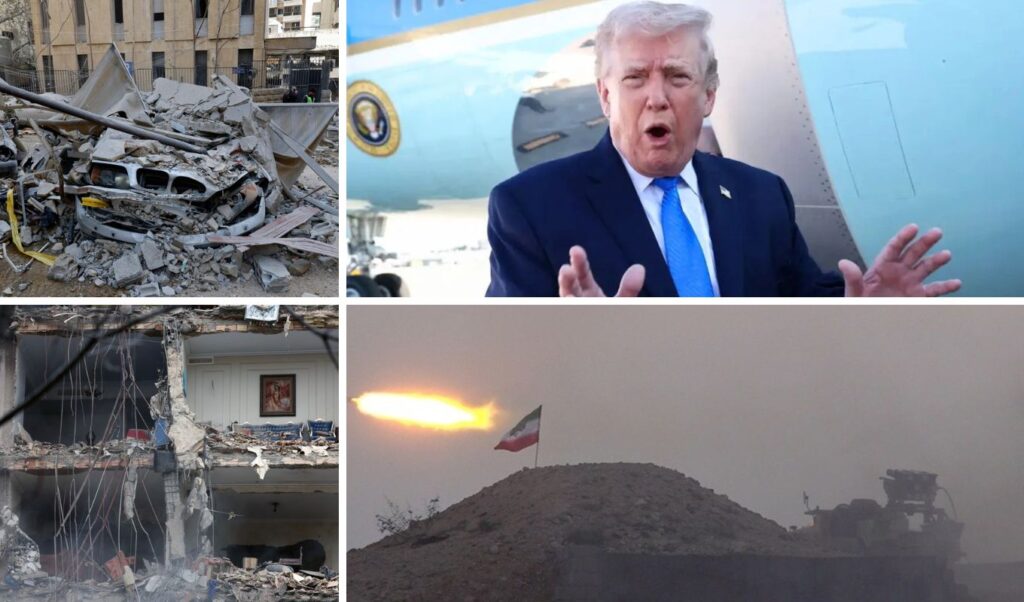
War rages in the Middle East, with mutual strikes from Israel and Iran, as well as heavy Israeli strikes against Lebanon, while diplomatic processes appear to be intensifying – though Tehran categorically denies this – at least based on developments across the Atlantic. Meanwhile, military pressure doesn’t seem to be “off the table,” according to American media reports, while oil remains above $100.
Iran’s armed forces launched a new barrage of missiles against Israel in the early morning hours today, state television reported. “Iran launched a new missile barrage against the occupied territories,” state radio and television IRIB reported via Telegram.
Explosion in Jerusalem following warnings of missile barrage launches from Iran – 30 drones shot down in Saudi Arabia
A powerful explosion was heard in Jerusalem following a second warning from the Israeli military about the launch of another missile barrage from Iran on Monday night to Tuesday, reports an AFP correspondent.
The Israeli military reported that missiles were fired at northern Israel and that anti-aircraft defense elements were operating to “intercept the threat.” Specifically, the Israeli military referred during the night to at least four missile barrages launched from Iran and at least one strike in northern Israel, while Tehran reported launching a “new wave” of missiles against its sworn enemy’s territory around 04:45 (Greek time). Magen David Adom (Israel’s equivalent of the Red Cross and Red Crescent) reported that it has not been informed of casualties at this stage, but sent rescuers to an area where a missile strike was reported.
Regarding Gulf countries that are also in Iran’s crosshairs, Saudi Arabia reported early in the morning about shooting down approximately thirty unmanned aerial vehicles, while Kuwait’s military said it took action to counter “hostile” missiles and drones.
Israel conducted seven airstrikes overnight in the southern sector of Lebanon’s capital
The Israeli military launched at least seven airstrikes on Beirut’s southern suburb during Monday night to Tuesday, the Lebanese official news agency ANI reported early in the morning.
The southern sector of Lebanon’s capital, which is considered a stronghold of the Iranian-backed Shiite armed movement Hezbollah, had already been bombed at least once yesterday evening.
مشهد للغارة الإسرائيلية التي استهدفت الضاحية الجنوبية قبل قليل pic.twitter.com/2GUQa0l1iA
— Sawt Beirut International (@SawtBeirut) March 23, 2026
In recent days, it’s noted that six of the seven main bridges crossing the Litani River have been destroyed, limiting transportation and military movements.
🔴 Israeli forces struck bridges in south Lebanon, saying they were used by Hezbollah to cross the Litani River, stoking fears of a wider ground invasion 👇 pic.twitter.com/dX3GZNNLzi
— FRANCE 24 English (@France24_en) March 23, 2026
WSJ: Saudi Arabia and UAE move closer to active involvement in war against Iran – Thousands of US Marines arrive in Middle East on Friday
Meanwhile, Saudi Arabia and the United Arab Emirates appear to be moving toward more active participation in military operations against Iran, as the Middle East conflict extends and intensifies. According to the Wall Street Journal, Gulf states are “gradually approaching” a more active role in the conflict, following Riyadh’s decision to allow US forces to use an air base within its territory.
A source cited by the newspaper estimates it’s “a matter of time” before Saudi Arabia enters the war directly, noting that the country’s Foreign Minister had stated last week that the kingdom’s patience with Iranian attacks “is not inexhaustible.”
At the same time, thousands of US Marines are expected to arrive in the Middle East on Friday, according to the Wall Street Journal, citing two American officials, on the same day President Donald Trump has set as a deadline for Iran to open the Strait of Hormuz.
Specifically, the amphibious assault ship USS Tripoli, landing ship USS New Orleans, and approximately 2,200 Marines from the 31st Marine Expeditionary Unit will enter the US Central Command (CENTCOM) area of responsibility on Friday, which oversees American forces in the Middle East.
As the same sources note, it will take several more days for the unit to reach the Strait of Hormuz. Meanwhile, the Pentagon has ordered the deployment of a second Marine unit to the region: the 11th Marine Expeditionary Unit, based in California, which will deploy with the USS Boxer amphibious group. This unit is expected to depart within the coming weeks and arrive in the region a few weeks later.
Oil above $100 per barrel
The American president’s reversal, before yesterday’s Wall Street opening, began with his message in which the American president stated he has the “pleasure” to announce that “very good and productive talks for the complete termination” of hostilities in the Middle East were conducted.
Oil prices fell by 10% and more yesterday, before starting to rise again early this morning in Asian markets, with North Sea Brent, the international benchmark variety, remaining above $100 per barrel.
Fragile optimism seemed to prevail in Asian stock markets, as well as in European markets – except London – and on Wall Street yesterday.
The negotiations and the choice of Ghalibaf, Iranian parliament speaker – Prospects for peace agreement within the week, according to Politico
At the same time, the Trump administration appears to be discreetly exploring Iranian parliament speaker Mohammad Bagher Ghalibaf as a potential interlocutor – or even as a future leadership figure – in an effort to find a diplomatic solution to the Iran crisis, reports Politico. American officials say Washington is trying to identify a person within the Iranian political system who could negotiate an agreement, while Trump reportedly shifts focus from military pressure to political solutions.
The 64-year-old Ghalibaf, despite his repeated threats against the US and its allies, is considered by some in the White House as a potentially reliable interlocutor for this phase. However, the American government doesn’t plan to support exclusively one person, examining multiple candidates to determine who could pursue an agreement.
“He’s a strong choice, but we haven’t decided definitively,” an anonymous official said. “We need to test them and can’t rush.”
The search for an interlocutor suggests the Trump administration is trying to find ways out of a crisis that has disrupted international markets and raised oil prices, causing inflation concerns.
White House spokesperson Caroline Leavitt emphasized these are sensitive negotiations and that “the United States does not negotiate through the media.”
Trump announced a temporary 5-day suspension of military strikes on Iranian energy infrastructure, noting that diplomatic discussions continue. According to a government official, protecting the Kharg Island oil center shows the importance of energy in American strategic moves.
Despite focusing on Ghalibaf, experts express doubts about whether the US can directly influence Iran’s next leadership. According to Politico, analyst Ali Vaez estimates that even if Ghalibaf wanted compromise, Iran’s military and political system would likely limit his capabilities.
Washington also isn’t seriously considering exiled Reza Pahlavi, due to lack of internal legitimacy, focusing on officials who already hold positions of power within Iran.
As Politico notes, a senior White House official said Trump seeks a peace agreement within the week, aiming for stability in the Strait of Hormuz and ceasefire. “Like any person, the president would prefer peace over war,” he characteristically added.
Iran denies negotiations are taking place – Netanyahu’s message and possible meeting in Pakistan
At the same time, according to information published on the Axios news website, Iranian parliament speaker Mohammad Bagher Ghalibaf spoke with American special envoys Steve Witkoff and Jared Kushner.
He denied this. “No negotiations took place with the US, false news is being used to manipulate financial and oil markets and escape the deadlock in which the US and Israel are trapped,” Ghalibaf emphasized via X.
Israeli Prime Minister Benjamin Netanyahu noted for his part that Donald Trump considers it feasible “to achieve war objectives within an agreement that will protect our vital interests.” Pending this, Netanyahu appeared determined last night to continue bombings in Iran and Lebanon, where Israeli aviation targeted Hezbollah in southern Beirut early this morning.
Iranian Foreign Minister Abbas Araghchi also denied yesterday that “any negotiations with the US were conducted during the 24 days of war imposed on us.”
However, he said he received, through “friendly countries,” “messages” concerning an “American request for negotiations” to end the war.
According to Axios and Reuters international news agency, Witkoff and Kushner and possibly US Vice President JD Vance may meet with an Iranian delegation within the week in Pakistan.
Asked about this by AFP, White House spokesperson Caroline Leavitt didn’t deny this information, but emphasized that such “scenarios” cannot be considered fait accompli unless officially announced by the American presidency.
Pakistani Prime Minister Shehbaz Sharif for his part promised Tehran Islamabad’s contribution to efforts to restore peace in the region.