Kyriakos Mitsotakis, in his customary Sunday post, addressed the serious geopolitical crisis in the Middle East, emphasizing the strong energy shock it has caused with direct consequences for households and businesses across Europe. The Prime Minister also stressed that the solidarity shown by Greece along with other EU member states towards Cyprus proved that Europe “can be united,” while highlighting the need for a clear and applicable roadmap in case of an attack on European territory.
Meanwhile, the Prime Minister noted that Greece’s contribution since 2021, through the Patriot system deployment in Saudi Arabia, strengthens the protection of critical infrastructure within the framework of strategic cooperation, while “Greece continues to act responsibly, enhancing stability and security in the region.”
Full post by Kyriakos Mitsotakis:
Good morning to everyone. This March confirms our people’s saying, “March the flayer.” Just when we thought spring had arrived, the weather spoiled things a bit this week. Let’s get to our matters though, because there are many important issues running.
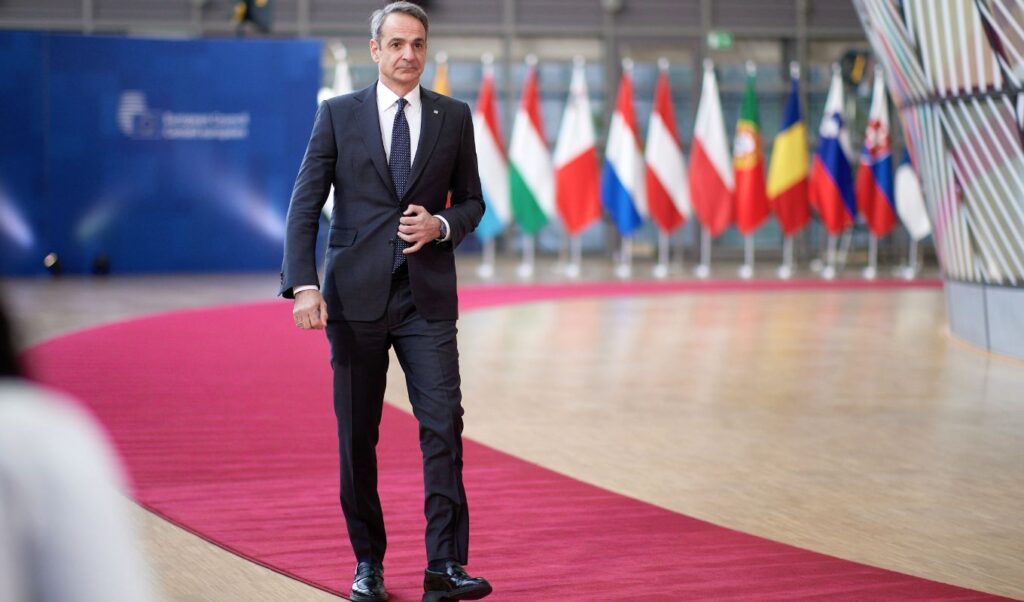
I’ll start with international affairs, as the prolonged geopolitical tension in the Middle East is not a distant crisis. It has already caused a strong energy shock, with direct impacts on households and businesses across Europe. At the European Council Summit in Brussels, we discussed the full spectrum of crisis impacts – on energy prices, consumers and businesses, as well as migration. Targeted national interventions are required. At the same time, Europe must have a specific toolkit, capable of offering temporary and targeted support to households and businesses. This is the other side of competitiveness we discussed extensively at the European Council, so we don’t face an energy crisis. Recent attacks on critical energy installations in regional countries further burden the global supply chain and affect energy prices internationally. In this context, Greece, together with France, supported the proposal for a moratorium on attacks on energy infrastructure as a basic de-escalation step. At the same time, we’re moving forward with strengthening Europe. We discussed how to give substantial content to the EU’s mutual assistance clause. The solidarity shown by Greece and other EU member states towards Cyprus proved that Europe can be united. But it must also be ready – we need a clear and applicable roadmap in case European territory is attacked. Meanwhile, Greece’s contribution since 2021 with a Patriot system in Saudi Arabia strengthens the protection of critical infrastructure, within our strategic cooperation framework. Greece continues to act responsibly, enhancing stability and security in the region.
From the first day of the war, the Greek State stood with consistency and professionalism beside Greeks who found themselves trapped in war zones. The Foreign Ministry handled more than 10,000 requests and organized, under extremely difficult conditions, a complex evacuation operation. More than 2,000 of our compatriots returned safely from regional countries, through a combination of land transport, chartered flights and Air Force flights. In fact, on the last repatriation flight from Abu Dhabi and despite strict related restrictions in the region, the Foreign Ministry secured special terms for boarding pets as well. Thus, 45 pets returned with their owners. This was the only flight from a war zone with the participation of a large number of companion animals. Our country, pioneering once again, highlighted a new paradigm of valuing every life.
This ability of the state to function with planning, speed and empathy in crises is the same we want to characterize our daily operations. Because the international credibility we gain abroad must go hand in hand with a state that becomes faster and more effective domestically every day. This is evident in practice from how our economy now attracts capital. Since 2019, our country has improved impressively in accelerating investments. But we want more. With the new framework from the Development Ministry, we’re concentrating all related competencies at one point, the General Secretariat of Private Investments, for speed and mainly more transparency and less bureaucracy. An important change is also the control of state aid, which will now happen from the beginning of the process, enhancing predictability for investors. The new framework incorporates business community proposals and in the coming days, additional interventions will follow to support industry and address energy costs.
Alongside “housekeeping” in investments, we continue “housekeeping” our finances. Our goal is for Greece not to have the highest public debt in Europe by 2030. That’s why we’re proceeding with early repayment of installments from the €52.9 billion loan the country received in 2010 from Eurozone countries. Next June, an additional €7 billion will be paid from the remaining €26.3 billion, while remaining installments will be covered with approximately €5 billion annually over the next four years. Thus, debt decreases not only as a percentage of GDP, but also in absolute numbers: from €364.95 billion in 2024, we dropped to €362.8 billion at the end of 2025.
However, I consider the most important news of the week to be the new Collective Labor Agreement signed, this time in food service, covering approximately 400,000 workers in a wide range of activities from hotel units to taverns and bakery businesses. It has a two-year duration and provides increased compensation from 6% to 25% for all specialties. Basic salaries will range between €950 and €1,000 gross depending on specialty and will positively affect bonuses for seniority, marriage, studies, unhealthy work and seasonal employment. Another important agreement in the workplace.
I also consider the new regulation we’re about to pass for those under the out-of-court mechanism particularly important. What will we do there? For the first time, we’ll give a debtor the ability to separate their primary residence from the rest of their property, thus achieving greater “haircut” and lower monthly installments. Let me give an example: if a debtor with a €200,000 loan has a house worth €120,000 and a vacation home worth €80,000, until today both properties’ values were considered and the algorithm resulted in zero haircut and many installments. With the new regulation, by declaring they want to save only the primary residence, only the €120,000 value will be considered and the debt will be immediately “cut,” liquidating the vacation home. The goal is a more effective and functional process that gives real debt settlement possibilities and primary residence protection.
This week we also presented the roadmap for universal implementation of the ban on selling tobacco products and alcohol to minors. The ban becomes universal and responsibility for age verification now passes to the seller, with help from a new digital verification system through Gov.gr Wallet and Kids Wallet applications. Violating the framework constitutes a criminal offense and violations are punished with three years imprisonment and monetary fines. The central tool of the new framework is the Digital Registry for Tobacco, Alcohol and other non-tobacco products Control (alto.gov.gr), where all natural and legal persons selling these products at all sales points nationwide must register, while market supervision is enhanced with a special EODY department. Entry and stay of minors in pure bars and nightlife centers is also prohibited. It will only be allowed under specific conditions for conducting private events, provided they have been previously declared on the events.gov.gr electronic platform.
We also signed a donation contract worth €3.8 million for procuring a new communication system for air traffic control, to be used at Athens and Macedonia Control Centers. To save time acquiring this critically important system, we approached the private sector which responded immediately, so the expense will be covered entirely through donations from Athens International Airport, Fraport Regional Airports of Greece A, Fraport Regional Airports of Greece B, GEK TERNA, Aegean Airlines and Sky Express.
Other things happened too.
Like presenting the Local Government Performance Monitoring Hub. For the first time, the state stops hiding behind generalities and systematically collects, processes and publishes comparable data for almost all municipalities in the country. Every citizen – and I encourage you to do this – can go to deiktesota.gov.gr, compare and see the truth about their municipality: how clean is the city? How fast are digital services? How’s social policy going? Performances of municipalities like Thessaloniki, Trikala, Volos, Ampelokipoi-Menemeni and Peristeri show that progress is feasible when there’s planning, consistency and accountability. Of course, this is just the beginning. Because the first year also revealed real difficulties: in property recording, infrastructure mapping, energy data monitoring. But precisely this mapping is the basis for becoming better. By utilizing modern data infrastructures and cooperation of relevant bodies, we’re building a new governance model: a state that measures to improve and compares to progress.
This digital revolution doesn’t just concern administration, but now directly reaches our property value itself, putting the Digital Land Bank into pilot operation. You might reasonably ask what this is, and I’ll answer: it’s a new digital platform on gov.gr that gives property owners who can’t utilize their property, for example because it’s heritage-listed, the ability to transfer this right elsewhere instead of losing it. It’s a tool that contributes both to environmental protection and public spaces, as well as more organized spatial planning, through a transparent and reliable framework. Simultaneously, the Land Registry presented a new digital service at maps.ktimatologio.gr, which through connection with the Technical Chamber of Greece and the Unified Digital Map, incorporates cadastral and urban planning data in a unified environment for the first time, allowing citizens, engineers and investors to immediately see basic building terms (like land uses, building coefficient, coverage, height and plot adequacy) for each land parcel.
In social policy, I should mention we submitted to the European Union the Greek proposal for utilizing Social Climate Fund resources worth €5.3 billion. We’ve designed 25 interventions for 1.5 million households and 70,000 very small businesses to address energy costs, enhance construction and building improvement, environmental protection and public transport modernization. Emphasis is given to families, people with disabilities, households struggling with energy and transport costs, as well as small businesses. This Fund is one of the basic tools for the economy’s next day and an opportunity we’ll utilize fully and without delays.
Meanwhile, we’re extending the School Meals Program to six more municipalities – Orestiada, Soufli, Grevena, Paeonia, Istiaea-Aidipsos and Aegina. In practice, this means 4,680 additional children will have a quality meal at school every day, from a program already supporting 179,000 students nationwide. I consider it a simple but very substantial intervention reaching from the most remote points to islands and areas where there’s greater need.
I’ll close with cultural prescribing. The term might sound strange, but its essence is simple: culture as therapy. And I’m particularly proud that our country is proceeding with implementing this practice. Now, doctors can prescribe through EDIKA participation in theater, museums or concerts as part of mental health care, with EOPYY compensation. It’s an approach tested internationally showing that mental health isn’t just about treatment, but also participation, expression and connection with society.
This is ultimately the goal of all the efforts I described: a state that modernizes, gets its house in order and develops, not for numbers, but to return this progress in every way to citizens’ daily life and quality of life. Have a good Sunday everyone!