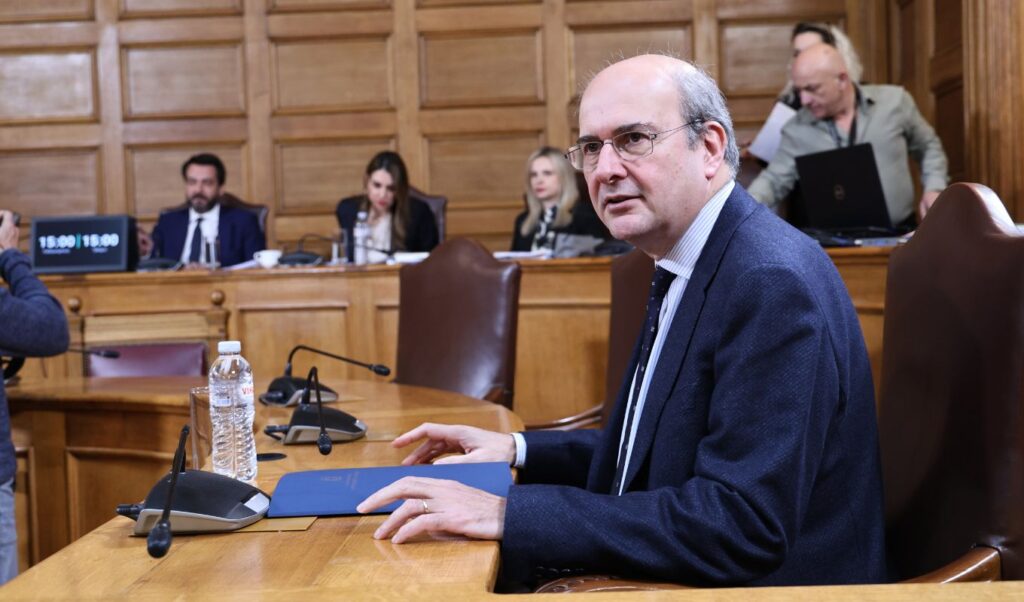
“The government is adopting a series of common-sense regulations for the benefit of the average vulnerable citizen. I would have expected criticism from the opposition for not bringing these measures earlier. I would also have expected proposals so that these moves could be enriched with others, and I commit that if there are such logical and substantiated interventions, I will include them in the bill. Instead, however, to my surprise, I heard no proposals. But I heard criticism ‘how dare you move in this direction!'”, stated the Deputy Prime Minister, Kostis Hatzidakis, speaking today at the Parliamentary Committee on the draft law “Interventions for a more citizen-friendly state”.
Read: Kerameos on minimum wage: “The Cabinet will decide next Thursday how much it will be increased” (Video)
Mr. Hatzidakis categorized the opposition’s reactions into two groups. The first consists of those who favor inaction. “If even a small group that might vote for us protests against change, let’s leave things as they are. And let the average vulnerable citizen suffer,” he noted. The second category, mainly including the left, comprises the protectors of the “Holy Public Sector.” “The left in Greece, instead of standing for equality and the social character of the state, has turned to protecting the Public Sector. As if the Public Sector were a sacred cow that no one should touch, even if it torments citizens”.
Kostis Hatzidakis: 14 interventions to reduce bureaucracy, increase transparency and tackle the “deep state”
Mr. Hatzidakis presented the 14 interventions to reduce bureaucracy, increase transparency and tackle the “deep state” included in the draft law, noting the following:
1. Replacing documents already held by the State with a statutory declaration. “Why should the citizen be deprived of this right? At a time when strict deadlines for controls are imposed on one hand, and very strict fines proportional to the illegal benefit someone would seek to obtain on the other,” questioned the Deputy Prime Minister.
2. State abstention, under conditions, from claiming citizens’ properties. “The State was claiming the town of Saronida or a series of apartment buildings in central Karditsa with Ottoman firmans. Is it conceivable that this should happen and continue?” he emphasized.
3. Digital notification of citizens about the progress of their application. “This issue arose from the Interior Ministry questionnaires. It’s a major change toward transparency and respect for citizens”.
4. Submission of citizens’ complaints through the Integrity Advisor. “We are strengthening this institution so that citizens can file complaints about excessive delays, poor service, or corruption. Those complained against will know who filed the complaint against them, as this has also been decided by the Personal Data Protection Authority. If the opposition prefers complaints to be made with hoods on, let them say so”.
5. Non-exercise of legal remedies by the State in court disputes of particular social significance (such as Mandra, Mati, Tempi). “Today relevant decisions are made case by case. It’s in the realm of the obvious that there should be unified treatment by the Cabinet”.
6. Assigning compliance with court decisions to the Internal Audit Unit. “Today in cases where decisions are not implemented by the Administration, citizens are forced to resort to courts again, seeking their implementation. With this regulation, we will also fulfill some of our obligations regarding the European Court of Human Rights”.
7. Mandatory posting of circulars. “Thus every minister, secretary general, and the public administration as a whole become accountable to the citizen”.
8. Digital information on service hours on the Ministry-Organization website. “A regulation of transparency and respect for citizens”.
9. Unified body for examining citizens’ objections. “Until now we have various services issuing conflicting decisions. There is no legal certainty and there is prolongation of pending cases from which I don’t know who benefits. We’re moving toward homogenization of the procedure, with the possibility for citizens to participate via teleconference. The question is why the opposition isn’t bothered that this procedure is already applied in AADE for tax matters but is bothered because it will be applied, for example, in EFKA for insurance matters. Is AADE a different state?” wondered Mr. Hatzidakis.
10. Certified professionals in transactions with the State. “Here too I’m surprised that you criticize this regulation and the corresponding one I brought for EFKA for pension issuance, but you don’t criticize a series of other regulations with the same philosophy. For example, we have notaries who issue divorces or inheritance documents. We have lawyers who can issue decisions and certificates. Engineers who operate on behalf of building services, a regulation that PASOK actually brought. Why the double standards? For example, why leave the Agricultural Declaration Reception Centers as they are and not expand the system with certified accountants, agronomists, veterinarians? Moreover, the final signature remains with the State. That’s why I say you’re attached to the ‘Holy Public Sector’ to the extent that you forget the regulations you yourselves brought. You support 10 bureaucrats and give us the citizens”.
11. Upgrading notaries’ role and their operation as a one-stop shop. “This already applies and we’re expanding it; there’s positive reception of the regulation from property owners”.
12. Abolishing mandatory topographical survey for transfer contracts. Provided the property is in an area with an approved and transferred implementation act and a functioning cadastre.
13. Possibility to pay inheritance, gift, or parental provision tax upon property transfer, to facilitate citizens.
14. AADE’s ability to definitively release the transfer of seized property. The regulation gives citizens the possibility to release their property and proceed with transfer while AADE ensures debt collection.
“In the 5.5 years of governance by New Democracy, a series of significant interventions have been made to address bureaucracy,” concluded Mr. Hatzidakis. “Digital modernization of the State, digital tools in the National Health System, 1555 in the Labor Ministry, 1566 in the Health Ministry, acceleration of pension issuance. With this draft law, we’re adding new initiatives, which won’t be the last. Instead of cockfighting and negativism in advance, let’s have a mild and substantive dialogue. Because above parties there is the citizens’ interest and our obligation to make the state more friendly to citizens”.