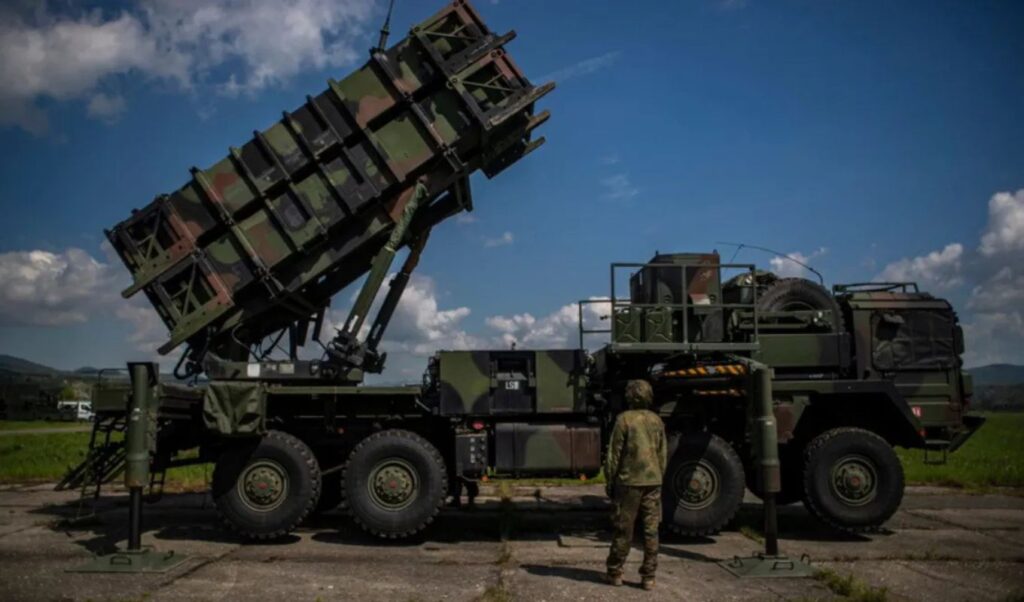
The Greek government communicates in every way that Greece does not participate in the war conflict in Iran, and its presence in the broader Eastern Mediterranean region demonstrates only its defensive character. However, yesterday’s interception of two ballistic missiles originating from Iran by Greek Patriot systems in Saudi Arabia has caused concern in many centers (military, political, diplomatic).
The statements by the Defense Minister and government spokesperson that this was a defensive action appear reassuring. However, how visible is the possibility that the multifaceted forms of this war could drag other countries into the conflict, as has happened with Arab countries?
Sotiris Roussos on Iranian missile interception by Greek Patriot systems: It’s war involvement – We should benefit from Saudi Arabia’s defensive fortification
Professor of International Relations Sotiris Roussos argues that “this is involvement in the war, it’s obvious, there’s no doubt about it, otherwise we would be divorced from all logic. We struck ballistic missiles from a country and therefore we participate in this war. What happened is very serious. I don’t know if we understand this. We are the only European country that has used its weapons in this war. No other country exists. Even the British haven’t used their weapon systems against ballistic missiles.”
According to Roussos, Greece does not gain any geopolitical benefit from its participation in Saudi Arabia’s defensive fortification. As he says, “we should have a benefit from this. Right now I don’t know of any major Saudi investment in Greece and no support from Saudi Arabia on issues of Greek interest. Whether they concern the Eastern Mediterranean, Cyprus, or the Aegean. On the contrary, I see very close relations between Saudi Arabia and Turkey over the past two years. Defense agreements, agreements with Pakistan in defense industry, etc. There could be positive intervention by the United States, which sent us there, on our national issues since Saudi Arabia didn’t ask us – we went there for the Americans’ sake. We haven’t seen anything like that. Instead, Turkey remains steadfast in its claims and provocative actions. I haven’t seen from 2021 when we went there until today in 2026, a clear benefit for Greece.”
Thrasyvulos Eftychidis: “We participate because we have benefits – The artillery did its job – Our role as security provider is significant”
International relations expert Thrasyvulos Eftychidis expresses the exact opposite view, arguing to parapolitika.gr that we are very far from the possibility of war involvement. As he says, “we participate in this story based on an interstate agreement we made with Saudi Arabia obviously because we have benefits. And later we joined an international force whose purpose was precisely to defend Saudi Arabia’s energy sector. Therefore, we’re doing our job. Once the war began, the solutions were simple. Either we should have gotten up and left, or from the moment the artillery remained there, it had to do its job. Well, it did its job. It couldn’t fail to intercept the two missiles. From there on, how the Foreign Ministry utilizes this is a matter of its own assessment.”
Eftychidis doesn’t identify any danger Greece could face from yesterday’s incident. The only case, as he claims, would be if the Greek artillery in Saudi Arabia received a new strike, but he doesn’t consider a strike on Greece likely at all. Instead, he argues that Greece truly appears as a security guarantor in the broader Southeastern Mediterranean region and the Balkans. “Our role as a security provider is significant; we prove we have the means. In reality, we have five. One of the five Patriot batteries has been in Saudi Arabia for a very long time; everyone knows this, it’s not secret. It’s positive that we have these weapons, which are American-made. In any case, they are extremely effective in missile defense,” explains Eftychidis.
It should be noted that the agreement for installing Greek Patriot systems was signed in April 2021 by then-Foreign Minister Nikos Dendias. The goal was to participate in protecting Aramco refineries from attacks by Houthis in the Red Sea. After yesterday’s strike, Saudi Foreign Minister Prince Faisal bin Farhan warned that the kingdom reserves the right to take military action “if deemed necessary,” thus showing that the danger of Saudi Arabia being drawn into the war is visible.