New developments emerging in the Eastern Mediterranean from the Middle East conflict have alarmed Turkey, as it observes increased military activity in the region that could overturn its geopolitical plans. Ankara’s concern was initially expressed through the deployment of six F-16 fighter jets to the Occupied Areas and, of course, through issuing counter-NOTAMs, in an attempt to send a message to Greece and Cyprus that security in the Eastern Mediterranean cannot exist without Turkey, as it remains a guarantor power on the island.
It should be noted that in the past, the Republic of Cyprus has issued similar NOTAMs, reserving areas for exercises by countries other than the US, since the Northern Cyprus regime is not recognized by any country except Turkey. However, Washington’s request to Cyprus at this juncture raises second thoughts in Turkey about the consequences of so many countries supporting the Republic of Cyprus, especially as it coincides with increased accumulation of weapons systems on the island. What appears to have truly bothered Ankara is the interpretation given to Washington’s move to request the Republic of Cyprus to issue the NOTAM, which demonstrates the strengthening of US-Cyprus defense cooperation and, by extension, America’s support for Cyprus. All this, of course, combined with Congress’s decision to proceed with the complete lifting of the arms sales embargo from the US to Cyprus, which constitutes yet another proof of Washington’s support for Nicosia, particularly when it is being communicated that the presence of Turkish F-16s in the Occupied Areas violates US arms export rules.
Kairidis to parapolitika.gr: Turkey’s stance expected – Unease over Cyprus strengthening, American factor is “key”
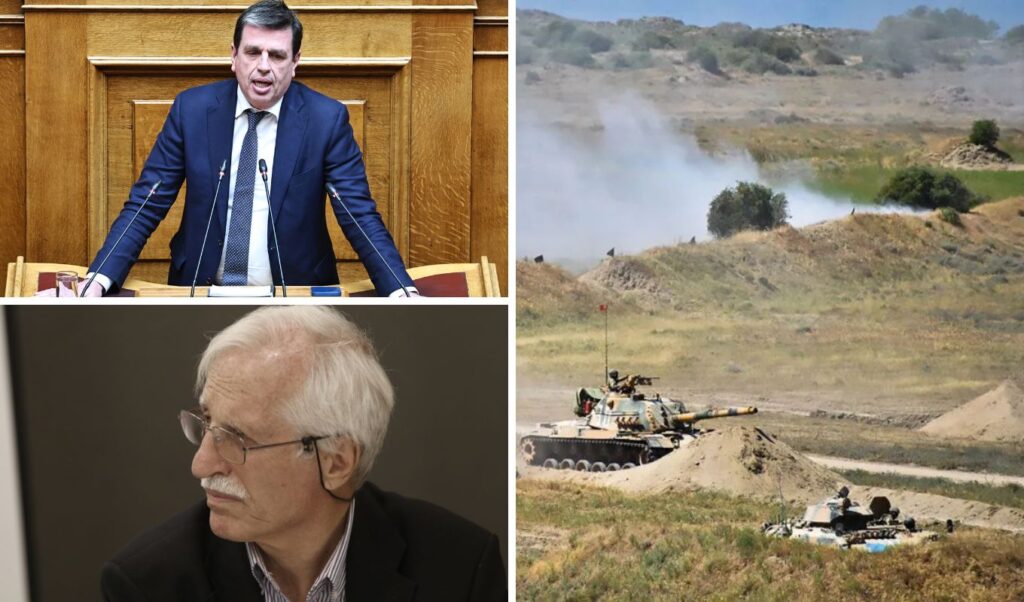
Professor of International Relations and parliamentary spokesman for New Democracy, Dimitris Kairidis, argues to parapolitika.gr that Turkey’s stance toward developments in Cyprus is expected. As he says, “there is great concern in Turkey about the current Iranian crisis, but also unease about the strengthening of Cyprus through displays of solidarity from both Greece and Europe, as well as from the strategically deepening relationship with the United States, and this is troubling. Turkey’s reaction to the Cypriot NOTAM for the Nicosia FIR was to some extent expected based on Ankara’s established positions. What’s interesting and very significant, however, is that the Cypriot side coordinated completely with the American factor.” “With the presence of so many forces around Cyprus, have no doubt that Greece and Cyprus are strengthened today,” emphasizes Mr. Kairidis.
Ioakeimidis to parapolitika.gr: US overlooks so-called Turkish Cypriot state, causing expected Turkish reaction
Professor Emeritus of European Studies Panagiotis Ioakeimidis also interprets Turkey’s stance as expected. As he argues to parapolitika.gr: “Turkey sees that the United States in practice essentially overlooks the so-called Turkish Cypriot state. Consequently, it reacts in this way. It is, in other words, Turkey’s familiar reaction in its attempt to safeguard the illegal, of course, declaration of the pseudo-state.”
It is indeed a fact that the presence of supporting forces in Cyprus, primarily Greek ones, has created – perhaps for the first time since 1974 – a sense of security among residents. The protective shield being formed now indicates that in the future, the Republic of Cyprus will have alongside it its partners in the European Union, Britain, the US, and Israel.
The Greek anti-drone system “Centaurus”
Meanwhile, Cyprus is strengthening its defensive armor with the purchase of the Greek anti-drone system “Centaurus,” upgrading the “Andreas Papandreou” air base in Paphos and the “Evangelos Florakis” naval base in Mari, with France and the US having expressed interest in participating in their upgrade.
At the same time, questions are being raised about the future of British bases in Cyprus, since the drone attack they suffered on March 2 highlighted Britain’s inability to protect them. On Wednesday, British Foreign Office Minister Steven Doughty was in Cyprus. This is the second visit by a British official to the island in the same month, following the visit of British Defense Secretary John Healey. Today, Great Britain maintains in Cyprus the destroyer Dragon, the transport vessel Lime Bay, Wildcat and Merlin helicopters, as well as specialized personnel for coordinating the air defense of the bases.