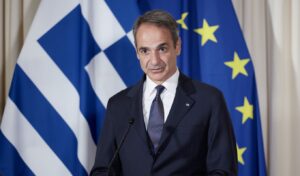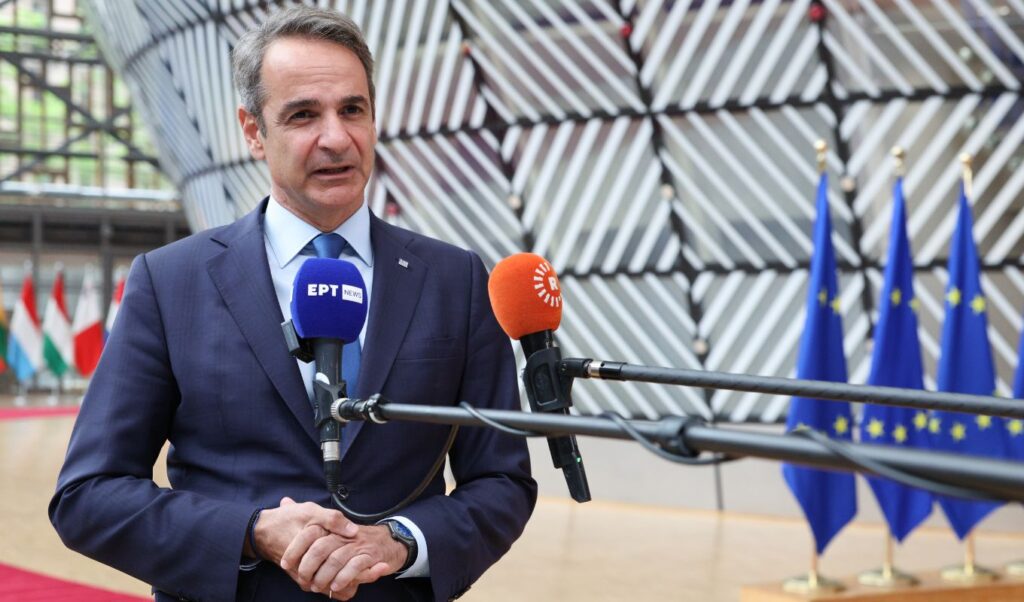
Greek Prime Minister Kyriakos Mitsotakis will participate today, Thursday (19/3), in the first European Union summit in Brussels since the outbreak of war in the Middle East. In his interview with the diaspora newspaper “Neos Kosmos,” the Prime Minister announced he will attend today’s session with the position that Europe must build “barriers so that, at a time when our societies are already being tested, they are not burdened by additional increases, whether we’re talking about electricity or fuel.”
One day earlier, speaking to Bloomberg, Mitsotakis had specified this position. “A possible solution would be, if prices remain at high levels, to have a limited escape clause for these taxes, so that governments can reduce them without the fiscal cost being counted in the deficit or surplus targets,” the Prime Minister emphasized.
The leaders of the “27” will examine today, based on the meeting’s agenda, the military escalation in the Middle East and the situation in Iran, as well as its implications for the EU regarding energy prices and energy security. They will also discuss the EU’s strategic competitiveness, the next multiannual financial framework, security and defense, and migration.
What the EU leaders’ draft statement says about potential operations related to the Iran war
According to a draft statement by the leaders cited by Politico, they will support sending more ships to the Middle East, as the war creates major problems for maritime transport, but will insist that these will operate strictly within the limits of missions that pre-existed the Iran war and in any case not in the Persian Gulf.
“The European Council underlines the role of the EU’s defensive naval operations Eunavfor Aspides and Eunavfor Atalanta and calls for their reinforcement with more resources,” states the latest version of this text, according to Politico’s reporting. The ships, however, will participate in missions only “according to their respective mandates.” We note that Operation “Aspides,” with active Greek participation, is limited to the Red Sea and Gulf of Aden, while Operation “Atalanta” patrols the eastern coasts of Africa and the Indian Ocean to combat piracy.
What Kyriakos Mitsotakis will say at the EU summit
In his intervention today at the session, the Greek Prime Minister is expected to emphasize that Europe must rely on lessons learned from the 2022 energy crisis following Russia’s invasion of Ukraine. The compass for all decisions, as Kyriakos Mitsotakis also emphasized to Bloomberg, should be citizens’ purchasing power, which is the other side of competitiveness. If necessary, the European Union must have ready a plan that will offer temporary and targeted support to businesses and households.
Greece, according to government sources, is initially positive about the proposals included in the letter addressed to leaders ahead of the European Council by European Commission President Ursula von der Leyen. However, one must not overlook the fact that today the crisis starts from a different base – higher natural gas and carbon prices – and any proposals should not add additional burden.
Regarding the Iran war and the Middle East, Mitsotakis will emphasize that the defensive support Greece provided – and subsequently other member states – to the Republic of Cyprus was a demonstration of European solidarity in practice, without activating Article 42.7 (TEU), creating a precedent. At the same time, he emphasizes in the most emphatic way the geopolitical significance of the Eastern Mediterranean.
The 360-degree defense strategy
Today’s developments in the broader region vindicate, as the same sources emphasize, the Prime Minister who insisted in his positions at the European Council that the EU’s defense strategy (and the EU defense readiness map) must have a 360-degree approach. That is, Europe must be ready to face threats not only on its eastern borders, but also on the EU’s southern borders. Greece’s position is that the EU’s goal must be to achieve a diplomatic solution with Iran that addresses all aspects – primarily that of Tehran’s nuclear and ballistic program.
Mitsotakis has been in Brussels since Wednesday to participate in the anniversary event for the 50 years of the European People’s Party, where special references were made to the debt crisis and Greece’s remaining in the eurozone – as an example of the EPP’s efforts and the EU’s resilience. “I am proud that we kept Greece in the eurozone,” said former Commission President Jean-Claude Juncker, while European Parliament President Roberta Metsola addressed the Prime Minister from the stage saying “with Kyriakos, Greece is now a success story.”