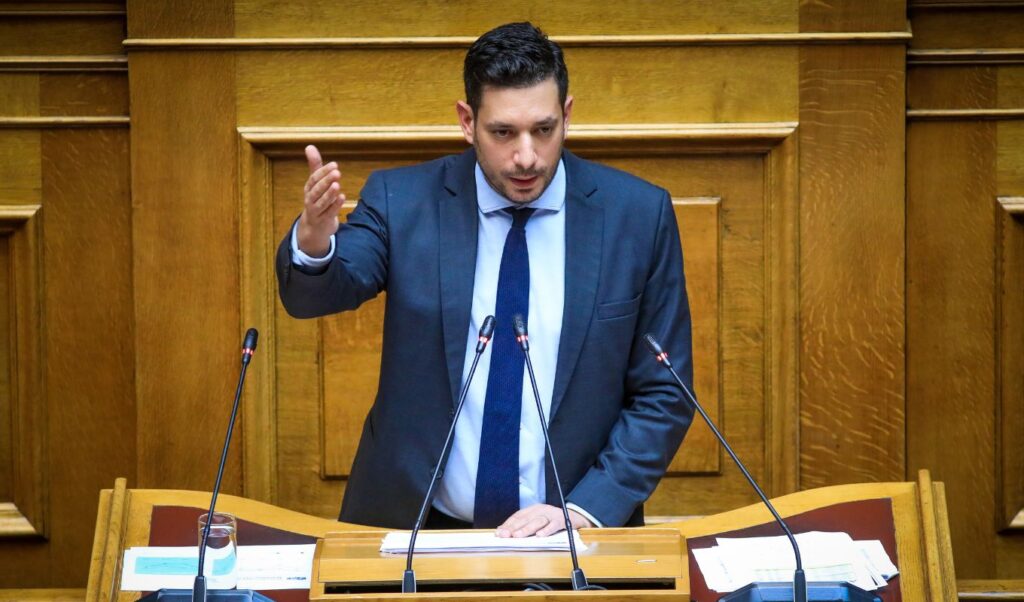
The digital transformation train will whistle next week on every citizen’s… mobile phone. With railway.gov.gr set to debut in just a few days, the Greek railway system is leaving behind its pathologies and entering the era of real-time control. Deputy Minister of Infrastructure and Transport, Konstantinos Kyranakis, reveals his cards in an exclusive interview, explaining how the government’s new digital weapon places passengers at the center of safety, regaining their trust once again. He emphasizes that this initiative is part of the overall government intervention for the renewal of the national railway network, which comes at a significant turning point, shortly before the completion of three years since the deadly tragedy at Tempi.
“This is not an isolated project. It’s part of a comprehensive restart of the Greek railway system. We follow a clear three-pillar approach: new infrastructure, new trains, new stations. This is the foundation for real change in a sector that has deeply wounded Greek society and must regain its trust,” emphasizes Mr. Kyranakis, noting that projects on the country’s main railway axis are progressing with a strict timeline. “By summer, the Athens-Thessaloniki axis will operate with 100% installed and active safety systems: remote control, signaling, and ETCS along the entire length of the line. Not fragmentarily but universally. Railway.gov.gr comes to complement this change. It is the visible pillar of transparency and technological upgrade. For the first time, there is complete, digital, real-time visibility of traffic on the network,” the minister adds. The completion of the above will allow, according to the Ministry of Transport and Infrastructure, the full operation of modern European safety standards on the Greek railway network.
Second-by-second updates on train progress
But what is railway.gov.gr and what will it offer? As Mr. Kyranakis explains, “for the first time we know with precision, in real time, where every train on the national network is located. Not approximately, not with delay. With centimeter accuracy!” he says characteristically, noting that “each locomotive is equipped with a high-precision satellite tracking system, with corrections from ground stations and continuous data transmission to the OSE control center. This means that upon completion of installation, we will be able to know every second the position of each train on the entire 2,000-kilometer network. Essentially, we’re talking about universal network coverage.” At this point, Mr. Kyranakis doesn’t fail to make a clear distinction between the new system and simple GPS that all citizens know: “We’re talking about cutting-edge technology, at the level of industrial and scientific use. The system is based on high-precision GNSS/INS receivers, which receive RTK corrections from terrestrial reference stations. This means that from typical 5-10 meter accuracy of conventional GPS, we move to accuracy of a few centimeters. In simple terms, we can safely distinguish on which of two parallel tracks, separated by just three or four meters, a train is moving. Additionally, the system doesn’t rely exclusively on satellite positioning. It combines inertial sensors, mapped topological network model, and track matching algorithms so that position is continuously controlled and verified. When there’s signal loss, for example in a tunnel, the system continues to calculate position based on speed and track geometry. Communication occurs via satellite link, independent of terrestrial networks, and data reaches the control center almost in real time,” he emphasizes, speaking of “a solution that utilizes technologies which until recently were used mainly in aerospace, military, or heavy industrial applications.” “So yes, we’re talking about universal coverage of the national network but with cutting-edge technology, not simple GPS. And that’s a critical difference,” he stresses.
The guarantee
With the Tempi tragedy not having faded from any Greek’s memory, the deputy transport minister also speaks about how the new modern system will prevent a new accident: “Even in the scenario of two trains being on the same track, this system guarantees we’ll know automatically, within seconds, so there can be immediate reaction from OSE to avoid collision. We don’t leave safety only to human judgment. We create a digital safety net that operates complementary to existing safety systems.”
Additionally, he speaks about the provision in the new, pioneering system to respond to difficult points on the railway network, such as tunnels, gorges, and mountainous sections. “When a train enters a tunnel and the satellite signal weakens, the system uses inertial navigation and knowledge of network topology to continue estimating the train’s position. As soon as signal is restored, immediate correction occurs. Under normal conditions, total delay from signal reception to map display is under 1.2 seconds,” he explains.
Actions and responsibility
It’s noted that through railway.gov.gr -which is one of the basic steps toward a more controlled, transparent, and safe railway system, aiming for full alignment of the Greek network with European standards- all citizens will be able to see at any moment where each train is located, while the platform will provide accurate estimated arrival times and updates on potential delays. “We want citizens to know that the state monitors, controls, and intervenes when necessary,” notes Mr. Kyranakis, then sending the clear political message for this initiative: “The state is changing. From the era of fragmentary management, we’re moving to an era of digital oversight, prevention, and accountability. We prove that after Tempi we didn’t remain in words. The technology exists and the issue was the will to implement it. And we demonstrated this will in practice.”
Published in “Apogeumatini”