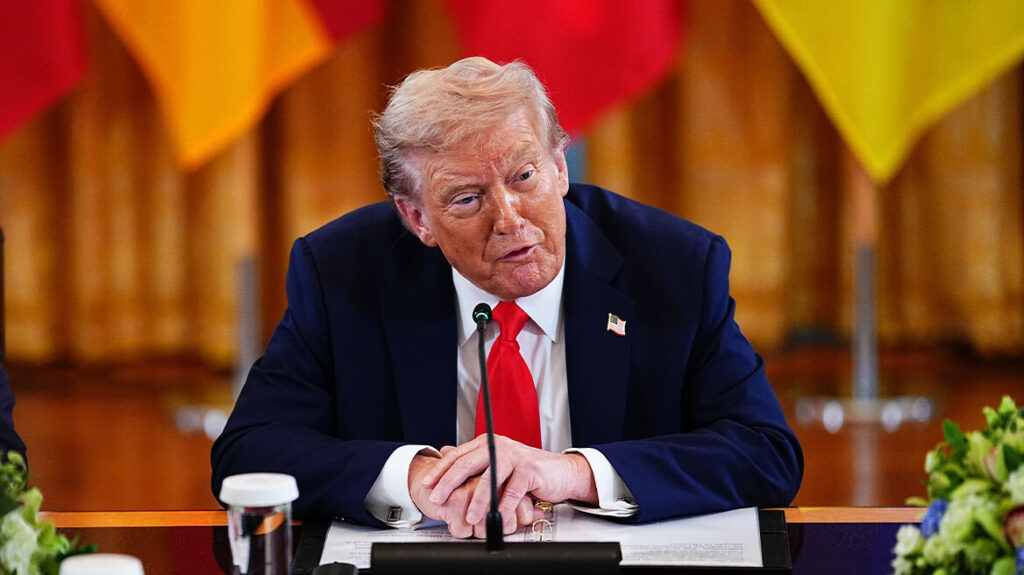
US President Donald Trump expressed fury with the Supreme Court of the United States, calling it a “disgrace” that the Court overturned his tariffs, during a morning breakfast he hosted at the White House for governors, according to CNN, which cites two people with knowledge of his statements.
The Supreme Court ruled that Trump violated federal law by unilaterally imposing sweeping tariffs globally. The decision represents a resounding defeat for the White House on an issue that is at the core of its foreign and economic policy.
Tariffs & Trump: His most significant judicial defeat of his second term
According to one of these sources, the president told attendees that he already has an alternative plan.
The decision is estimated to be probably the most significant judicial defeat of Trump’s second term before the conservative Supreme Court, which last year had repeatedly sided with the president in a series of challenges concerning immigration policy, the removal of heads of independent agencies, and extensive cuts to public spending.
It is noted that in Greece, as in all European Union countries, tariffs of around 20% had been imposed.
BREAKING: The Supreme Court blocked President Trump from using emergency powers to impose sweeping tariffs on most U.S. trading partners, dealing a major setback to one of his signature economic policies. pic.twitter.com/sXkTbUEWaI
— Fox News (@FoxNews) February 20, 2026
Supreme Court rules major portion of Trump’s tariffs illegal
The US Supreme Court ruled that Donald Trump exceeded his powers by imposing tariffs on many products entering the US, dealing a serious blow to the American president on a central element of his economic program. Trump called the Supreme Court’s decision on tariffs a disgrace.
Based on the decision issued today by a majority of six justices in favor versus three against, Donald Trump cannot justify these tariffs due to an economic emergency.
The decision concerns tariffs that were presented as “retaliatory” by the American government, but not those applied to specific sectors of economic activity, such as the automotive industry or steel and aluminum.
Donald Trump chose to impose these customs tariffs based on a 1977 text that theoretically allows the American administration to act in the economic sector, without first getting the green light from Congress, once an “economic emergency” is recognized.
However, according to Supreme Court Chief Justice John Roberts, the US president must “have clear authorization from Congress” to impose tariffs.
The fact that the law text on which the White House relies “gives him the power to ‘regulate imports’ is insufficient,” given that “it contains no reference to tariffs.”
This law “does not allow the president to impose tariffs,” Justice Roberts insists in the decision text.
These tariffs had been announced in April, with the presentation of a table showing the different rates that would apply, depending on the origin of the products.
They theoretically targeted countries with which the US faced a trade deficit in product exchange, with the American president seeing them as a tool to balance it out.
Donald Trump also aimed to secure additional resources for the federal state to offset tax cuts.
However, the Republican partially backed down by adding exceptions for certain products, especially those that cannot be manufactured or grown in the United States.
These tariffs also served as a basis for negotiations that led to a series of trade agreements with key US partners, starting with the European Union (EU), Japan, and the United Kingdom.
These agreements now set, depending on the case, tariffs between 10% and 15% at most on products from countries that have signed them.
In recent days, the US government announced new agreements with several Southeast Asian countries, such as Vietnam and Indonesia, whose leaders were in Washington this week to attend the first meeting of the “Peace Council” established by Donald Trump.