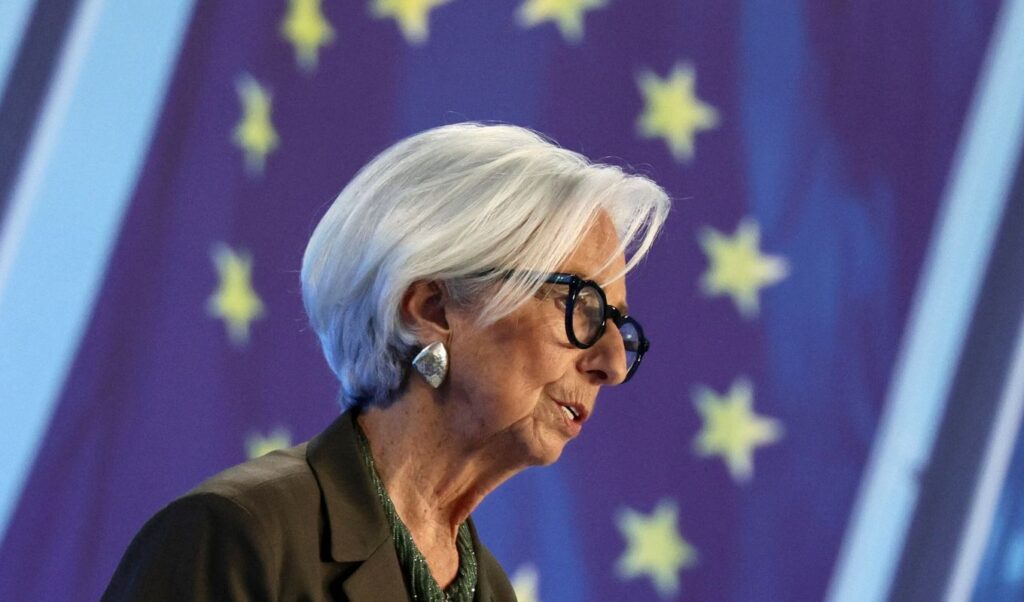
European governments are considering accelerating procedures to find a successor to Christine Lagarde as President of the European Central Bank (ECB). This has been rumored in recent hours, with Bloomberg dedicating extensive coverage to what’s happening behind closed doors. The driving force behind this strategic shift appears to be Brussels’ and the Eurozone’s key capitals’ desire to avoid institutional entanglement with a potentially far-right French President after the crucial 2027 elections. Lagarde’s term officially ends in October next year, and the decision on her succession would normally be made in summer 2027.
Read: ECB: These are Lagarde’s potential successors – Dutch candidate Klaas Knot leads the race
ECB: Challenges for Lagarde’s succession
However, the looming threat of a victory by Marine Le Pen or her protégé, Jordan Bardella, in the polls beginning in April 2027 in France, is pushing European leaders to reconsider their timeline. This trend is confirmed by the recent resignation of Bank of France Governor François Villeroy de Galhau. His early departure, announced last week, automatically means that choosing his replacement falls under Emmanuel Macron’s responsibilities, “securing” the position before the elections.
“There are good reasons for making decisions before the French elections,” states Emmanuel Mönch, professor at Frankfurt School of Finance and former Bundesbank executive. “It would certainly be easier with Macron than with Le Pen or Bardella, who have already signaled they have very different ideas about what the ECB’s role should be.”
Whether governments will move swiftly to protect the central bank depends on their perception of the threat posed by the “National Rally’s” rise to European Union operations.
Investor nervousness regarding the Federal Reserve succession, especially as President Donald Trump attacks its current leadership, reinforces the case for faster European decisions. On the other hand, persistent disagreements within the bloc over high-responsibility positions could act as a restraint.
There is no set calendar for appointing ECB presidents. The agreement on Lagarde was part of a broader EU position-trading “package,” which was finalized four months before her term began.
National Rally’s rise causes concern
From Brussels’ perspective, the “National Rally’s” rise is concerning. Such a Eurosceptic force has never come so close to power in an EU founding member.
While Le Pen has backed down from her position on eurozone exit, Bardella stated in November that the party would pressure the ECB to restart quantitative easing to address France’s bloated debt.
Antonio Barroso, senior geoeconomics analyst at Bloomberg Economics, warns: “An early package deal could preempt tensions, but there’s no guarantee that Le Pen or Bardella would feel bound by agreements made before they took office.”
Last week, Bundesbank President Joachim Nagel warned about the risk of central banks prioritizing fiscal objectives, referencing Trump’s Fed attacks as a potential “template for politicians in other countries.”
Potential successors
Nagel is a potential candidate, although his Dutch rival, Klaas Knot, is currently considered the frontrunner according to a Bloomberg survey of economists. Spain’s Pablo Hernández de Cos, head of the Bank for International Settlements (BIS), is also in the race.
There’s always the possibility that Lagarde herself could accelerate developments by resigning earlier, as she did at the International Monetary Fund. Despite rumors about her move to the World Economic Forum, she insists: “I am fully determined to complete my term. Sorry to say it, but you’re not getting rid of me anytime soon.”
As Macron selects a new head for the Bank of France, he knows that depriving the “National Rally” of such choices comes at a cost. It feeds the populist narrative – also used by Trump – that “establishment” choices undermine democracy.
“It could increase dissatisfaction with centrist parties,” says Vallée, “but it’s a risk worth taking,” he concludes.