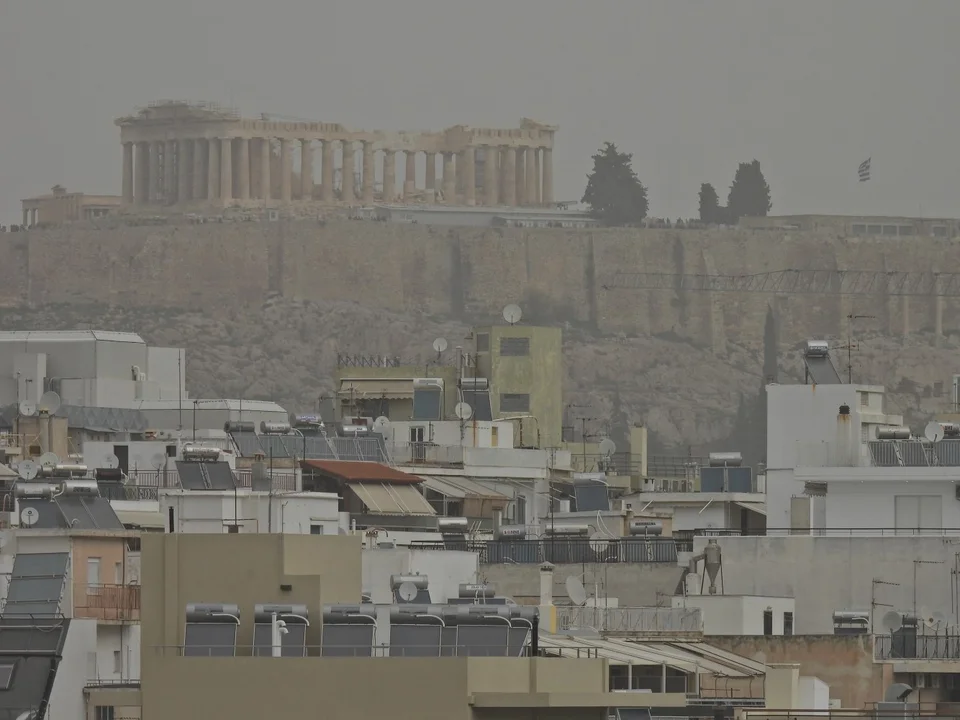
Since the early morning hours, Saharan dust has been blanketing Athens, with a large part of Greek territory trapped in a distinctive “orange” shroud as the African dust wave peaks, creating an otherworldly scene across the basin. The phenomenon, which originated from the Sahara Desert, has covered the city’s iconic landmarks with a thick layer of haze, affecting visibility and air quality. According to the National Observatory of Athens, concentrations of airborne particles are expected to remain high until the early morning hours of tomorrow, when westerly winds will begin to clear the atmosphere.
Photographs by Giorgos Kontarinis for Eurokinissi agency reveal the surreal landscape. As shown, the capital is shrouded by the wave of African dust with the Parthenon and Mount Lycabettus barely visible in the frames.


Saharan dust: recommendations for vulnerable groups
Citizens, especially vulnerable groups, are advised to exercise caution.
– Children and infants.
– People over 65 years old.
– People with chronic respiratory conditions, mainly bronchial asthma and Chronic Obstructive Pulmonary Disease (COPD).
– People with chronic cardiovascular diseases.
– Potential symptoms from Saharan dust exposure
Exposure to Saharan dust has been associated with:
– Eye irritation (itching, watery eyes, tearing)
– Upper respiratory system irritation, such as the nose and oral cavity (runny nose, sneezing, sore throat, hoarseness).
– Lower respiratory system irritation (difficulty breathing or dyspnea, persistent cough with or without phlegm, chest pain).
– Worsening of allergic reactions (skin redness, itching)
Additionally, Saharan dust has been linked to increased visits to hospital Emergency Departments for:
– Bronchial asthma exacerbation
– Chronic Obstructive Pulmonary Disease (COPD) exacerbation
– Acute cardiovascular diseases
– Asthma and other respiratory conditions
– If you suffer from bronchial asthma, Saharan dust may worsen your symptoms. You may need to increase the dosage or frequency of inhaled medications during days when dust concentration is high. Carefully follow your individualized asthma treatment plan according to your doctor’s instructions.
If you use any medication for respiratory disease that includes an inhaler device, make sure to have it with you at all times. Use it according to your doctor’s instructions.
For mild clinical symptoms mainly due to allergic rhinitis, common preparations for allergy relief, such as antihistamines and steroid nasal sprays, can alleviate your symptoms. Consult your doctor.
Cardiovascular diseases
If you suffer from cardiovascular conditions, inhaling Saharan dust may cause:
– Chest pain or tightness.
– Rapid or irregular heartbeat.
– Feeling of shortness of breath, suffocation or choking.
– More fatigue/exhaustion than usual
– If you experience any of these symptoms, contact your doctor immediately to receive necessary care and advice. Make sure to inform your doctor if symptoms worsen or last longer than usual.
What you can do to protect yourself
Stay informed. Monitor air quality reports and weather forecasts to know when Saharan dust levels are expected to be high.
When dust levels are high, take measures:
a). Limit outdoor activities.
Minimize outdoor activities or unnecessary movements as much as possible.
Stay indoors, such as at home or in the office. If it’s necessary to go outside, minimize travel time and stay in outdoor spaces.
Prefer cars for your movements. It’s recommended to keep windows closed and have the ventilation system activated in internal recirculation mode.
Avoid intense physical work or athletic activities, such as cycling, running or walking in outdoor spaces, sports training or competitions in open spaces (swimming pools, fields, stadiums). Transfer such activities to suitable closed sports facilities or postpone them for other days, if possible.
b). Use high respiratory protection masks. When going outside, especially in conditions of high dust concentrations, it’s recommended to wear high respiratory protection masks (FFP2/KN95/N95) to reduce particle inhalation.
c). Take measures to improve indoor air quality.
– Maintain good air quality levels at home, office, etc.
– Minimize external air penetration by keeping windows and doors closed as much as possible.
– Improve insulation of indoor spaces (door and window gaps) to prevent dust entry into interior spaces.
– Activate the air purifier device early -if available- and ensure it has appropriate filters and functions normally.
– Clean contact surfaces with a damp cloth, such as tables and counters, and mop the floor.
– Avoid activities that worsen indoor air quality, such as smoking, using vacuum cleaners, cooking with gas, lighting candles and fireplaces.
d). Stay hydrated. Drink plenty of water.