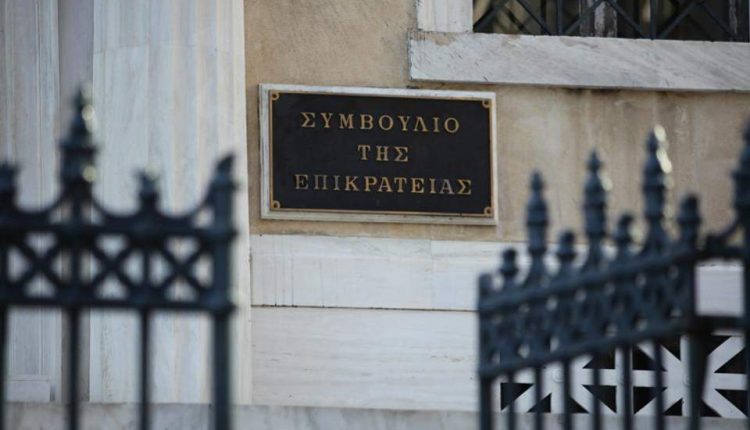
The Plenary Assembly of the Council of State rejected the appeal by ADEDY and an educator regarding the restoration of bonuses (13th and 14th salary) to public sector employees. During the closed-door session, the Supreme Court ruled that their non-payment does not constitute unfavorable discrimination against public servants nor violates the Constitution.
The case concerned the entire public and broader public sector, including public law legal entities and local authorities, stemming from an educator’s lawsuit against the State for holiday and leave allowances.
The court also rejected a separate application by another educator, who—as one of approximately 700,000 public and broader public sector employees—sought the restoration of the three bonuses. Through his lawsuit, he aimed to establish the State’s obligation to pay him compensation equivalent to Christmas, Easter, and summer vacation allowances for 2023 and 2024, due to their non-restoration to the level provided by Law 3205/2003.
Meanwhile, ADEDY intervened in support of the educator, representing all public servants, and became a party to the proceedings before the Council of State.
The case was examined by the Court’s 29-member Plenary Assembly on June 5, 2025, under the presidency of Michalis Pikramenos and with State Counselor Ioannis Michalakopoulos as rapporteur.
ADEDY’s position
During the hearing, ADEDY argued that the non-restoration of the 13th and 14th salary violates the Constitution, particularly the principles of human dignity, equality, equality in public burdens, and proportionality. Additionally, it invoked provisions of European law, such as the Charter of Fundamental Rights of the European Union and Directive 2022/2041/EU.
According to ADEDY, Directive 2022/2041/EU mandates equal treatment between private and public sector workers regarding the guarantee of adequate minimum wages that ensure a decent standard of living. It also emphasized that, unlike in 2012, today there are fiscal surpluses, which—in its view—makes the restoration of bonuses feasible.
The State’s position
Conversely, the State argued that the non-restoration of allowances violates neither constitutional nor supranational provisions. It pointed out that public servants are governed by a special salary regime, within the framework of their particular service relationship, as provided by Article 103 of the Constitution, and therefore constitute a distinct category of workers compared to the private sector.
It also argued that maintaining the abolition of bonuses serves the general interest and is part of the legislator’s economic and social policy, taking into account the country’s fiscal situation and socioeconomic conditions. State attorneys also noted that a contrary ruling would exceed the limits of judicial review, leading the Court to assume the role of legislator.
The Council of State’s decision
The Plenary Assembly ruled that the non-restoration of the three allowances does not violate the Constitution, Greek legislation, or EU law. Specifically, it decided that the non-payment of the 13th and 14th salary does not constitute unfavorable discrimination against private sector workers and does not violate Directive 2022/2041/EU.
It was emphasized that public servants fall under a special salary regime and constitute a different category of employees. Furthermore, it was ruled that the suspension of bonuses does not violate the constitutional principles of equality, proportionality, human dignity, and equality in public burdens.
According to the decision’s reasoning, the non-restoration of allowances does not affect public servants’ decent standard of living or their right to contribute equally, along with other social groups, to national and social solidarity.
State Counselors also examined the fiscal implications of potentially restoring the allowances. According to data presented by the State, the annual permanent burden would amount to €1.37 billion, excluding employer contributions, while including them would reach €1.55 billion. The Court concluded that, under current circumstances, fiscal constraints do not allow undertaking such a significant burden.