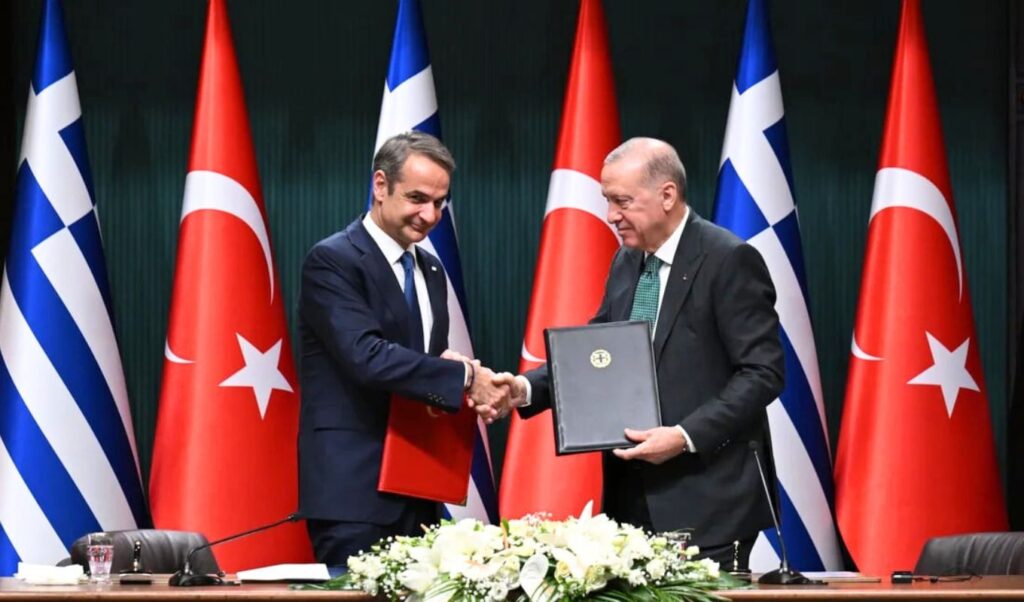
In September 2024, in New York, the sixth meeting between Kyriakos Mitsotakis and Tayyip Erdogan took place within just 14 months, something unprecedented in the history of the two countries. However, nearly eighteen months had to pass before the Greek Prime Minister met again with the Turkish President, this time in Ankara, within the framework of the High-Level Cooperation Council between the two countries. The surveys for the electrical interconnection between Greece and Cyprus, the designation of marine parks in the Aegean, the agreements for hydrocarbon exploration south of Crete, and the close Greece-Israel relationship had caused intense irritation to the Turkish government, which had shown this either indirectly or more directly and cynically.
After intense and months-long behind-the-scenes consultations and diplomatic moves, it became possible for the two leaders to sit at the same table again, discuss for about an hour and a half, and in their joint statements that followed, show a consensus on one fundamental issue: De-escalating pre-existing tensions, further normalizing relations, and maintaining relative calm between the two countries. The seven agreements signed between Greek and Turkish ministers, as well as the Joint Declaration, shows that in so-called low politics issues, the two countries have managed over the past three years to find solutions and overcome obstacles.
Erdogan did not add “fuel to the fire”
Far from the “poisonous” statements by Omer Celik and Hakan Fidan in recent days, Tayyip Erdogan showed in his statements that he had no intention of adding fuel to the fire, and beyond referencing the “Turkish minority” of Thrace, he moved in mild and friendly tones. This reference was actually answered by Kyriakos Mitsotakis, who spoke of a religious minority in Thrace, said that “Greek Muslims of Thrace live harmoniously with our Christian fellow citizens,” and talked about “bridges of friendship and mutual understanding between our peoples” through the two minorities in Greece and Turkey.
The two leaders referred to the prospect of resolving the maritime zones dispute, however, recourse to the International Court of Justice in The Hague is still far away, as according to all information, common ground has not even been found for the framework and procedure that would lead there.
An important observation regarding the statements of the two leaders concerns Mr. Mitsotakis’ reference to “threat,” an indirect but clear barb about the casus belli, as well as the gray zones. A few months ago, from the podium of the Thessaloniki International Fair, the Prime Minister had said that Turkey “as long as it insists on casus belli against Greece, as long as it insists on raising gray zone issues in the Aegean, will not enter the SAFE program. Greece will not allow it.” From Ankara, Mr. Mitsotakis said that “it is time to lift every threat between us,” publicly raising this issue for the first time before Mr. Erdogan.