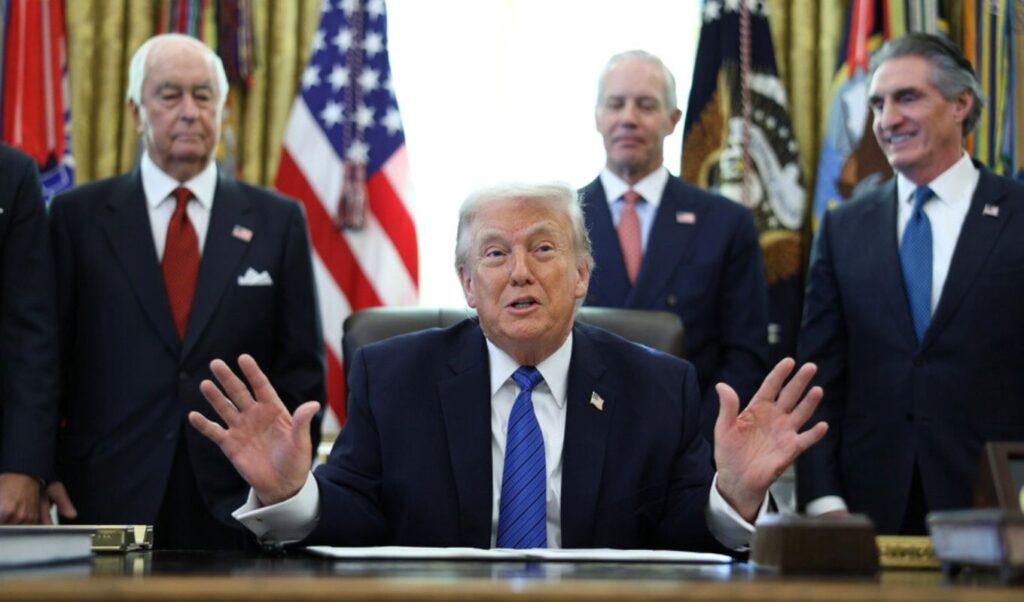
Donald Trump is expected tomorrow, Thursday, to abolish a regulatory framework established during Barack Obama’s presidency that formed a cornerstone of American policy for limiting greenhouse gas emissions, as announced Tuesday by White House spokesperson Caroline Leavitt. “This is the largest deregulation effort in American history,” she told reporters, arguing that the decision will help reduce costs for American citizens.
Read: The Trump phenomenon: 5 books that reveal the governance and plans of the American president
This move has triggered intense reactions from scientists and environmental organizations, who have already announced they will challenge it in court seeking its reversal. If implemented, the decision is estimated to overturn a significant portion of federal US action to address climate change. The United States historically ranks among the countries with the highest emissions of gases contributing to global warming.
“Trump is leading the country into a dead end” by promoting “polluting oil and contaminated air,” thundered Dan Becker of the ecological NGO Center for Biological Diversity. “This measure is illegal, defies scientific evidence and denies reality,” criticized California’s Democratic Governor Gavin Newsom, a major opponent of President Trump, in a joint statement with another Democratic governor, Tony Evers of Wisconsin. “We will not stop our fight to protect Americans from pollution,” the governors promised.
Trump administration targets EPA’s “endangerment finding” on greenhouse gases
The controversial text, known as the “Endangerment Finding,” was adopted by the US Environmental Protection Agency (EPA) in 2009, when Barack Obama was still president.
It established that six gases causing the greenhouse effect are dangerous to public health and therefore fell under the category of pollutants controlled by the federal agency. This opened the path for many federal-level regulations aimed at reducing emissions of gases that increase atmospheric temperature (carbon dioxide, methane…) starting with trucks and private vehicles, which emit CO2 by burning gasoline or diesel.
Its cancellation would therefore end a series of vehicle restrictions and pave the way for the Trump administration to begin dismantling a series of other regulations, particularly for power plants.
The Trump administration, which made clear from the start that it intends to strongly support the oil and coal industries, has been seeking for months to reverse this decision, to the great disappointment of scientists, who speak of an anti-scientific decision harmful to the public interest.
“The scientific evidence regarding human-caused climate change and its consequences was indisputable in 2009 and has since become even more alarming and compelling,” emphasized over 1,000 scientists and experts in their public letter last July.
Fierce confrontation over US climate policy – court battle ahead
The current American government downplays the role of human activities in climate change and argues that greenhouse gases should not be characterized as pollutants in the classical sense because their effects on human health are indirect and global, not local.
It further argues that abolishing the text will allow reducing the cost of new vehicles, which have been on an upward trajectory since the COVID-19 pandemic struck. Either way, it’s certain it will be challenged in courtrooms and very likely that the Supreme Court will have the final word.
Although the latter, where conservatives have had a decisive majority in recent years, has shown openness to dramatic legislative changes, opponents of the measure point out that it was based on its own 2007 decision that formed the foundation for the EPA text. “We’ll see you in court,” recently promised Manish Bapna, president of the environmental organization NRDC.
Washington’s regression was announced while 2025 was confirmed by climatologists to be the third hottest on record on Earth, and while the consequences of climate disruption are becoming painfully felt in the US and the rest of the world.
Despite the indisputable manifestations of the climate crisis, the fight against greenhouse gas emissions has been making limited progress for the past two years in most developed economies, due to insufficient investment in carbon emission reduction technologies.