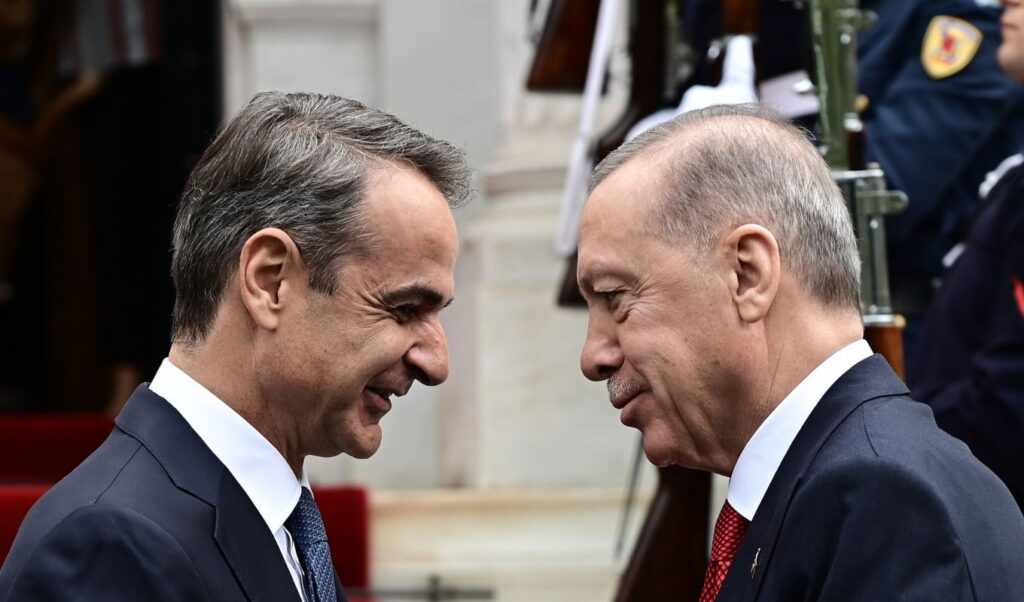
Greek Prime Minister Kyriakos Mitsotakis arrives in Ankara today, Wednesday, for a crucial meeting with Turkish President Recep Tayyip Erdoğan, which is expected to determine the course of bilateral relations. The official reception is scheduled for 3:15 PM (Greek time) at the White Palace, with the ceremony taking place behind closed doors, away from media attention.
According to the schedule, the two leaders will have a private meeting lasting approximately two hours, while the High-Level Cooperation Council (HCC) will convene simultaneously. After the talks conclude, around 5:00 PM (Greek time), statements will follow that will reveal the atmosphere and possibly the results of the visit. Notably, until the last minute, the meeting time of the two delegations at the Presidential Palace was not “locked in,” while the exclusion of media from the Greek delegation’s arrival ceremony has also caused surprise among press representatives.
The critical Mitsotakis-Erdoğan tête-à-tête in Ankara: the “red lines” for Aegean and Cyprus
Meanwhile, the Turkish press welcomes the Greek delegation with positive coverage, speaking of a “new turn” in relations between the two countries. The Daily Sabah newspaper, with the headline: “New turn in Greek-Turkish relations with Greek PM’s visit,” refers to the discussion agenda, noting that “Turkey prioritizes dialogue based on good neighborly relations and International Law for resolving key differences with Greece regarding Cyprus, the Aegean islands, and Eastern Mediterranean rights.” Hurriet also writes that “energy, transport, tourism, culture, and migration are among the top issues the two delegations will discuss in Ankara,” while making special reference to positive statements by Turkish officials Hakan Fidan and Omer Celik about the Greek delegation’s visit. As the newspaper notes, “Turkish Foreign Minister Hakan Fidan stated that Mitsotakis and Foreign Minister Giorgos Gerapetritis demonstrate both the intention and ability to resolve differences and deepen bilateral cooperation,” and elsewhere writes that “Justice and Development Party (AKP) spokesman Omer Celik characterized Mitsotakis’s visit as a valuable platform and opportunity for restoring and promoting ties between the two countries.”
Despite the positive atmosphere, Athens harbors no illusions, as fundamental differences remain on the table. Although the issue of maritime zones is not officially included in the agenda, the Greek side is prepared to discuss it if raised by Ankara, as Foreign Ministry spokesperson Lana Zochios stated on Tuesday, who, while maintaining “that the issue of maritime zones is not on the discussion agenda, nevertheless, if raised by Turkey, it will be discussed.” Government sources, however, clarified that the goal of the Greek Prime Minister’s arrival in Ankara and the High-Level Cooperation Council meeting is to maintain and strengthen open communication channels and establish a functional relationship with Turkey, in an international context full of uncertainty and instability.
However, Ankara is expected to raise issues such as the demilitarization of Eastern Aegean islands again, with the threat of war (casus belli) remaining on the table as a means of pressure on Greece to lift its veto on Turkey’s participation in the European defense program SAFE. The Turkish President is also expected to express his annoyance at the strategic alliance between Greece, Cyprus, and Israel. Additionally, the Cyprus issue remains a central concern, with Turkey closely monitoring the Republic of Cyprus’s initiatives as UN-led processes unfold. It should be noted that today also marks the first meeting between Turkish Cypriot leader Tufan Erhurman and UN Secretary-General Antonio Guterres. It’s worth mentioning that Foreign Minister Giorgos Gerapetritis spoke by phone with Cyprus Foreign Minister Constantinos Kombos just hours before arriving in Ankara, while Prime Minister Kyriakos Mitsotakis also had a telephone conversation with Cyprus President Nikos Christodoulides before his meeting with the Turkish President.
Gradual rapprochement
Today’s meeting is the first between the two leaders since September 2024. It represents the continuation of a period of gradual rapprochement that began in 2023 with meetings in Vilnius and New York and culminated with the signing of the Athens Declaration in December of the same year. Despite recent tensions with the issuance of a Navtex, today’s meeting aims to maintain normalcy in dialogue, even if immediate results on major Aegean differences are not expected.