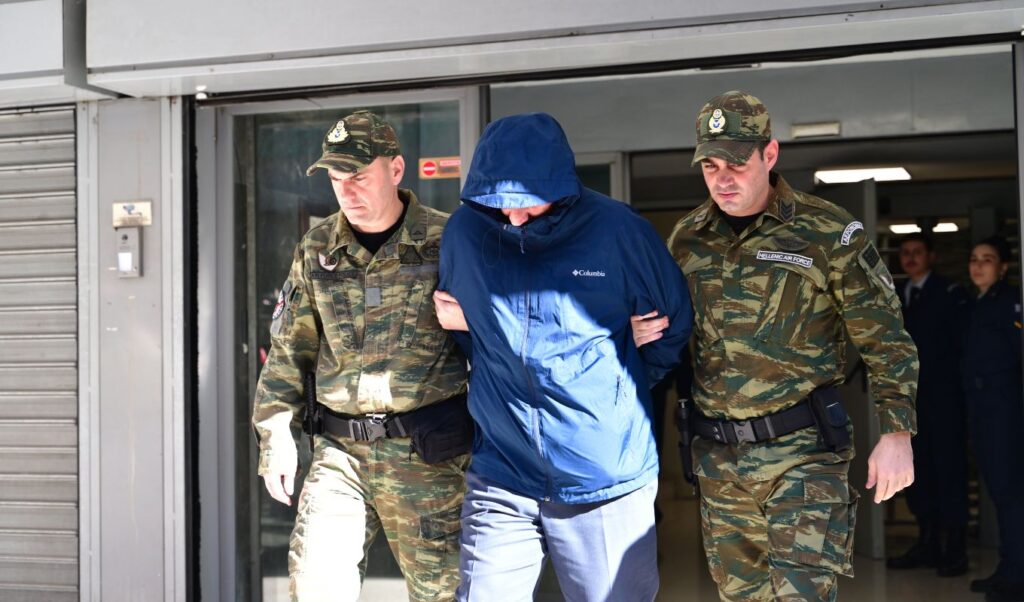
A 54-year-old Air Force commander appears before the Athens Air Court today to testify on charges of espionage, accused of leaking classified information to China in exchange for financial compensation. The case has caused serious concern among the competent authorities, while investigations continue with the participation of the National Intelligence Service (EYP), the General Staff, and specialized cybercrime investigators. The investigation focuses on mapping the defendant’s contacts and identifying potential accomplices.
Read: Espionage in the Armed Forces: The network operates with a “pyramid structure” authorities estimate, woman is the key figure with a decisive role in recruitment
“Serious” charges against Air Force commander accused of espionage
According to security service sources, the indictment against the Air Force commander is particularly serious, based on evidence obtained after months of investigation and digital data analysis. The competent military and intelligence services estimate this is a serious espionage case with international implications.
The defendant, held at the Air Force prison in Kareli, is expected to repeat in his testimony what he had stated during the preliminary investigation, when he allegedly confessed to committing espionage for China, also naming his alleged Chinese contact.
Investigations continue for the 54-year-old Air Force commander-spy, who leaked military documents to China through encrypted software installed on his mobile phone. The commander used a specific application that allowed him to photograph classified material and convert it into encrypted data, accessible only to an authorized recipient in China.
The application operated using a special decryption key held by the Chinese recipient. According to the investigation, the Chinese recipient could restore the data to its original form and gain access to sensitive information, including data concerning NATO.
Air Force commander’s phone at center of investigation
Authorities continue thorough investigation into how extensive the information leak was, as well as the commander’s relationship with other officers or personnel within his unit in the Kavouri area. The investigation centers on the defendant’s mobile phone and the contacts he maintained through it with China, as he allegedly used his position to facilitate the transfer of encrypted data within the military unit.
According to information, the Air Force commander allegedly used his military status to facilitate carrying his mobile phone, which he used for contacts with the Chinese spy.
The Air Force commander’s relationship with the Chinese spy began under the guise of professional interest. The Chinese agent, who appeared as a technology company representative, was impressed by the Greek officer’s resume and approached the commander during an official trip to China. Their initial contact seemed innocent, but the commander quickly succumbed to the spy’s requests.
Meeting in Piraeus with “Steven”
According to ERTnews sources, the Air Force commander accused of espionage was allegedly recruited by a man named “Steven,” who likely uses this as a pseudonym. The two men met at a restaurant in Piraeus, with their collaboration initially involving geopolitical studies for compensation of 500-600 euros.
After the commander gained “Steven’s” trust, he began transmitting classified military documents, with his compensation reaching 5,000 euros per month or 15,000 euros per quarter. Authorities are investigating whether “Steven” is a real name or pseudonym and continue their investigation into the espionage case.
How intelligence services uncovered the leak
The case was uncovered when the National Intelligence Service took over the investigation and managed to locate encrypted material on the 54-year-old commander’s mobile phone. The commander’s cooperation with authorities opened the path to revealing the full extent of leaked information. The officer surrendered the passwords to his mobile phones, allowing intelligence agents to break the encryption and recover the incriminating documents.
Notably, the Air Force commander had received 30,000 euros through cryptocurrency from the Chinese spy. He claimed the money was sent as “payment” for professional services he provided.