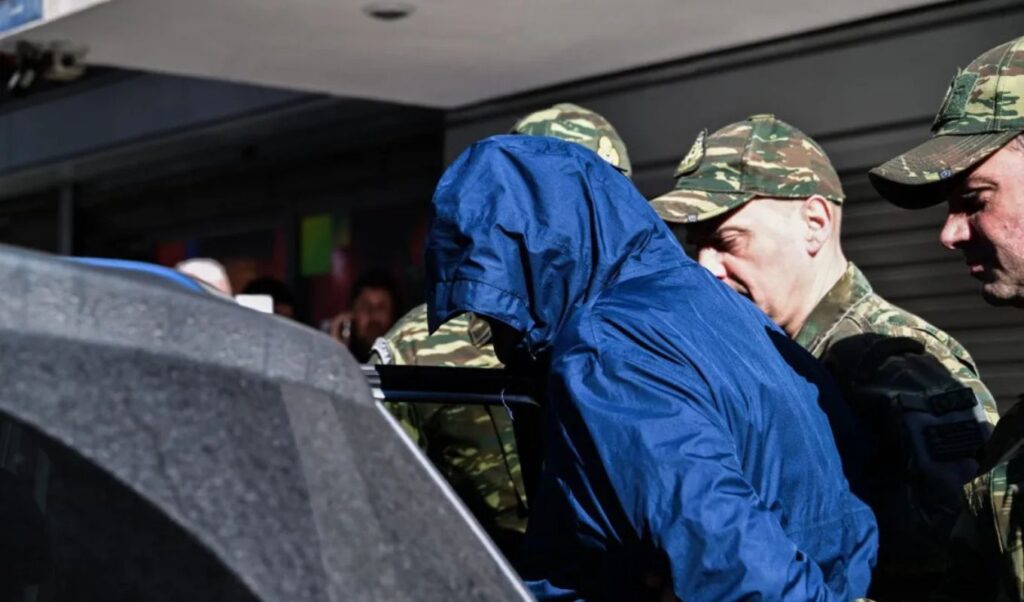
Information about the “cinematic” method of operation of the Air Force Squadron Leader accused of espionage is coming to light, along with details of the Greek officer’s connections to China. It should be noted that the 53-year-old accused is expected to testify before authorities on Tuesday (10/02) regarding the espionage case that has shocked the entire nation. Notably, he “broke” during interrogation and revealed the method he used to leak classified documents to his “contacts,” thanks to his knowledge of information systems.
Espionage case: May face life imprisonment if found guilty
The profile of the Greek officer is under the microscope. From administrative positions in the Air Force, certifications in NATO training schools, to conferences and contacts with “liaisons” from China with cryptocurrency payments, the case is gradually unraveling.
The Squadron Leader is accused, among other things, of “collecting and transmitting secret information of military importance to third parties, with risk of causing damage to national interests,” which means the Greek officer could be sentenced to life imprisonment if found guilty, while under the new Armed Forces bill, there is the possibility of revoking Greek citizenship for espionage cases.
Already, the Squadron Leader has been placed on standby, following a relevant order from the Chief of General Staff of National Defense, General Dimitrios Houpis, and is being held at an Air Force military base in Vyron.
Timeline of the case
Everything appears to have started in 2024, when the Squadron Leader came into online contact with representatives of Chinese companies regarding geostrategic policy matters, followed by a NATO conference meeting in a European country where Chinese spies were also present. The first contacts had become reality.
However, everything changed when the Greek officer wanted to travel to China, claiming he wanted to learn the language and possibly expand his connections, aiming to have some future professional prospects. During this trip, he was initiated into software and other information systems, and his contacts with his “liaisons” moved to another level.
After returning to Greece, he began leaking classified and secret information in exchange for large payments.
Meanwhile, the CIA was put on alert for possible espionage cases by Armed Forces officers on behalf of third countries, and the NIS began in October 2025 to monitor the Squadron Leader in cooperation with the Cybersecurity Directorate of HNDGS.
Greek authorities carefully and precisely planned both his arrest operation and the legal, bureaucratic and other dimensions of the case, now having the necessary evidence to bring him before Greek justice.
The lightning arrest operation
The arrest took place on Thursday (06.02.2026) within the 128th Communications Training Squadron, which the Squadron Leader commanded, in the presence of a prosecutor, by a team from the NIS and the Cybersecurity Directorate of HNDGS.
The unit’s gate was not informed, as this would mean that the Squadron Leader could have “disappeared” incriminating evidence, while everything proceeded with absolute secrecy to ensure their surprise.
The service agents entered his office, announced his arrest and immediately began checking his electronic devices. There, they located his second mobile phone, which was not declared to the service as required.
A specialist officer managed to decrypt his phone on the spot, presenting the evidence to him one by one. At that point, the squadron leader reportedly “broke” and confessed.
Confiscations of computers, mobile phones, hard drives and USB devices followed, while a raid was also conducted at his home, where a laptop and the special encrypted communication device were found.
How the Squadron Leader operated
The Greek officer, under pressure from investigators, confessed and admitted to his connections in China, while the method by which he transmitted classified data to his “contacts” was also revealed:
– Thanks to his knowledge of information systems, he accessed networks of sensitive information using codes that all personnel have according to their classification level
– He then gathered the information, converted it using special software – from a phone he had not declared since his contacts from China had given it to him – into QR code and then sent it in this form.
– The recipient would receive the documents and convert them from QR code to photograph for evaluation and use.
Payments are reported to have been made through an encrypted application installed on the “shadow” Samsung mobile phone, while transfers ranged from 5,000 euros to 15,000 euros per month or quarter, depending on the importance of the information.
Now, authorities’ investigations are also focused on the possibility that the Squadron Leader attempted to recruit retired personnel, as well as whether it involves a network of contacts or an isolated individual in China who collaborated with the Greek officer.
Why was he the “chosen one” for espionage activities?
But why did the “liaisons” from China choose the 54-year-old Squadron Leader as their “chosen one” for espionage activities? The reason is simple. The Greek officer has an impressive resume, specialization in these areas, particular knowledge and most importantly a low-key character. In short, he was “above suspicion.”
He is a certified NATO tactical evaluator in Communications and Information Systems (CIS), has served in radar and telecommunications units, served as Support Section Chief and implementation staff officer for missile system contracts.
He also served as Communications Section Chief of the Air Force Command of HNDGF in Cyprus, and was Chief of Electronic Warfare and Flight Simulators Section of the Communications Directorate of HAF.