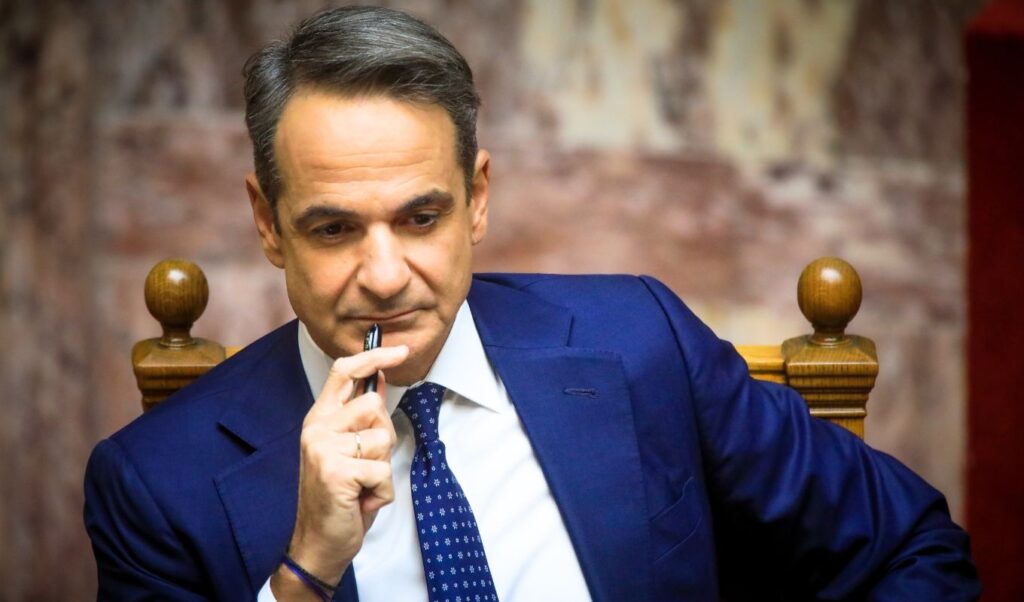
The government will present its final proposal regarding Constitutional Reform within March, as announced by Prime Minister Kyriakos Mitsotakis. Through his weekly review, the prime minister expresses hope that there will be “a willingness for understanding, without dogmatism, pretexts, and party calculations” from the other political forces.
At the same time, Mr. Mitsotakis makes special reference to the tragedy involving 15 dead migrants in Chios, emphasizing that “the State shows and will show zero tolerance toward migrant smuggling networks.
With the bill from the Ministry of Migration and Asylum passed by Parliament, penalties for these criminals are being tightened, while simultaneously establishing rules for the organized management of legal migration. The actions of NGOs are not criminalized, but the criminal behavior of individuals who may be members of such organizations is addressed, and obviously they cannot maintain a privileged relationship with the state and its structures. Our migration policy is based on clear rules, consistency, and respect for human life. A framework that combines border protection, diplomacy, and decisive action against smugglers, with absolute support for the work of the Coast Guard”.
Full weekly review by the prime minister:
Good morning! Last week was politically colored by the beginning of dialogue on Constitutional Reform. Another institutional commitment of ours that becomes reality.
As we traverse the third decade of the 21st century, I posed a question to myself -and I call on you to do the same- what among everything we have established actually serves us today and what needs to be adapted to continue functioning. This is not an easy discussion, nor does it concern only the present. It concerns how we want our institutions to function over time, with more transparency and accountability, so that citizens’ trust is strengthened and our political system can respond to the great challenges of our era, from artificial intelligence to climate crisis.
I clearly outlined our proposals: constitutional protection of fiscal stability, changes to the law on ministerial responsibility, the possibility of establishing non-state universities, participation of the judicial body in selecting its leadership, as well as evaluation in the public sector, with potential lifting of tenure. All these are issues that concern public life, but ultimately touch every citizen individually. Our final proposal, incorporating the positions of our MPs, will be presented within March. With the expectation that other political forces will also approach the dialogue with a willingness for understanding, without dogmatism, pretexts, and party calculations. Because this undertaking transcends all of us and requires all of us. The country’s Constitution is the social contract that defines the coordinates of our common life and sets the bar for both our ambitions and our demands from Democracy and its institutions. My personal vision is for the country to celebrate 200 years from the establishment of the modern Greek state in 2030 having addressed, through the revision of the Constitutional Charter, pathologies of decades.
Another issue I believe should be outside ideological compartments and electoral cycles is Education. That’s why within February we’re also opening dialogue on the National High School Diploma. What we want to achieve is for high school to gradually acquire greater educational value and autonomy. Not to function only as a mechanism for exam preparation, but as a space for substantial learning that equips children with knowledge and skills useful for their next step, whatever that may be. Naturally, the dialogue doesn’t start from zero. The reforms that have already been made since 2019 will be evaluated, but the discussion will be focused on the future of high school: a school that is not limited to university admission, but gives children tools for life and work in the new era. I want to be absolutely clear. The changes being discussed do not affect students currently attending high school, nor students in their final year of middle school, while university entrance exams are not being abolished. A possible implementation horizon is the first year of high school, academic year 2027–2028. The “New Public School” is not a slogan. It’s a national goal and a bet worth winning together.
Before leaving the education sector, it’s worth noting that this week the contract was signed for the renovation of the Athens Student Residence, worth 18.6 million euros. This is a project that had been discussed for years and finally enters implementation phase. The renovation will economically relieve hundreds of low-income families seeking affordable but quality housing for their children during their studies. The Student Residence will undergo complete energy upgrade, structural reinforcement, and substantial infrastructure improvements, with particular emphasis on accessibility and student safety. The project is estimated to be completed in about a year and a half from now. However, let me highlight the timeline with which the project proceeded: announced in early 2025, the programming agreement with TAIPED was signed last July and the tender was announced on September 3. Times that, by Greek standards, can be characterized as record-breaking.
Bridging the previous and next topic is the operation of Greece’s first public Professional Training Academy in the pharmaceutical sector, in Tripoli, Arcadia. It will function as an extension of the existing public Higher Professional Training School there, attendance will be free, and 40% of graduates will be absorbed by member companies of the Panhellenic Pharmaceutical Industry Association.
Very important is the next topic. We’re implementing another commitment to our fellow citizens suffering from chronic and very serious diseases, enabling them to receive specific high-cost medications from the pharmacy of their choice. This is an additional option given to them after home delivery of medicines for their convenience. And when we say neighborhood pharmacy, we mean pharmacies in Kastelorizo or Symi or a pharmacy in a mountainous settlement of Greece. Without travel, expenses for the patient, hassle, and anxiety. The relevant contract was signed on Thursday by EOPYY and the Panhellenic Pharmaceutical Association, and in the coming days EOPYY’s platform will be operational for patients to make their requests. Initially, it will concern patients suffering from cancer and multiple sclerosis. This equals approximately 23,000 prescriptions per month, with the goal of reaching 66,000 prescriptions per month within the first quarter of 2026.
Now to the particularly positive data from the labor market. I spoke about this in the previous review, but as we had new data, it’s worth mentioning. For young people under 25, unemployment in our country stands at 13%, lower than the European average of 14.7%, with sixteen EU countries recording higher rates. Also, the male-female employment gap in salaried employment has decreased. Today 1,185,757 women work in salaried employment, that is 259,480 more than in 2019. But also regarding male unemployment, with a rate of 5.5%, our country is again below the European average (5.8%), with twelve countries showing worse performance. Overall, with unemployment at 7.5%, Greece now records lower rates than countries like Finland, Sweden, Spain, and France. With much work still ahead, the data shows we’re moving toward a more balanced and resilient labor market.
We want to keep the Greek periphery alive and we attempt this with a combination of policies: from regional development plans to interventions of the National Action Plan for Demographics. The relocation program that started pilot in Evros and will now be implemented in 8 other Regional Units fits into this framework. To the initial 6 -Kastoria, Kilkis, Serres, Florina, Pella, Drama- we now add the prefectures of Kozani and Grevena, as Western Macedonia is demographically the most vulnerable region of the country. To make the program even more attractive, we’re expanding the circle of beneficiaries of the 10,000 euro financial support. Greeks from abroad who wish to return to the country, students who studied in these areas and want to remain, uniformed personnel, so-called “digital nomads,” and retirees who choose to return to their place of origin can now be included. 50% of the total amount, that is 5,000 euros, will be paid before relocation, which can also happen in small settlements since population restrictions won’t apply. We don’t claim the program is a panacea for addressing the complex and multifactorial demographic problem. It is, however, a substantial and targeted tool that complements a broader national effort.
Since we went north, let me say how the upgrade of critical infrastructure at our land borders is progressing. After Kipoi in Evros, the tender for the Evzones Station upgrade project was announced recently. The interventions contribute to national security and better border control, improving our country’s image to visitors while facilitating cross-border economic and commercial activity.
However, our land and sea borders are not only gateways for visitors, economic and commercial activity. They are also passages exploited by ruthless networks of illegal migrant smugglers, indifferent to their lives, as unfortunately shown once again by the deadly shipwreck in Chios. No one remains unmoved by so many human losses. The investigation into the exact circumstances of the tragic accident has begun and will be conducted with complete transparency. However, we must, and I first, acknowledge the self-sacrifice with which Coast Guard personnel perform their patriotic duty, guarding sea borders and saving human lives. The State shows and will show zero tolerance toward smuggling networks. With the bill from the Ministry of Migration and Asylum passed by Parliament, penalties for these criminals are being tightened, while simultaneously establishing rules for organized management of legal migration. NGO actions are not criminalized, but the criminal behavior of individuals who may be members of such organizations is addressed, and obviously they cannot maintain a privileged relationship with the state and its structures. Our migration policy is based on clear rules, consistency, and respect for human life. A framework that combines border protection, diplomacy, and decisive action against smugglers, with absolute support for Coast Guard work.
There are also news items showing how innovation can make a difference, even in the smallest places of our homeland. One comes from Halki, which is not only our first island that secured cheap “green” energy for its residents through the GR-eco Islands strategy. It has now also become an excellent example of artificial intelligence utilization for addressing climate change. It became Greece’s first municipality to record its carbon footprint and complete its emissions reduction plan, with 80% of the work done with technology’s help, in multiple times shorter than conventional time. For this “green” success, Halki won the award in the Bravo Sustainability Dialogue & Awards 2025 competition. Recently, the municipality converted a landfill into an interactive new technologies park, featuring drones, sensors measuring air, pollution, and sea level. Additionally, a pilot system runs where when there’s a power outage, the municipality’s electric vehicles are powered from there. I believe Halki proves that innovation doesn’t depend on a municipality’s size, but mainly on vision and cooperation. And with such projects, it becomes an even more attractive place!
Speaking of technology, I move to something even bigger that becomes feasible precisely through its utilization. Greece enters a new era in managing and showcasing its cultural heritage by implementing digital services and innovative systems in archaeological sites, museums, monuments, and historical places. The heart of this integrated digital services system for upgrading visitor experience in these spaces and better promotion of our valuable cultural heritage is the digital portal hh.gr (Hellenic Heritage). Special emphasis is given to universal accessibility with new applications ensuring equal experience for people with disabilities. This emblematic project is expected to be fully operational initially in 108 archaeological sites and museums this spring. Already, many sites have electronic tickets, multilingual audio tours, and augmented and virtual reality “visits.”
I close by reminding that tomorrow -and henceforth every year on February 9- is World Greek Language Day. A deserved recognition, by UNESCO’s unanimous decision, of our language’s unique and invaluable contribution to humanity’s global cultural heritage. The history and value of the Greek language is perhaps best captured by Elytis’s wonderful verse, “My only care the language on Homer’s sands.” A living miracle of 40 centuries. Foundation of our national identity, but also a responsibility, especially today, in a fluid digital age. Have a good Sunday!